


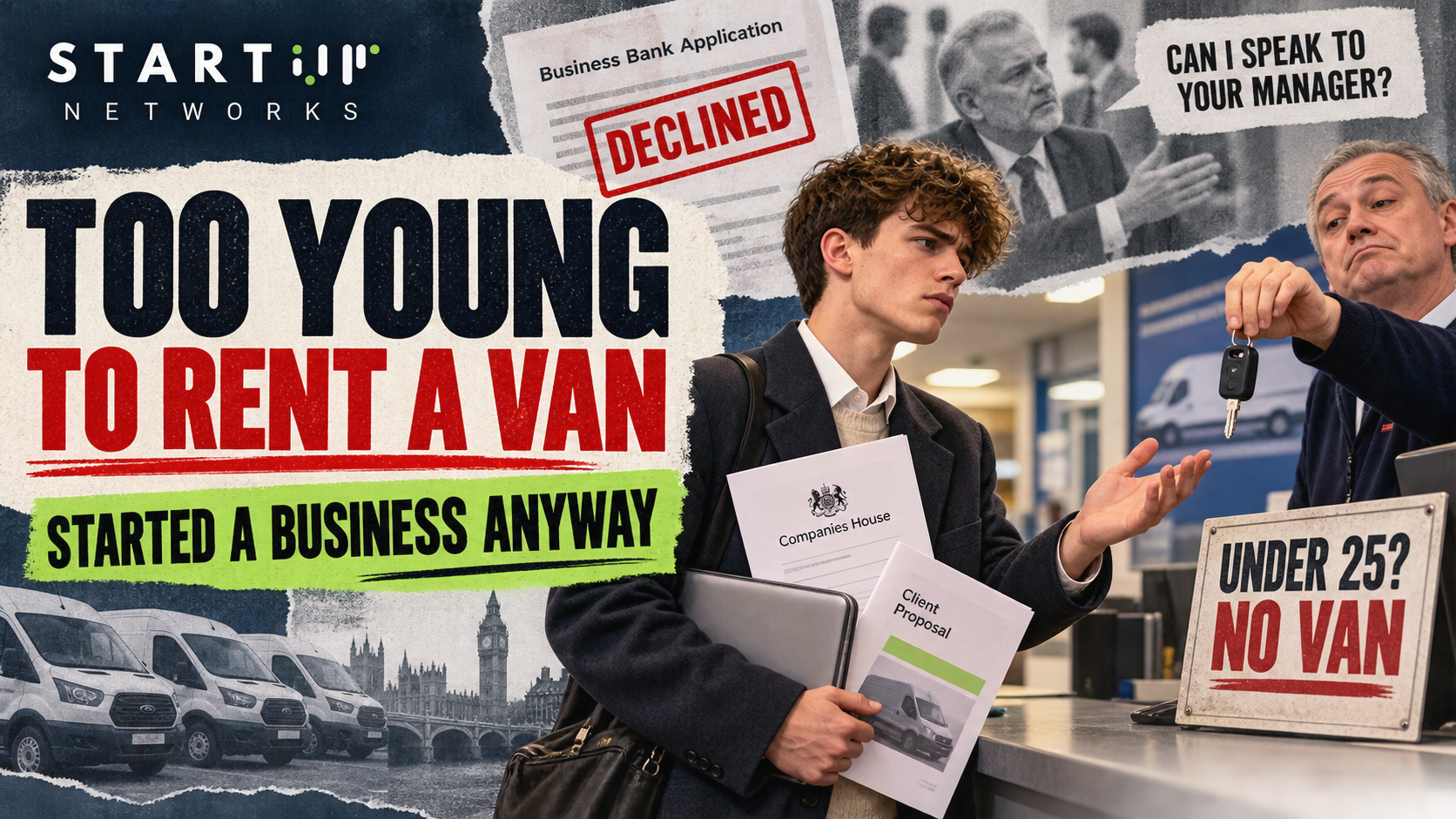
I Started My First Business Before I Could Legally Rent a Van. Here's What Nobody Warns You About.

By James in Young Entrepreneurs
· 236 views
I was too young to rent a van. Too young for a business credit card. Too young for the client across the table to take me seriously. I started a business anyway.
Most "young entrepreneur" content is written by people who want to inspire you.
This isn't that.
This is the article I needed when I was starting out and couldn't find, because everyone was too busy posting motivational quotes on Instagram to tell me the bank would reject my application three times, clients would ask to speak to my manager (I was the manager), and my mum would ask me every Sunday for roughly eighteen months whether I'd "thought about getting a proper job."

The Van
I needed to move equipment for an early project. Rent a van. Drive to the location. Simple.
Except most van hire companies in the UK won't rent to under-25s. Some won't rent to under-23s. The ones that do charge a young driver surcharge that roughly doubles the price.
I stood in the hire office while a man behind the counter explained, very slowly, like I might not understand English, that I was too young to be trusted with a Transit van. I had a registered business. I had a client waiting. I had insurance.
I did not have a birth certificate that said a number he found acceptable.
That hire office was my introduction to something nobody warns young founders about. The entire business infrastructure of this country was built for people who are older than you. Banks, insurers, landlords, hire companies, suppliers, clients. All of them have systems, policies, or prejudices that assume the person running a business is at least 30, probably 40, and definitely not someone who was doing their GCSEs five years ago.
You don't read about this in startup guides because the people writing startup guides are 42 and have never had this problem.

The Bank Said No. Three Times.
Opening a business bank account should be straightforward. Register your company. Walk into a bank. Open an account.
First application: rejected. "We are unable to offer you an account at this time." No reason. No appeal process. Just no.
Second application, different bank: rejected. Business "too new." I'd been trading for three months. They wanted twelve. How you trade for twelve months without a business bank account was a question nobody at the bank could answer. I asked. The woman behind the counter looked at me like I'd asked her to explain gravity. She didn't have an answer. Neither did the system she was following.
Third bank said yes. A digital bank. Not a high street one.
I nearly cried in my kitchen. It actually happened to be Starling!
That sentence tells you everything about what the process does to your confidence as a young founder. You start the day thinking "I'm building a business" and end it thinking "I can't even open a bank account." Maybe mum's right about the proper job. Maybe I'm not ready. Maybe the system knows something I don't.
It doesn't. The system just wasn't built for you. There's a difference between not being ready and not being expected. Young founders experience the second one constantly and mistake it for the first.
If you're under 25 and reading this: go digital first. Starling, Tide, or Monzo Business. Days rather than weeks. Fewer arbitrary rejections.
Don't let a bank clerk with a checklist convince you that you're not ready to run a business.

"Oh. I Thought You'd Be... Older."
The first time it happened in person was the worst.
I walked into a meeting with a potential client. I was early twenties. He was mid-fifties. He looked at me, looked behind me as if expecting someone else to follow, and said those words. Not rude, exactly. Just surprised that the person who'd been sending professional emails and delivering competent proposals was someone who looked like his son's university friend.
I didn't get the contract.
There were others. "Can I speak to your manager?" on the phone. "Could you put me through to someone more senior?" in emails. I was the most senior person. I was the only person. The entire company was me, a desk from Facebook Marketplace, and a shirt I'd ironed specifically for this video call.
I'd love to tell you I handled it with grace.
I didn't. Each one chipped away. Each one fed the imposter syndrome that was already running riot. Each one made me consider putting "15 years of experience" on my website just to stop people being surprised when I turned up looking like I'd just finished sixth form.
I didn't fake anything. But I understand why some young founders do. When the world tells you repeatedly that you're not what it expected, the temptation to become what it expected is enormous. Resist it. Not because honesty is a virtue (though it is). Because the clients who need you to be older to trust you are the clients who'll find another reason not to trust you later. Age was never the real objection. It was the convenient one.

Sunday Lunch
For roughly eighteen months, every Sunday at my parents' house:
Mum: "So how's the business going?"
Me: "Good, yeah. Got a new client this week."
Mum: "That's nice, love. Have you thought about what you'd do if it doesn't work out?"
Me: Dies just a little bit more each time.
Every week. Eighteen months.
My mum wasn't being unsupportive. She was being a mum. She'd watched me turn down a graduate scheme to pursue something she didn't fully understand. All she saw was her kid working constantly, earning inconsistently, and looking tired. A "proper job" with a salary and a pension and a boss who'd tell me when to go home was the safer option.
She wasn't wrong about the safety. She was wrong about what safety costs.
What I couldn't explain, because I didn't have the vocabulary for it then, was that the uncertainty of building something was less painful than the certainty of building someone else's thing. Employment felt safe. It also felt like slow suffocation.
I'd rather be scared and building than comfortable and stagnating.
I still would. That feeling hasn't changed. I just have better words for it now.
Mum eventually stopped asking about the proper job. She tells her friends about Startup Networks now with the kind of pride that makes me think she's forgiven me for the eighteen months of worry.
Probably. I should ask her.
If your parents are doing the same thing to you right now, try to hear the love underneath the doubt. They're not trying to crush your dream. They're trying to protect their kid. Those are different things, even when they feel identical over roast potatoes.

The Part About Money That I Don't Want to Write
I'm going to write it anyway because someone needs to.
I didn't have savings. Not real savings. Not "I can survive six months without revenue" savings. I had "I can cover rent for two months and then I'm in trouble" savings. Every client payment was the difference between paying bills and not paying bills. Not in the abstract. In the "will my card decline at Tesco" sense.
There was a month where a client paid an invoice three weeks late. Three weeks. For them, an admin delay. For me, three weeks of checking my bank balance every morning with a feeling in my chest I can only describe as controlled panic. I couldn't chase too aggressively because I needed the client. I couldn't ignore it because I needed the money.
So I refreshed my banking app. At 8am. At 8:07am. At 8:15am. As if the number was going to change because I wanted it to.
The invoice got paid. I paid my rent. Life continued.
That three weeks aged me about two years.
Older founders with mortgages will tell me they have financial pressure too. They do. But there's a specific vulnerability to being young and broke and self-employed that comes from having no cushion. No credit history to fall back on. No parents who can casually lend you five grand. No prior career earnings to draw from. Not "I left a £60K job and have savings" zero. "I have £847 in my account and rent is £750" zero.
Here's what I wish someone had told me: keep a side income running alongside the business for as long as possible. I know the startup mythology says burn the boats. Don't burn the boats. The boats are paying your rent. Burn them when the business can pay your rent instead.
Not before.

The Friendship Problem Nobody Warns You About
This is the part that hurts the most, even now.
Your friends go out on Friday nights. You're rewriting proposals. They book holidays. You're budgeting for software subscriptions. They get promoted at work and post about it on Instagram. You're trying to work out whether you can afford to hire someone or whether you need to keep doing everything yourself for another six months.
The paths diverge quickly. And quietly.
Nobody falls out. Nobody has an argument. People just... drift. You cancel plans because you're exhausted. They stop inviting you because you always cancel. You miss birthdays. They stop understanding what you do all day. The gap between "I work at a company" and "I AM the company" is invisible to people who haven't crossed it and enormous to people who have.
I lost friendships. Not dramatically. Slowly. Like paint fading. You don't notice it happening until one day you look up and realise the person you used to talk to every day hasn't messaged you in three months and you haven't messaged them either.
Some of those friendships came back. Some didn't.
The ones that replaced them, the ones I found through our community and at events and in late-night group chats with other founders who understood what 2am anxiety feels like, those friendships are different. Smaller in number. Deeper in honesty. Built on a shared experience that's hard to explain to anyone who hasn't lived it.
Find those people. They'll save you.

The Rapid-Fire Warnings
I'm going to list these quickly because each one is real and each one caught me off guard.
HMRC doesn't care that you're 22. Your tax obligations are identical to a 50-year-old running a £10M company. Get an accountant. A real one.
Insurance companies quote you more. Same logic as car insurance. Young driver, young founder. Shop around hard.
Networking events feel like school discos. Everyone else seems to know each other. You stand by the drinks table wondering if you should interrupt the group who are obviously mid-conversation. You do. They're polite but visibly uninterested in talking to someone who looks like the event photographer. You leave early and question the point. The point reveals itself six months later when one of those polite-but-uninterested people emails you needing exactly what you sell.
You'll price yourself too low. Young founders underprice more aggressively than anyone because imposter syndrome and desperation for validation combine into a cocktail that makes you quote £500 for £5,000 of work. I wrote an entire article about this. Read it.
You'll work too much. Because you're young and you can and nobody's telling you to stop. The burnout will find you eventually. I ended up in hospital. Read that article before you need it. Not after.
People will take credit for your work. Clients will present your strategy to their boards as if they wrote it. Agency partners will show your SEO results to their clients without mentioning you exist. It stings the first time. By the tenth, you've learned to build your portfolio quietly and let the credit flow wherever it wants.
The work speaks eventually. Just not always to the people you wish it would.

But Here's the Thing
I've spent this whole article on the hard parts. There's another side.
Your costs are lower than they'll ever be again. Houseshare. Bedroom desk. No mortgage, no car payment, no school fees. That's a structural advantage for bootstrapping that 40-year-old founders would genuinely kill for.
If it fails at 23, you start again at 24. No house to lose. No redundancy to negotiate. The consequences of failure are lower than they'll ever be. That's not a reason to be reckless. It's a reason to be brave.
The first year of running a business teaches you more about tax, law, sales, marketing, management, pricing, negotiation, and human psychology than three years of university. Not because university is useless. Because running a business is a full-contact education.
Your generation understands the internet in a way that older founders have to learn. You understand TikTok, Instagram, YouTube, and LinkedIn as distribution channels because you've been using them since you were 14. Older founders hire social media managers. You ARE the social media manager. That saves money and it's more authentic, which increasingly matters more than polish.
And people remember you. In a room full of grey-haired founders, the 22-year-old stands out. The client who said "oh, I thought you'd be older" called back six months later. The "older" person he'd hired instead didn't deliver.
I was memorable because I was young.
I was hired because I was good.
Those are two different things and the gap between them is where your entire career lives.

What I'd Tell the Kid Who Stood in That Van Hire Office
Get an accountant immediately.
Charge properly from your first invoice. The portfolio excuse is a trap you'll spend a year escaping.
The bank rejection isn't about you. It's about a checkbox on a screen.
Mum will come around. Give her time. She's scared for you, not against you.
The friends who drift away will be replaced by friends who understand. The second group is smaller. They're also the ones who answer the phone at midnight when you're panicking about a client.
Sleep matters more than hustle. You'll learn this the hard way or the hospital way. Choose the other option. Please.
Your age is not a disadvantage. It's a data point. The work is what matters. Do good work. Be reliable. Deliver what you promise.
The people worth working with won't care whether you're 22 or 52.
And the ones who do care?
They're not your clients. They're your filter.

Questions for people who didn't read this all
Can you start a business under 18 in the UK?
You can trade as a sole trader at any age, but you can't be a company director until 16. You can't sign most contracts until 18. Your parent or guardian would need to sign leases, bank accounts, and supplier agreements on your behalf. Most young founders start as sole traders and convert to limited at 18.
What's the biggest challenge for young entrepreneurs UK?
Being taken seriously. The practical barriers (bank accounts, credit, insurance premiums) are solvable. The credibility gap with clients, investors, and family is harder. It closes with time, results, and track record. Community helps enormously because other founders judge you on what you've built, not how old you are.
How do young people fund a business with no savings?
Government startup loans up to £25,000. The Prince's Trust Enterprise Programme for 18-30s. University enterprise grants. Start with a zero-cost side hustle alongside employment. Build revenue before quitting your income source. The boats are there to keep you afloat, not to burn.
Should I go to university or start a business?
Both, if possible. Start the business alongside your degree. University provides a safety net, a network, free workspace, enterprise programmes, and credibility that helps with the "being taken seriously" problem. The founders who did both are generally better off than the ones who dropped out, despite what the dropout mythology suggests.
How do young founders deal with imposter syndrome?
Talk to other young founders. Keep an evidence file of every win, every testimonial, every metric that proves the business is real. Separate feelings from facts. Read our full imposter syndrome guide. The fact that you started a business at an age when most people are still figuring out what they want to do is itself evidence that you're not a fraud.
What age do most successful entrepreneurs start?
The average age of a successful startup founder is 45, according to MIT research. The "young genius dropout" narrative is a myth. Most successful businesses are started by people with industry experience, professional networks, and financial stability. Starting young gives you a head start on accumulating those things. It doesn't mean you need to have them already.
Written by James Beresford-Morgan. 28. Started too young. Learned too slowly. Nearly lost everything once. Would do it all again without hesitation.
If you're a young founder wondering whether it's worth the struggle, the loneliness, the Sunday lunch interrogations, and the bank clerks who think you're not ready: it is. Come find us in the community. We don't care how old you are. We care what you're building.
-
 2
-
 1


Recommended Comments