


General Grants
Browse our earlier grant listings for startups, charities and community groups.
920 links
-
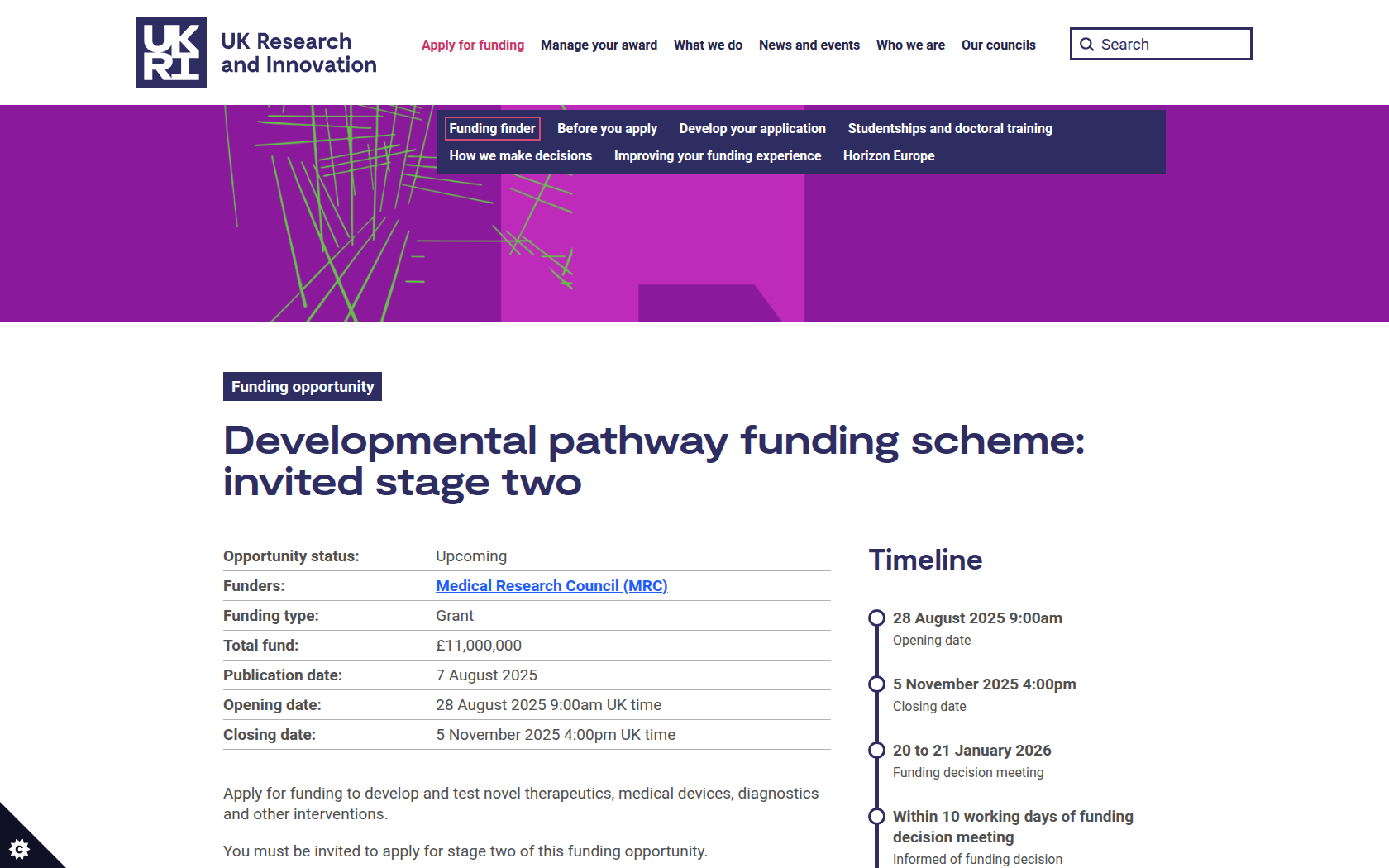
Funding opportunity: Developmental pathway funding scheme: invited stage two
Apply for funding to develop and test novel therapeutics, medical devices, diagnostics and other interventions.
You must be invited to apply for stage two of this funding opportunity.
Your project can start and finish at any stage on the developmental pathway from early development, through pre-clinical refinement and testing to early-phase clinical studies and trials (up to phase 2a).
There is no limit on the amount of funding you can apply for, but it should be appropriate to the project. We usually fund 80% of a project’s full economic cost.
This is an ongoing funding opportunity. Application rounds close every March, July and November.
-
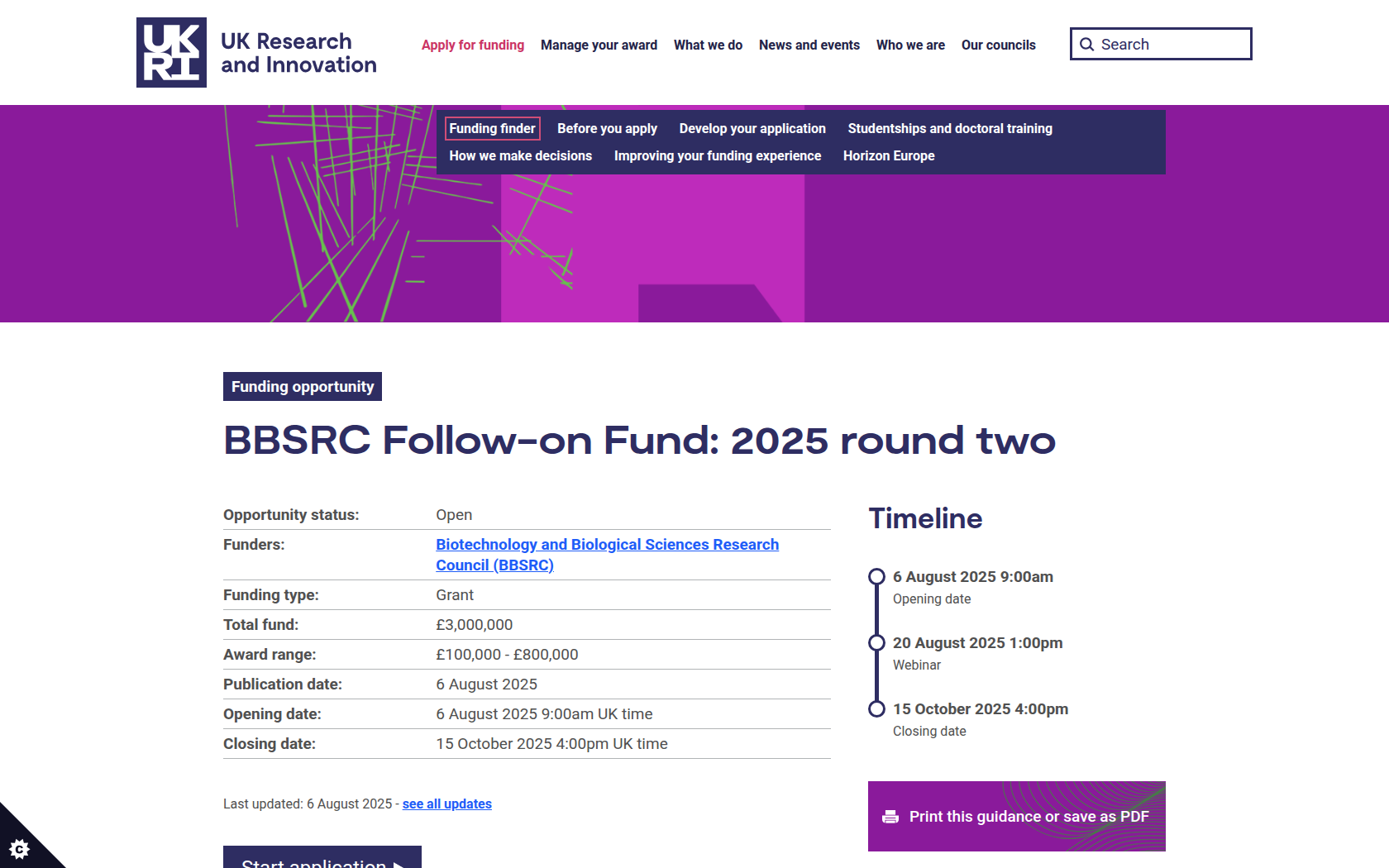
Funding opportunity: BBSRC Follow-on Fund: 2025 round two
Apply for Follow-on Funding (FoF) to bridge the gap between bioscience research and achieving economic and societal benefit.
You must be based at a UK research organisation eligible for Biotechnology and Biological Sciences Research Council (BBSRC) funding.
Follow-on Funding (FoF) applications must draw substantially on current or prior BBSRC funding.
FoF awards progress discoveries to a stage where the route to practical application is clear.
The full economic cost (FEC) of your project can be up to £800,000. BBSRC will fund 80% of the FEC.
FoF awards support defined programmes of work for up to two years.
-
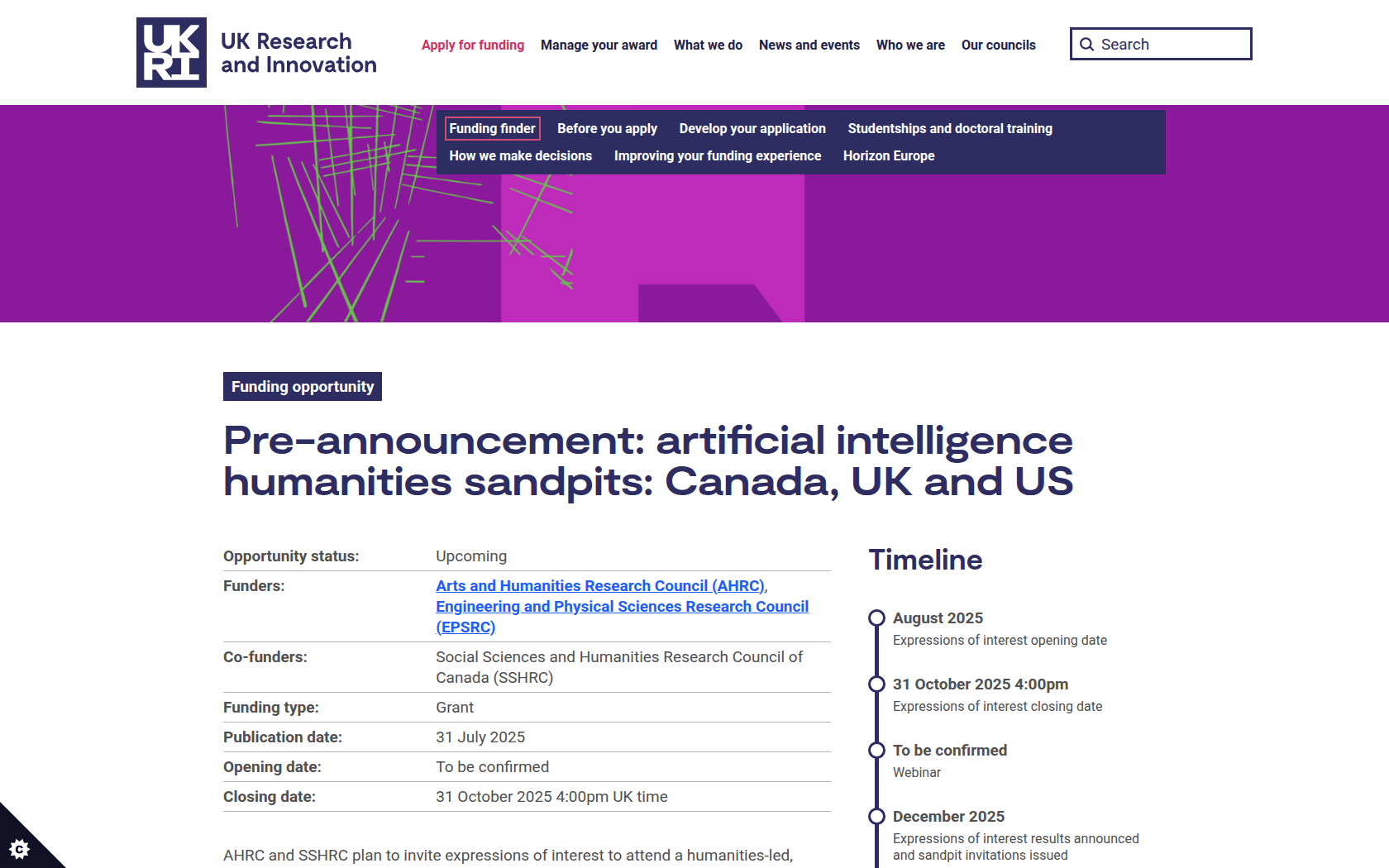
Funding opportunity: Pre-announcement: artificial intelligence humanities sandpits: Canada, UK and US
AHRC and SSHRC plan to invite expressions of interest to attend a humanities-led, interdisciplinary research sandpit putting humanities insights and methodologies at the heart of artificial intelligence (AI) tech design.
A sandpit is a facilitated workshop process through which new project teams and research propositions will be co-developed and funded.
We are looking for 60 participants from UK, Canadian and US research organisations to take part in in-person and virtual workshops.
During the sandpit process, teams would form and develop and refine project ideas for applications.
We plan to fund up to four grants.
Travel and subsistence costs for the in-person workshop will be covered by AHRC and SSHRC.
This is a pre-announcement, and the information may change. The funding opportunity will open in August 2025. More information will be available on this page by then.
-

Funding opportunity: Growth catalyst early stage: new innovators
See the full opportunity details on the Innovation Funding Service.
UK registered micro and small businesses can apply for a share of up to £10 million to develop affordable, adoptable and investable innovations in the five critical technologies.
Eligibility summary
This competition is open to single applicants only.
To lead a project your organisation must:
be a UK registered micro or small business not have previously been awarded funding from Innovate UK carry out its project work in the UK intend to exploit the project outcomes from the UK for domestic or global benefit -

Funding opportunity: ADOPT facilitator support grant: round three
See the full opportunity details on the Innovation Funding Service.
Farming, growing or forestry businesses based in England can apply for a grant of £2,500 to engage an external project facilitator to support the development of a full ADOPT grant application.
Eligibility summary
This competition is open to single applicants only.
To lead a project your organisation must:
be an active farming, growing or forestry business based in England be able to evidence that you are an established business, including sole traders and partnerships have a UK bank account -

Funding opportunity: UKRI-SBE lead agency opportunity
This opportunity allows UK and US-based researchers to submit a collaborative proposal that will go through a single review process.
The goal is to reduce some of the barriers that researchers and funding agencies encounter when trying to work internationally.
This opportunity does not represent a separate research funding scheme – applications will be integrated into existing programmes at the relevant lead agency.
The participating agencies include UKRI councils AHRC, BBSRC and ESRC, and the NSF/SBE.
-

Funding opportunity: Institutional strategic developmental projects in higher education
Apply for funding to develop institutional-level innovations in research and knowledge exchange.
You must be a higher education (HE) provider that is:
based in England registered with the Office for Students in the ‘approved (fee cap)’ category carrying out research. Your project should involve:
addressing government and UKRI priorities working with partners. You can apply for any amount of funding. However, proposals must include contributions from partners. We will not fund research projects.
This funding comes from the Research England Development (RED) Fund.
-

Funding opportunity: Daphne Jackson fellowship
These fellowships are for those looking to return to a research career after a break of two or more years for family, health or caring reasons. The aim is to give participants the confidence and skills they need to make a successful return to research.
They provide an opportunity to balance a personalised retraining programme with a challenging research project, in a supportive UK university or research establishment.
They are flexible, with at least 100 hours retraining per year, and part-time – usually completed over two years at 0.5 full-time equivalent although some UKRI funders may award longer than this.
-

Funding opportunity: Return to research support bursary
If you are a researcher looking to return to an academic research career after a break of two or more years, this bursary can help you to develop a proposal suitable for submission to the STFC fellowship scheme.
You can apply for funding of up to £2,500 to cover the cost of activities that will help you prepare a proposal for STFC fellowship funding, such as:
literature reviews familiarisation with equipment and techniques attendance at meetings and seminars. You may also use it to help cover the costs of preparing an application for funding, provided that you are a named researcher on the proposal.
-

Funding opportunity: Knowledge Transfer Partnership
Key features of a Knowledge Transfer Partnership (KTP) are that:
they are open to businesses or not-for-profit organisations, research organisations and graduates to work on an innovation project partnerships can last between 12 and 36 months funding is provided to support the total cost of the project – businesses provide around one-third to half of the project costs depending on their size. -

Funding opportunity: Researching ME/CFS: priority area
Apply for funding to research myalgic encephalomyelitis/chronic fatigue syndrome, also known as ME/CFS.
You can get the funding through any of MRC’s funding schemes.
We particularly welcome applications within MRC remit that address one or more of the research areas identified by the ME/CFS Priority Setting Partnership for ME/CFS research:
aetiology of post-exertional malaise pathways to repurposing of approved drugs for other conditions accurate and reliable diagnostic tools investigating the role of the immune system in ME/CFS stratification of ME/CFS evaluation of post-infection disease in ME/CFS neurological symptomology genetic links to ME/CFS susceptibility or disease drivers of severity in ME/CFS investigation of potential mitochondrial dysfunction in ME/CFS investigation of oxygenation dysfunction in ME/CFS We will usually fund up to 80% of your project’s full economic cost.
-
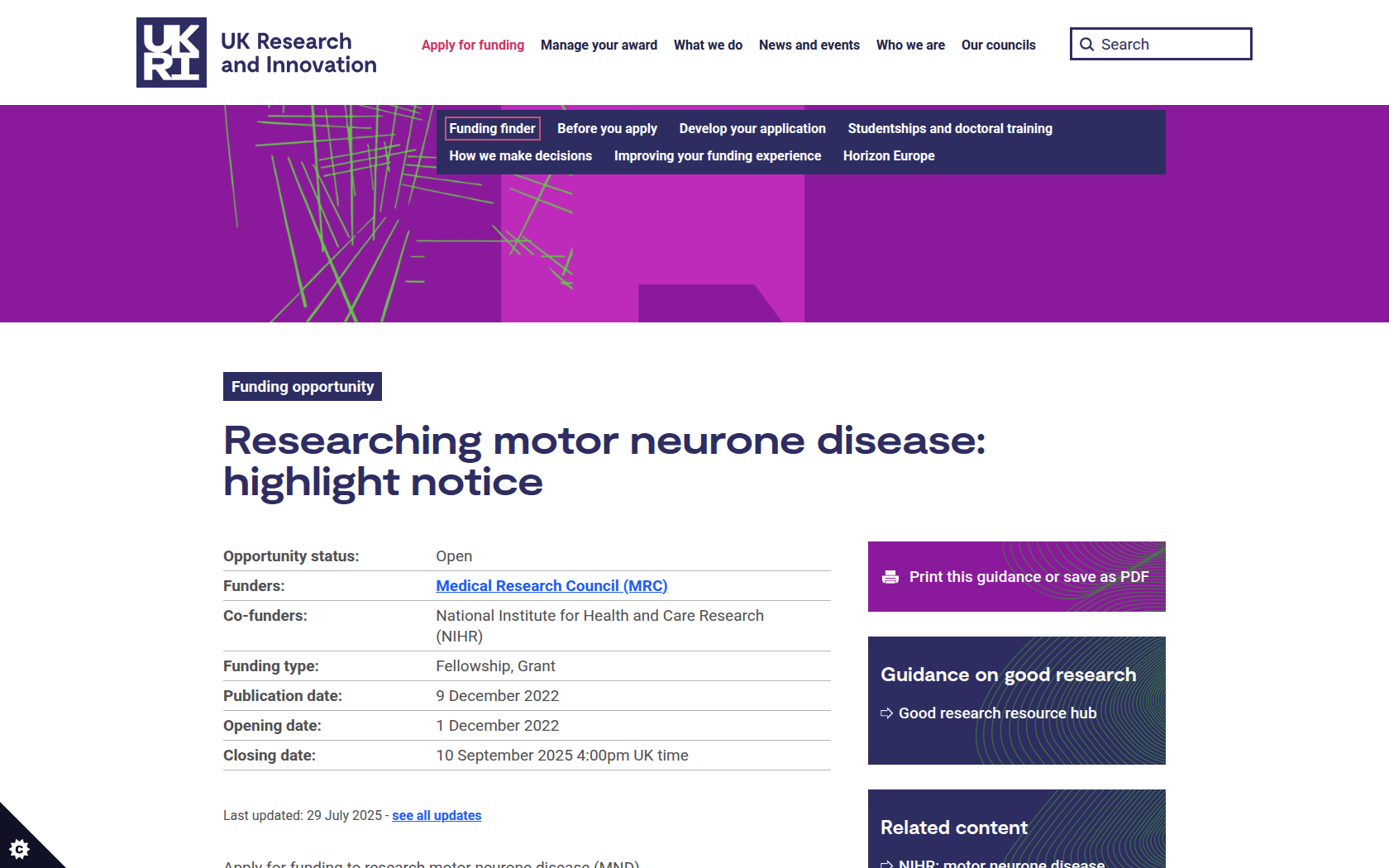
Funding opportunity: Researching motor neurone disease: highlight notice
Apply for funding to research motor neurone disease (MND).
You can get funding through any:
grants from MRC research boards or panels MRC fellowships You should apply through the existing funding opportunity that is most relevant to your science area and career stage.
We will usually fund up to 80% of your project’s full economic cost.
-

Funding opportunity: Work with Brazilian researchers: NERC FAPESP lead agency
This opportunity allows UK-based researchers and researchers in the State of São Paulo, Brazil to submit a collaborative application under existing NERC funding opportunities. This will go through a single review process.
The goal is to reduce some of the barriers that researchers and funding agencies encounter when trying to work internationally.
This opportunity does not represent a separate research funding scheme. Applications must be submitted under existing programmes, specifically NERC pushing the frontiers and large grants funding opportunities.
-

Funding opportunity: PATT travel claim for competitively awarded observation time
Claim back travel and subsistence costs when visiting an astronomy telescope. The visit must be for competitively awarded science observation time.
You must be a UK-based researcher at an eligible UK institution. You can only claim your own costs.
You must not already hold or have access to a travel grant from the Panel for the Allocation of Telescope Time (PATT).
To make a claim, your trip must be approved in advance. You cannot claim for historic trips that weren’t approved in advance.
We will cover 100% of the full economic cost.
-
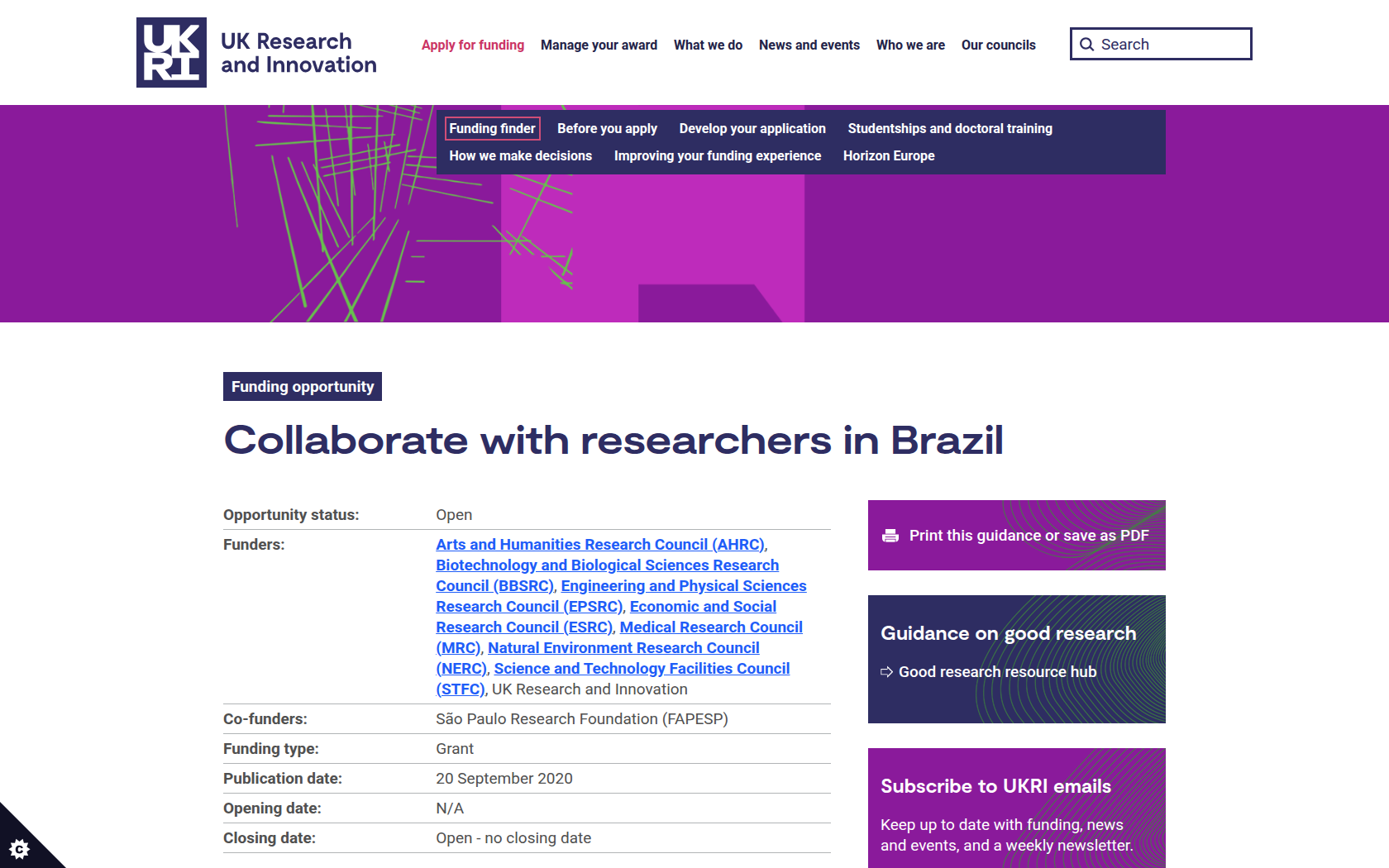
Funding opportunity: Collaborate with researchers in Brazil
UK Research and Innovation (UKRI) and FAPESP have signed a memorandum of understanding (MoU) to support collaborative applications. It provides for a lead agency agreement whereby participant UKRI research councils receive and assess joint applications from eligible UK and Brazil-based researchers from the state of São Paulo on behalf of both organisations.
UKRI and FAPESP will co-fund applications submitted to participant UKRI councils’ responsive mode funding opportunities via selected funding opportunities.
General conditions for applications will differ depending on the funding opportunity to which an application is being submitted.
-
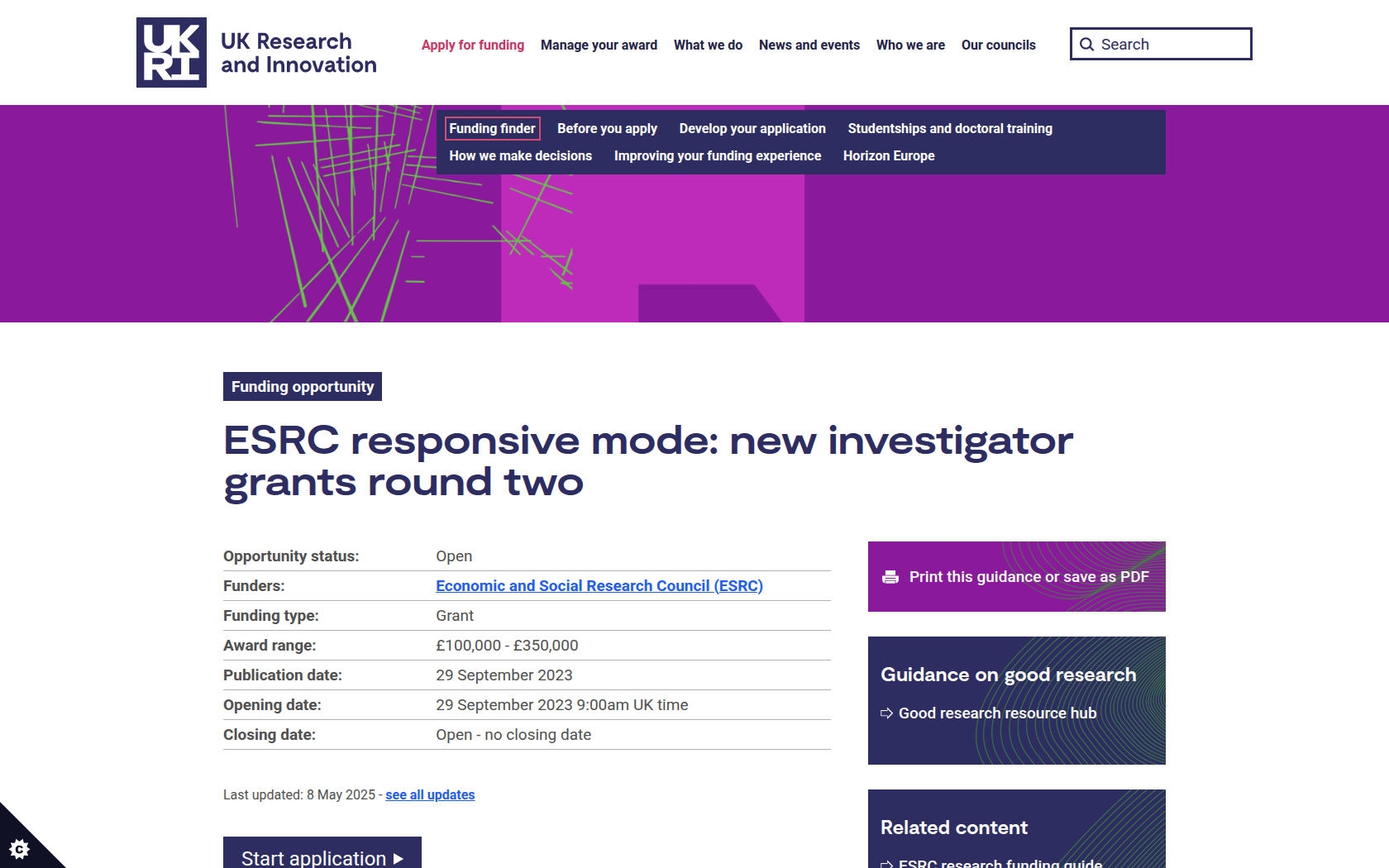
Funding opportunity: ESRC responsive mode: new investigator grants round two
This opportunity supports researchers at the start of their careers to enable their transition to become independent researchers through gaining experience of managing and leading research projects and teams.
It also provides an opportunity for them to support their own skill development, and that of any research staff employed on the grant.
You must be based at a UK research organisation eligible for ESRC funding.
Proposals can draw from the wider sciences, but the social sciences must represent more than 50% of the research focus and effort.
The full economic cost (FEC) of your project can range from £100,000 to £350,000. ESRC will fund 80% of the FEC.
Update: Applications submitted from 1 April 2024 will be able to apply for up to £350,000 at 100% FEC. ESRC will fund 80% of the FEC. This change to the award range closes the gap between the new investigator grant scheme and the standard grant scheme.
-
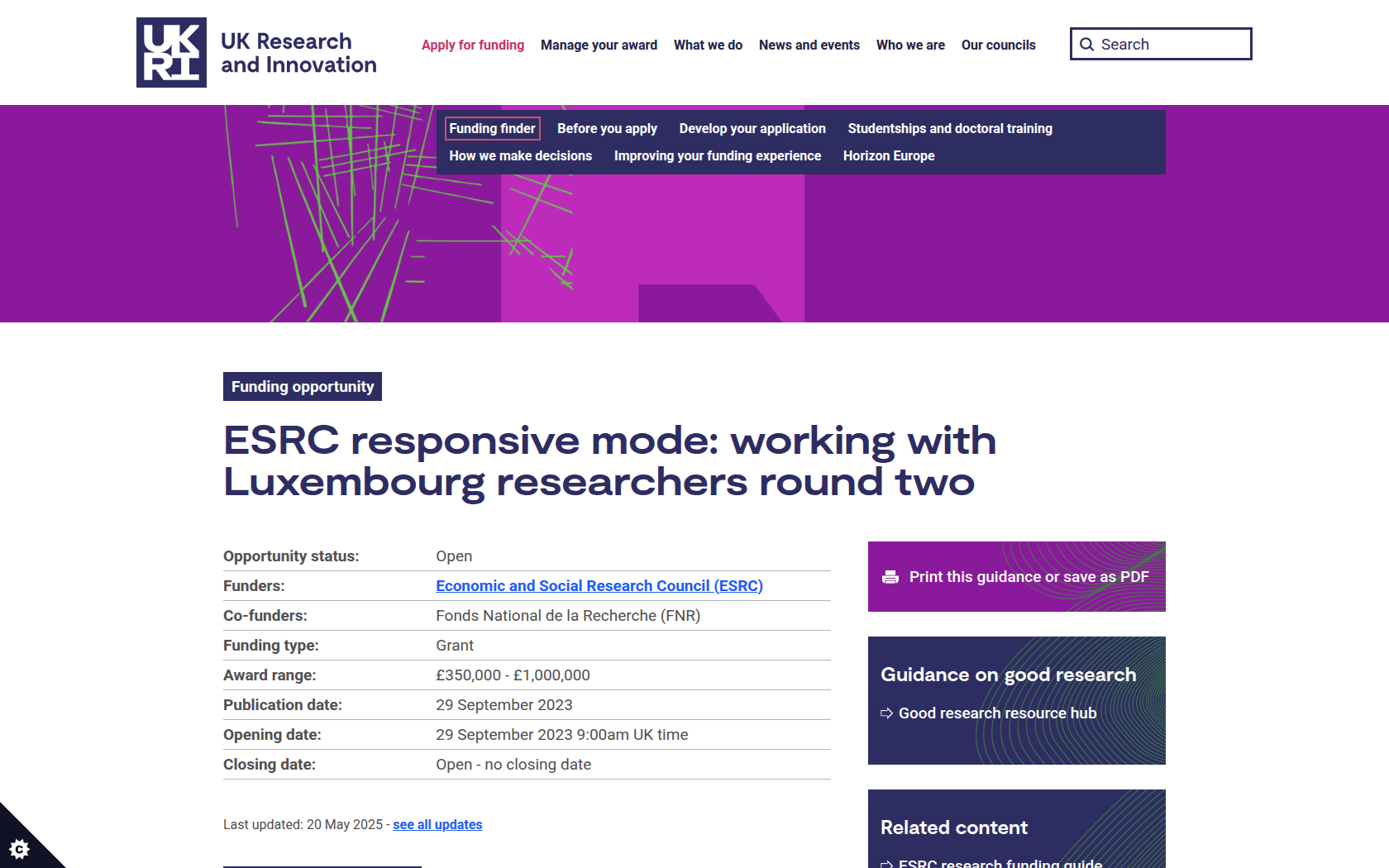
Funding opportunity: ESRC responsive mode: working with Luxembourg researchers round two
This opportunity funds work with researchers in Luxembourg. Collaborative work is governed by an agreement between UK Research and Innovation (UKRI) and FNR. You can submit collaborative research proposals in any area of social sciences within the remit of both ESRC and FNR.
Applications are via the UKRI Funding Service and will run as consecutive rounds with closing dates.
The full economic cost (FEC) of the UK part of your project can range from £350,000 to £1 million. ESRC will fund 80% of the FEC. FNR will pay all justified costs for Luxembourg submitted through their system.
You must be based at a UK research organisation eligible for ESRC funding.
-
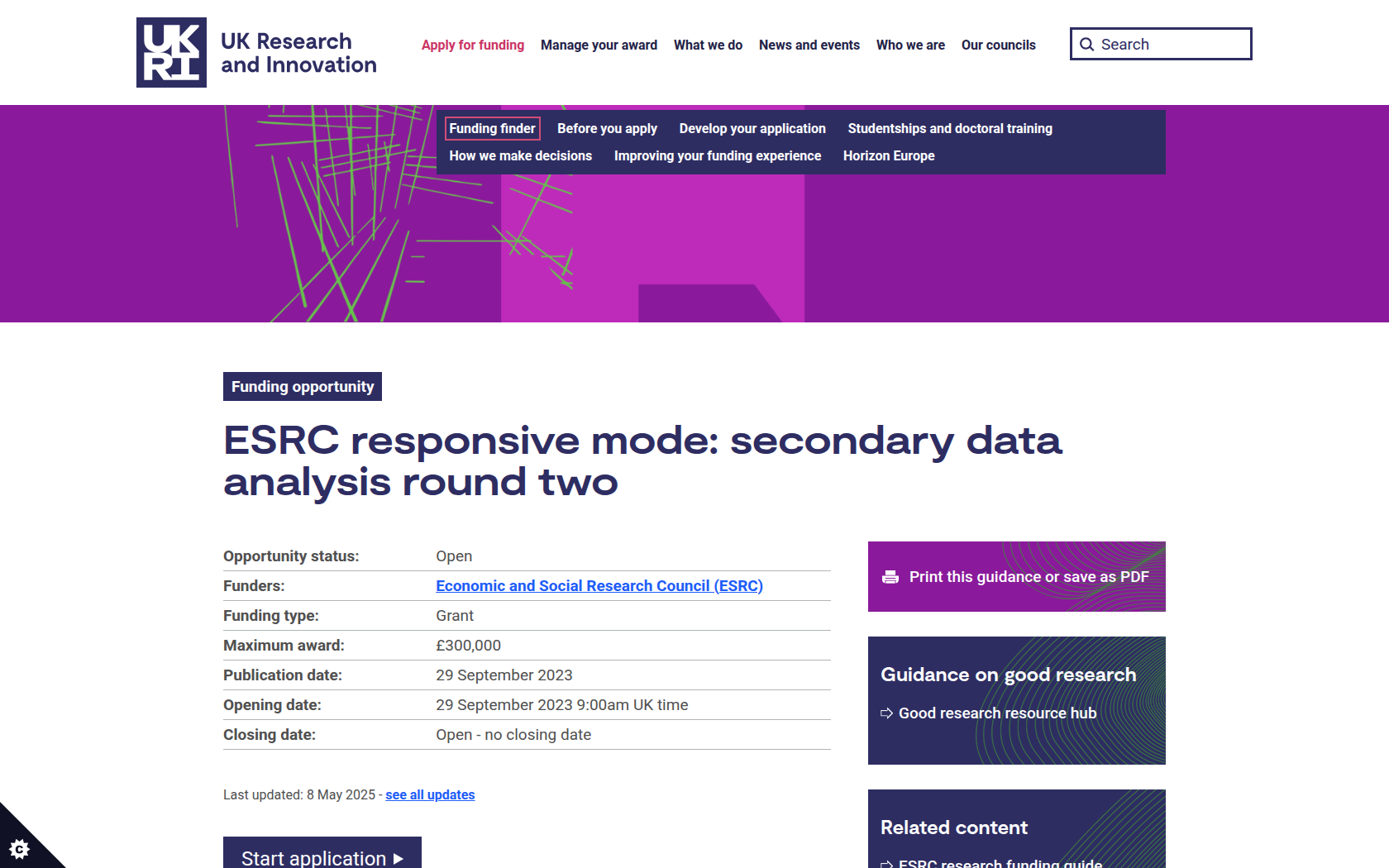
Funding opportunity: ESRC responsive mode: secondary data analysis round two
Apply for funding to support research that exploits existing data resources for social and economic research, created by ESRC or other agencies.
You must be based at a UK research organisation eligible for ESRC funding.
Proposals can draw from the wider sciences, as long as the social sciences are more than 50% of the research focus and effort.
Applications are via the UK Research and Innovation (UKRI) Funding Service and will run as consecutive rounds with closing dates.
The full economic cost (FEC) of your project can be up to £300,000. ESRC will fund 80% of the FEC.
-
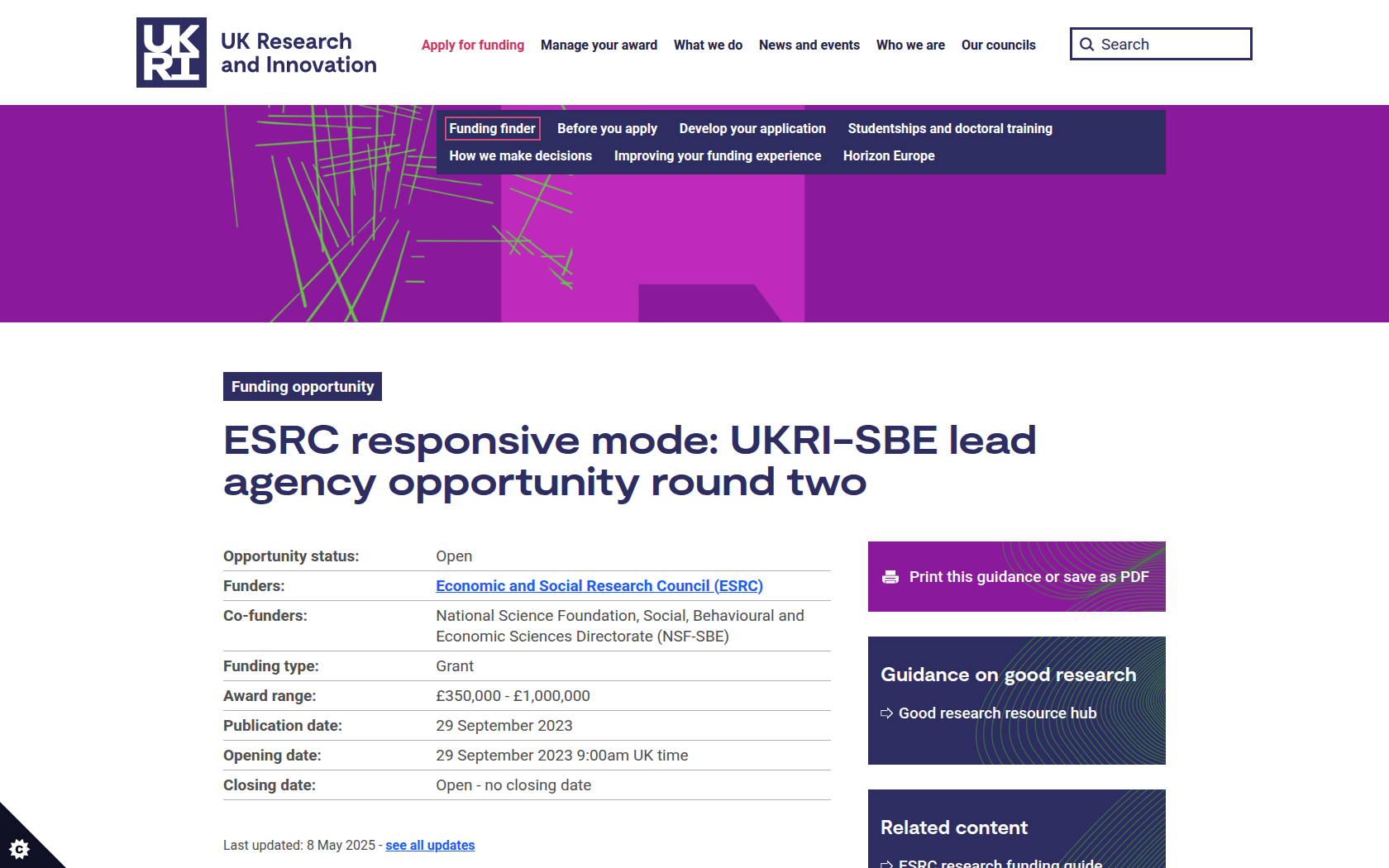
Funding opportunity: ESRC responsive mode: UKRI-SBE lead agency opportunity round two
This funding opportunity allows UK and US-based researchers to submit a collaborative proposal that will go through a single review process.
You can submit proposals in any area within the remits of both ESRC and NSF-SBE.
Applications for ESRC-led proposals are via the UK Research and Innovation (UKRI) Funding Service and will run as consecutive rounds with closing dates.
The full economic cost (FEC) of the UK part of your project can range from £350,000 to £1 million. We will fund 80% of the FEC.
-
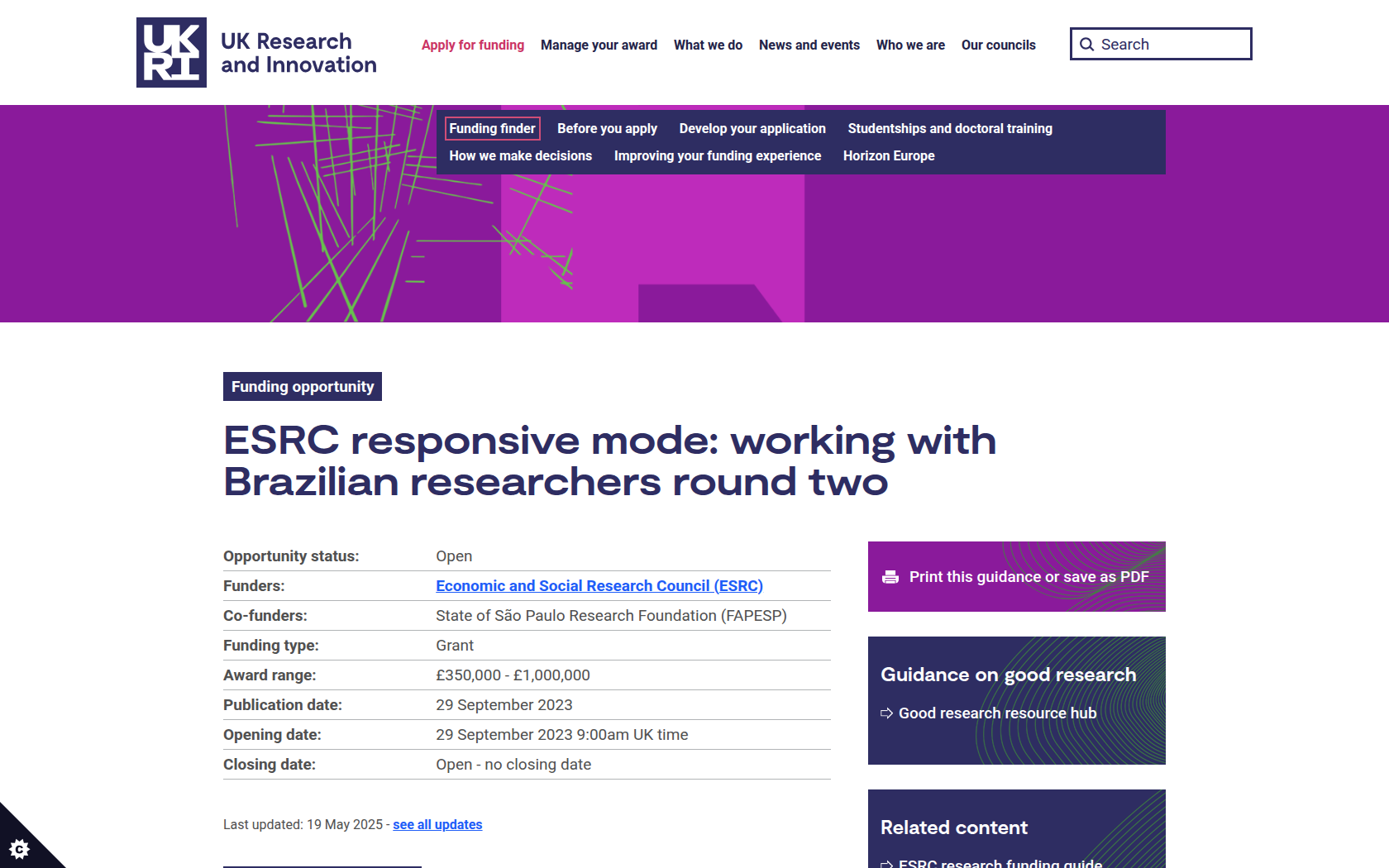
Funding opportunity: ESRC responsive mode: working with Brazilian researchers round two
Apply to work with overseas researchers in the State of São Paulo, Brazil.
You can submit collaborative research proposals in any area of the social sciences within the remit of both ESRC and FAPESP.
Applications are via the UK Research and Innovation (UKRI) Funding Service and will run as consecutive rounds with closing dates.
The full economic cost (FEC) of the UK part of your project can range from £350,000 to £1 million. ESRC will fund 80% of the FEC. FAPESP will pay all Brazilian justified costs submitted through their system.
-

Funding opportunity: Collaborate with researchers in Luxembourg
UK Research and Innovation (UKRI) and FNR have signed a memorandum of understanding (MoU) to welcome and support collaborative applications. UKRI will receive and assess joint applications from eligible UK and Luxembourg applicants on behalf of both organisations.
This is not a separate research funding scheme. UKRI and FNR will co-fund applications to UKRI councils’ responsive mode funding opportunities, in some cases named standard research grant opportunities.
This page will change to reflect the new UKRI Funding Service. See How applicants use the Funding Service.
If you have enquiries about submitting applications via the Funding Service, contact the research council you are applying to. Further information is available in the ‘Contact details’ section.
See contact details for the Funding Service.
-
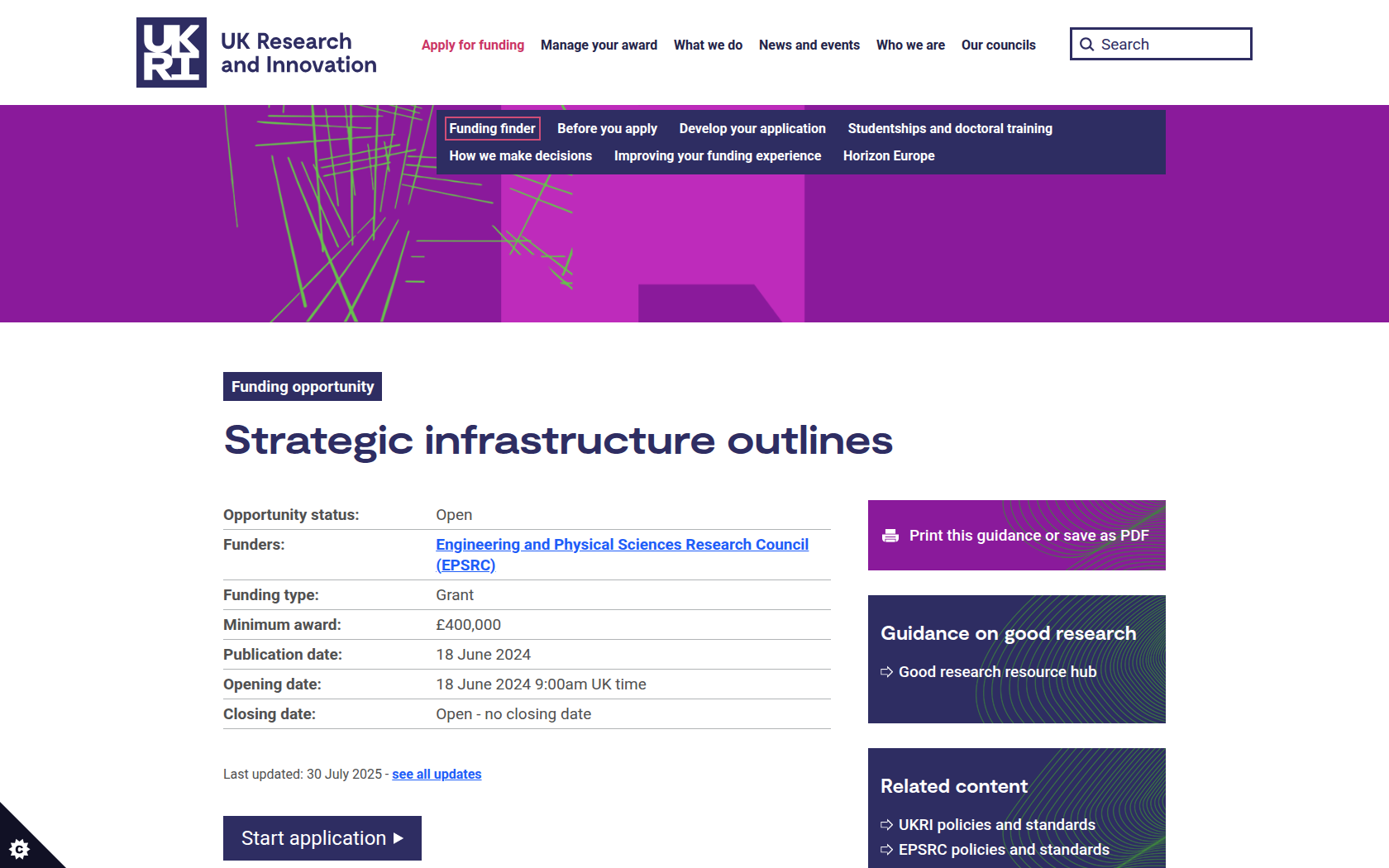
Funding opportunity: Strategic infrastructure outlines
Apply for funding to purchase strategic infrastructure including equipment, resources or both.
The funding seeks to improve UK scientific capability and enable cutting-edge research of high priority to Engineering and Physical Sciences Research Council (EPSRC).
You must be based at a UK research organisation eligible for EPSRC funding.
This funding is for either:
purchase and set-up of infrastructure resources to support existing infrastructure The full economic cost (FEC) of your infrastructure must be at least £400,000.
The resources to support existing equipment applications must have a maximum duration of two years.
-
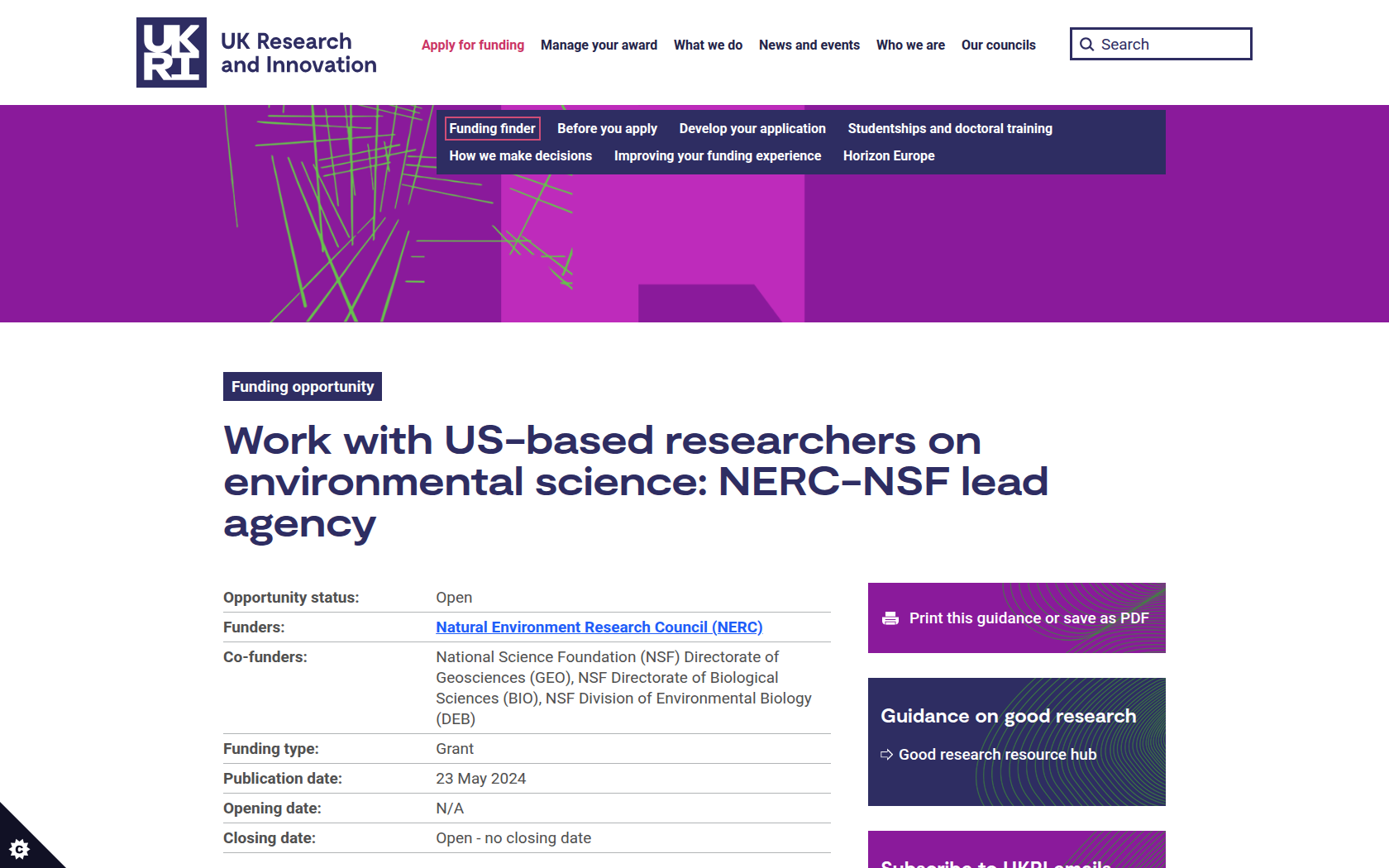
Funding opportunity: Work with US-based researchers on environmental science: NERC-NSF lead agency
This funding opportunity allows UK and US-based researchers to submit a collaborative application to either NSF or NERC under existing funding programmes. Applications will go through a single review process.
Collaborative work is governed by a lead agency agreement between NERC and NSF and must adhere to the remits of both NERC and NSF GEO or BIO-DEB schemes.
The UK-based applicant must be:
based at a UK research organisation eligible for NERC funding employed at lecturer (or equivalent) level or above If successful, UK-based researchers will be supported by NERC. The US-based researchers will be supported by NSF.
NERC will fund UK applicants at 80% of the full economic costs.
-
Funding opportunity: Collaborate with the functional genomics screening laboratory
Apply to collaborate with the functional genomics screening laboratory (FGSL) on projects using complex human in vitro models for CRISPR screening to better understand model biology and enable target identification.
You must be a researcher eligible for MRC funding.
Applications from UK based industry parties may also be considered.
The service from the FGSL is already funded, however cost will be considered when assessing feasibility of the project.
-
Funding opportunity: Open access fund for longform publications: stage two
Research organisations can claim open access (OA) costs for monographs, book chapters, and edited collections that are in-scope of UK Research and Innovation (UKRI)’s OA policy that have been approved at stage one.
Applications must be completed by the team responsible for OA within the organisation. Organisations must be based in the UK to apply.
All publications in your application must be:
in-scope of the policy approved at stage one available OA immediately with a Creative Commons licence