


Tenders & Contracts
Find contracts your business can bid for and see what buyers need.
4,026 links
-
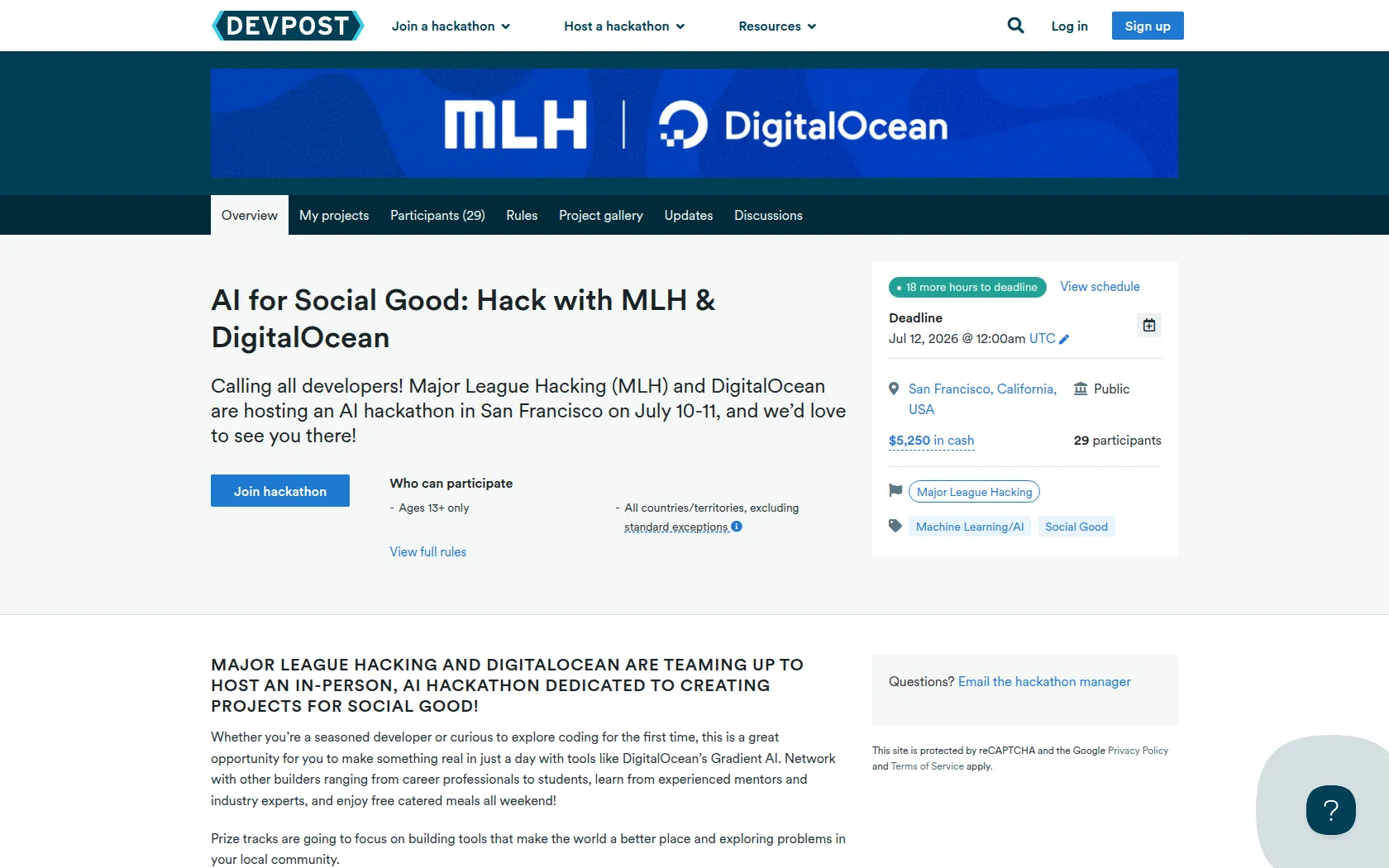
AI for Social Good: Hack with MLH & DigitalOcean
Major League Hacking and DigitalOcean are teaming up to host an in-person, AI Hackathon DEDICATED TO CREATING PROJECTS FOR SOCIAL GOOD!
Whether you’re a seasoned developer or curious to explore coding for the first time, this is a great opportunity for you to make something real in just a day with tools like DigitalOcean’s Gradient AI. Network with other builders ranging from career professionals to students, learn from experienced mentors and industry experts, and enjoy free catered meals all weekend!
Prize tracks are going to focus on building tools that make the world a better place and exploring problems in your local community.
All attendees must be registered on Luma and in person to participate.
Requirements
Must submit on Devpost and be in person for judging.
Hackathon Sponsors
Prizes
$5,250+ in prizes + other prizes Best Use of Gradient AI in a Social Good Hack
$1,750 in cash 3 winners 1st place: MLH Winner Pins + $1000 split amongst the team
2nd place: MLH Winner Pins + $500 split amongst the team
3rd place: MLH Winner Pins + $250 split amongst the team
Best Use of Data
1 winner This category is for the project that best utilizes or helps visualize data that is typically hard to parse or understand.
Prize Candle and Keyboard for each member of the winning team
Best UI/UX
1 winner This category is for the project that has the best user design for user experience and accessibility. Your design should be intuitive to interact with, and follow best practices for readability.
Prize Wacom Drawing tablet form each member of the winning team
Best Beginner Project
1 winner The team must be at least 50% first time hackathon participants.
Prize JBL Headphones for each member of the winning team
Devpost Achievements
Submitting to this hackathon could earn you:
<%= name %>
<% if (has_levels) { %> level <%= next_level %> <% } %> Judges
MLH
Judging Criteria
Originality
Is the concept fresh, bold, or whimsical? Does it explore a unique take on helping support social good in the community? Technology
How technically impressive was the hack? Was the technical problem the team tackled difficult? Did it use a particularly clever technique or did it use many different components? Design
Did the team put thought into the user experience? How well designed is the interface? Design
Did the team put thought into the user experience? How well designed is the interface? Learning
Did the team stretch themselves? Did they try to learn something new? What kind of projects have they worked on before? Adherence to Theme
Does the hack adhere to the event's theme of Social Good? Does it implement a focus fully on Social Good or just partially? Completion
Does the hack work? Did the team achieve everything they wanted? -
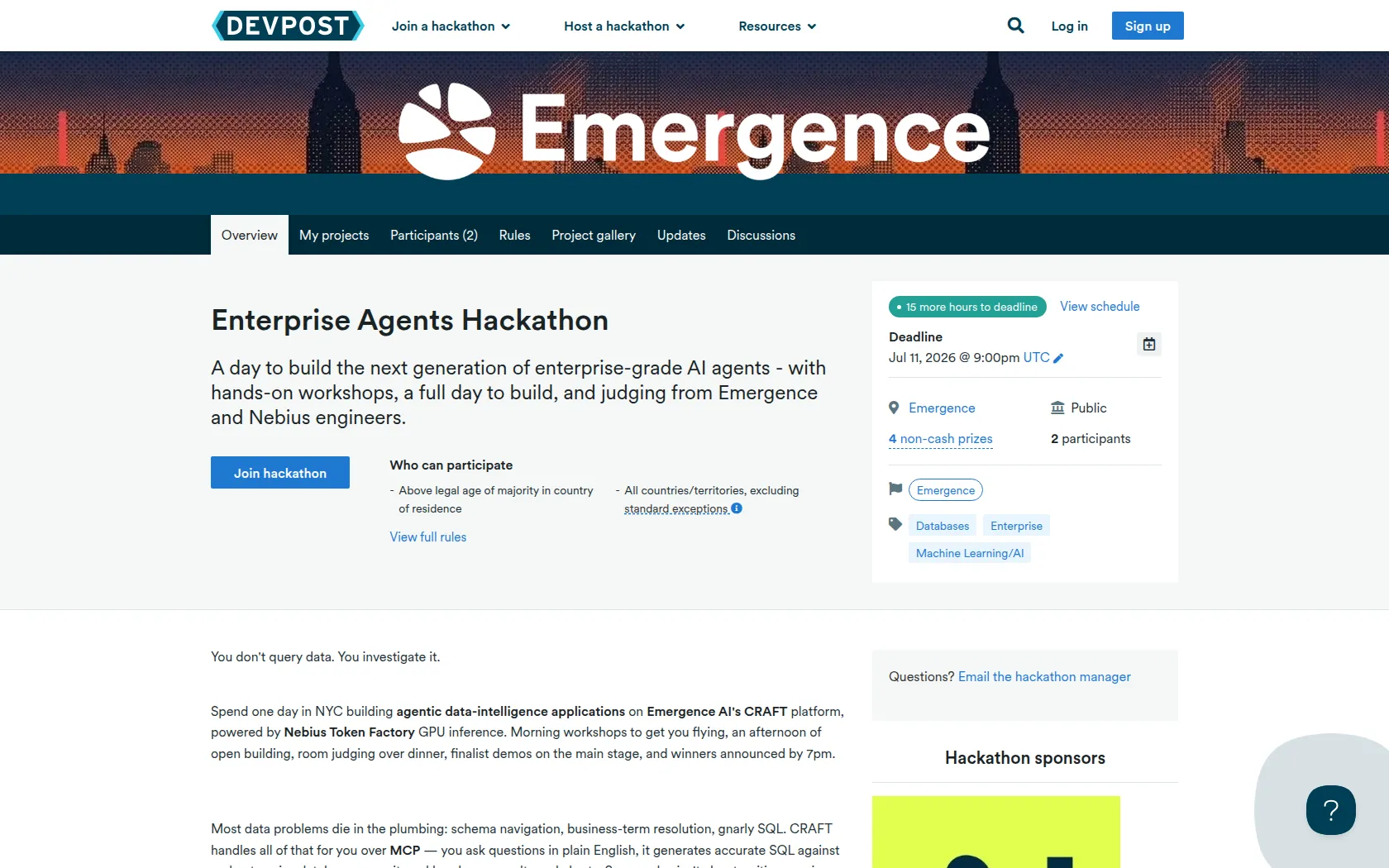
Enterprise Agents Hackathon
You don't query data. You investigate it.
Spend one day in NYC building agentic data-intelligence applications on Emergence AI's CRAFT platform, powered by Nebius Token Factory GPU inference. Morning workshops to get you flying, an afternoon of open building, room judging over dinner, finalist demos on the main stage, and winners announced by 7pm.
Most data problems die in the plumbing: schema navigation, business-term resolution, gnarly SQL. CRAFT handles all of that for you over MCP — you ask questions in plain English, it generates accurate SQL against real enterprise databases, runs it, and hands you results and charts. So your day isn't about writing queries. It's about the interesting part: forming a hypothesis, interrogating the data, and delivering an insight someone would actually act on.
Bring any agent framework you like. We'll help you connect it to CRAFT's MCP endpoint and point it at Nebius for inference.
What makes this special
CRAFT handles the what, you build the why. Accurate data retrieval from complex enterprise systems is solved for you — so you focus on investigating real business problems. Real enterprise data. You'll work against databases from the Spider 2.0 benchmark — the same real-world, enterprise-scale schemas that make most text-to-SQL systems fall over. The before/after moment: paste a nested GA4 schema into a generic assistant and ask for "top pages by engagement time" → broken SQL. Ask CRAFT → correct LATERAL FLATTEN. That's the value prop, live. Serious inference. Nebius Token Factory serves Nemotron-3 Super 120B (12B active, 1M context, native function calling) — a top open model for agentic tool use. Bring-your-own-agent, MCP-native. Use your favorite framework; connect in minutes. Judged by the people building the frontier — Emergence AI's founders and engineers, plus guests from the data/AI world. Requirements
The challenges One mission — use CRAFT to investigate a hypothesis in real enterprise data and produce an actionable finding — across five domains. Pick one (or bring your own hypothesis against any provided database):
Challenge What you'll investigate Level E-commerce Diagnose a revenue or conversion anomaly across orders, customers, and catalog Beginner → Intermediate Crypto / blockchain A compliance team suspects a wallet cluster is structuring cross-chain transfers to dodge detection thresholds — find the pattern Intermediate → Advanced Biotech / clinical Test whether imaging modalities correlate with molecular subtypes across cancers; produce publication-quality analysis (no genomics expertise required) Intermediate → Advanced Digital analytics Find where the onboarding funnel loses mobile users vs. web — deeply nested schemas, the hardest SQL pattern in Spider 2.0 Advanced Dev infrastructure Investigate reliability, usage, or cost patterns in engineering/ops data Intermediate Tech you'll use CRAFT MCP endpoint — a small, powerful tool loop: list_databases → get_schema → generate_sql → execute_query → generate_plotly_chart, plus DX helpers (search_schema, explain_error, get_hint). Connect via craft-sdk or a direct MCP config — one URL, one API key. Nebius Token Factory — OpenAI-compatible endpoint serving Nemotron-3 Super 120B. Point your agent at it in a few lines. How you'll be judged This is an investigation showcase, not a query competition — and it runs in two rounds: first-round judging in breakout rooms (5-min demo + 5-min Q&A), then the top finalists present on the main stage. Scoring:
CRAFT usage depth (30%) — did you use the semantic layer (generate_sql, DX tools), or just raw queries? Insight quality (30%) — is the business finding actionable? Would a real analyst care? Agent architecture (20%) — is the design interesting? Multi-step reasoning, delegation, error recovery? Story clarity (20%) — can we follow what the agent did and why?
Hackathon Sponsors
Prizes
4 non-cash prizes First Prize
1 winner 6-month CRAFT access + $5,000 Nebius Credits
2nd Place Prize
1 winner CRAFT access + Nebius Token Factory credits
3rd Place Prize
1 winner CRAFT access + Nebius Token Factory credits
Per-challenge standouts
1 winner CRAFT access + Nebius Token Factory credits
Devpost Achievements
Submitting to this hackathon could earn you:
<%= name %>
<% if (has_levels) { %> level <%= next_level %> <% } %> Judges
Colin Lowenberg
Dev Advocate, Nebius
Vishnu Mohan
Product Lead, Emergence
Sharad
CPO, Emergence
Abhishek
Lead Engineer, Emergence
Bhaskar
Engineering Manager, Emergence
Judging Criteria
CRAFT
CRAFT usage depth (30%) — did you use the semantic layer (generate_sql, DX tools), or just raw queries? Insight quality
Insight quality (30%) — is the business finding actionable? Would a real analyst care? Agent architecture
Agent architecture (20%) — is the design interesting? Multi-step reasoning, delegation, error recovery? Story clarity
Story clarity (20%) — can we follow what the agent did and why? -
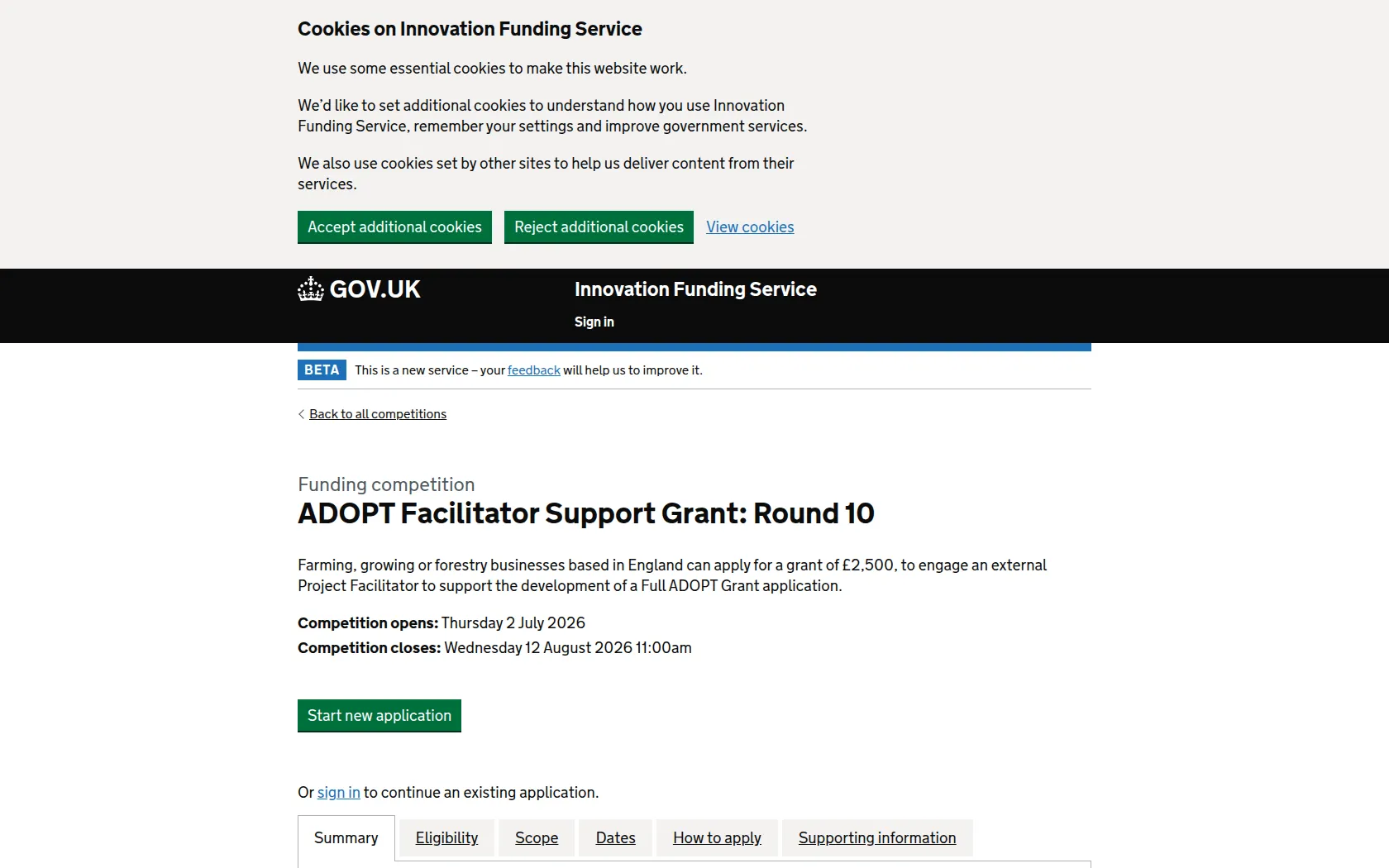
ADOPT Facilitator Support Grant: Round 10
ADOPT Facilitator Support Grant: Round 10
Farming, growing or forestry businesses based in England can apply for a grant of £2,500, to engage an external Project Facilitator to support the development of a Full ADOPT Grant application. Eligibility
This competition is open to single applicants only. To apply for this grant your organisation must: be an active farming, growing or forestry business of any size based in England be able to evidence that you are an established business, including sole traders and partnerships have a UK bank account Open now
Opened: 2 July 2026 Closes: 12 August 2026 -
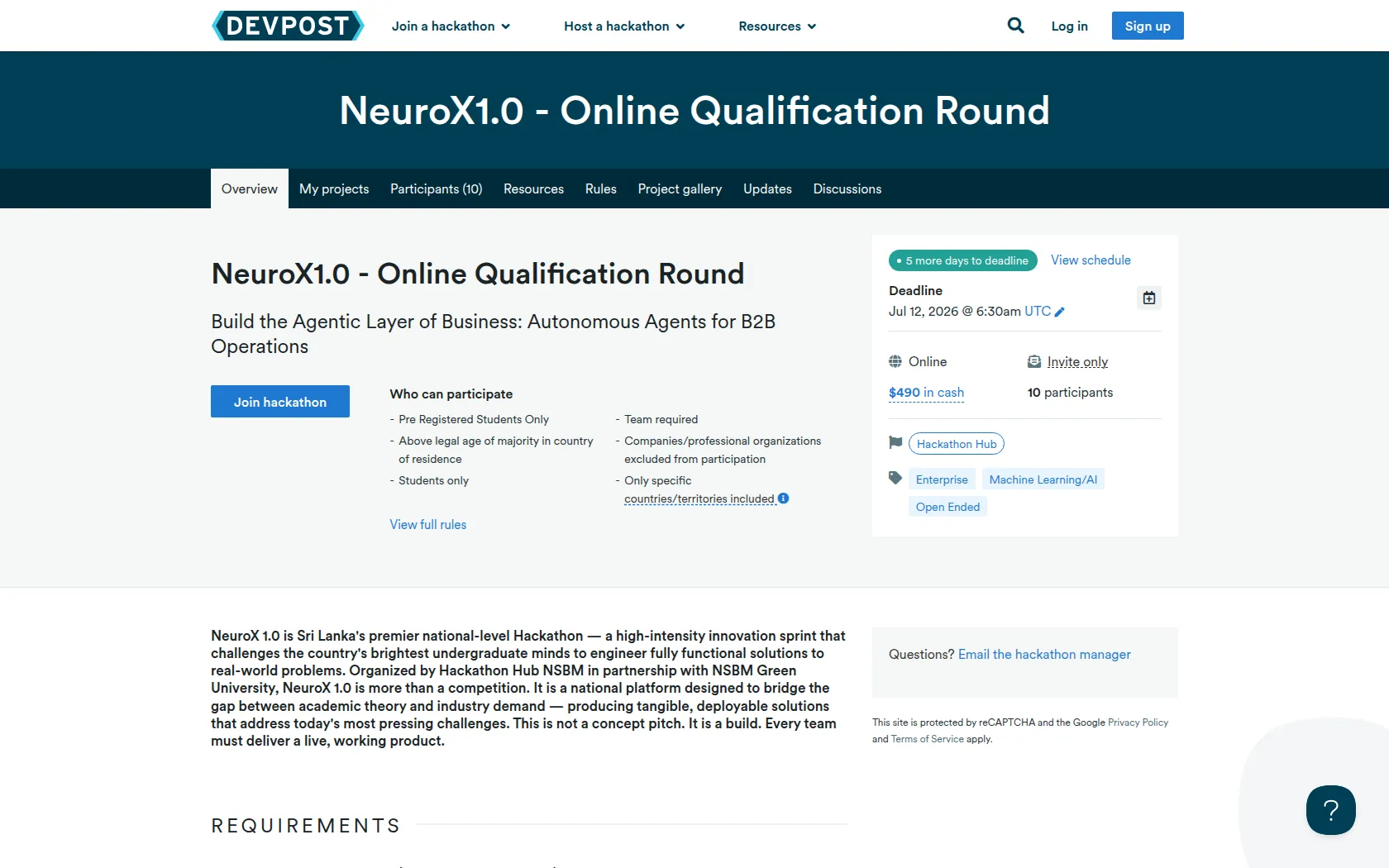
NeuroX1.0 - Online Qualification Round
NeuroX 1.0 is Sri Lanka's premier national-level Hackathon — a high-intensity innovation sprint that challenges the country's brightest undergraduate minds to engineer fully functional solutions to real-world problems. Organized by Hackathon Hub NSBM in partnership with NSBM Green University, NeuroX 1.0 is more than a competition. It is a national platform designed to bridge the gap between academic theory and industry demand — producing tangible, deployable solutions that address today's most pressing challenges. This is not a concept pitch. It is a build. Every team must deliver a live, working product.
Requirements
Phase 1: The Online Qualifier (First Week of July 2026) The search for Sri Lanka's top builders begins with a nationwide open call. The journey begins with an intensive online screening phase. Registered teams of 3 to 4 members from any state or private university across Sri Lanka are issued a problem domain, a broad thematic area that defines the challenge space for the competition. Teams then have one week to submit a short video pitch and written proposal outlining their idea, approach, and proposed solution. No working product is required at this stage. This phase is a rigorous filter of thinking, creativity, and technical direction. Ensuring only the most capable and resilient teams advance. Submissions are evaluated on originality, technical feasibility, and real-world impact potential. The finalists are selected to proceed to Phase 2.
Phase 2: The Build Week (Third Week of July 2026) The nation's top teams are selected. Now they have to build it. The selected teams will be issued a specific, well-defined problem statement within the same domain introduced in Phase 1. This ensures that while teams arrive adequately prepared, the exact challenge remains undisclosed until this stage. Because all participants address the same core problem, the competition maintains a level playing field, allowing for a direct comparison of methodologies during the final pitches. From this milestone, teams are allocated one full week to design, develop, and deliver a fully functional product. Development occurs remotely, allowing teams to manage their own schedule and working environment. Furthermore, no restrictions are placed on software tools or technology stacks. The primary evaluation criterion is the final deliverable: a live, functional product that successfully addresses the problem statement and is ready for live demonstration before the judging panel.
Phase 3: The Grand Finale (Last Week of July 2026) The nation's top builders converge at NSBM Green University for the ultimate showdown The finalists converge on campus to present the working products they have built over the past week to a panel of expert judges. Each team delivers a structured pitch demonstrating: 1.Their working product 2.The problem they solved and the approach they took. 3.The technical architecture and design decisions behind the build. 4.The real-world scalability and commercial viability of their solution. Judges evaluate each presentation against defined criteria covering technical execution, innovation, UX design, and product viability. The top 3 teams are announced at the closing ceremony on the same day
Hackathon Sponsors
Prizes
$490 in prizes Winner
$250 in cash 1 winner
1st Runner Up
$150 in cash 1 winner
2nd Runner Up
$90 in cash 1 winner
Devpost Achievements
Submitting to this hackathon could earn you:
<%= name %>
<% if (has_levels) { %> level <%= next_level %> <% } %> Judges
Anton Jayakody
Lecturer- NSBM Green University
Judging Criteria
B2B Impact & Viability
25% Is this a real problem? Would a business actually pay to solve it? Is the value proposition clear and defensible? Could this work at scale? Autonomous Reasoning Quality
25% Does the agent make genuine decisions? How does it handle ambiguity, missing data, or unexpected tool outputs? Does it know its own limits? Technical Architecture
20% Is the system well-designed? Are components modular and failure-tolerant? Can the team explain every layer of what they built and why? Human-in-the-Loop Design
15% Is the control point genuinely useful? Does it reflect thoughtful judgment about where human oversight creates the most value? Live Demo
15% Does it work with real, unrehearsed inputs in front of the judges? Can the team demonstrate the full agentic loop end-to-end under pressure? -
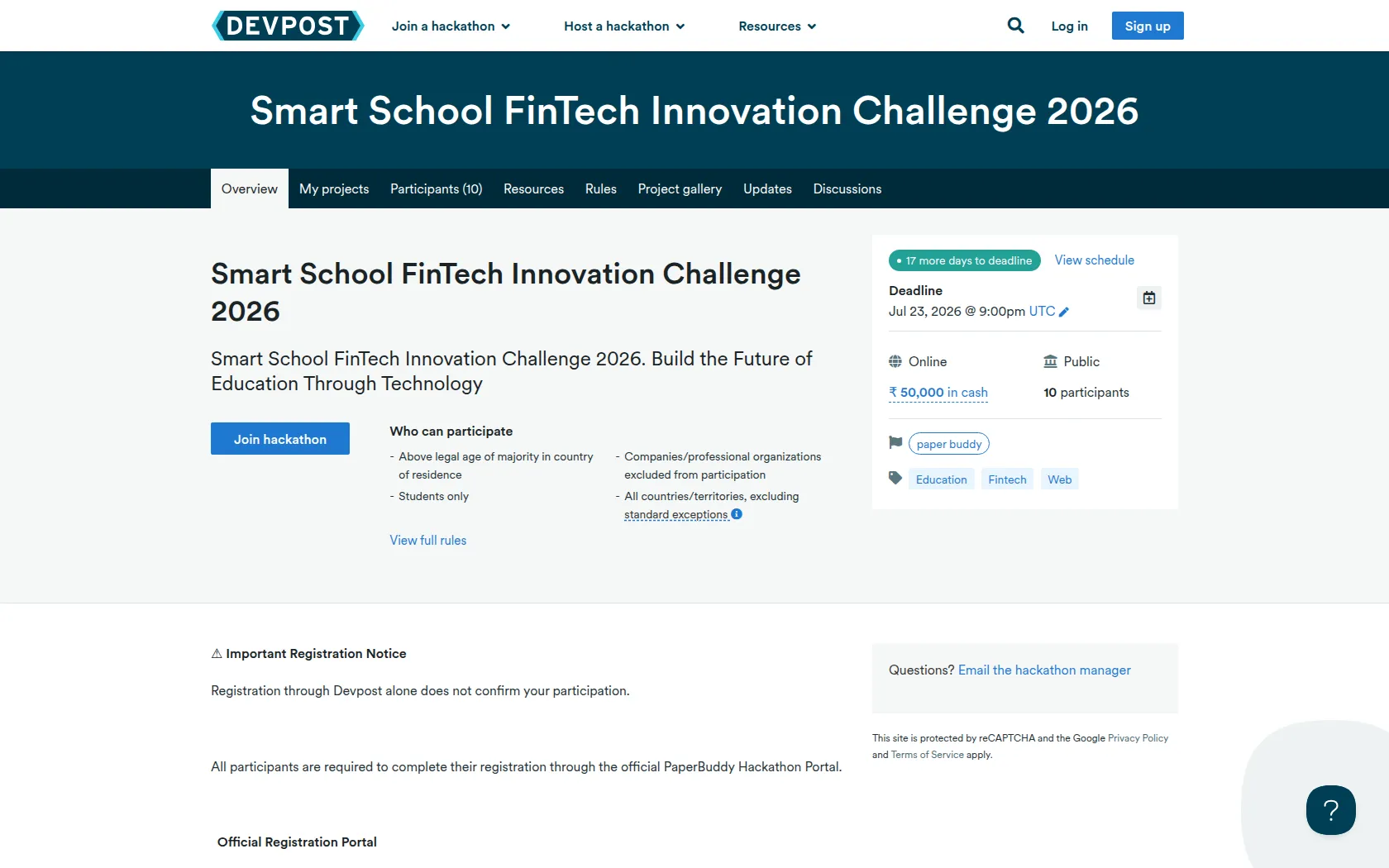
Smart School FinTech Innovation Challenge 2026
⚠️ Important Registration Notice
Registration through Devpost alone does not confirm your participation.
All participants are required to complete their registration through the official PaperBuddy Hackathon Portal.
🌐 Official Registration Portal
https://paperbuddy.in/hacktheweb
Only participants who successfully register through the official PaperBuddy website will be eligible for project submission, evaluation, certificates, cash prizes, and PPO consideration.
🚀 Smart School FinTech Innovation Challenge 2026
Build the Future of Education Through Technology
Technology has transformed industries worldwide, yet many educational institutions continue to face challenges such as fragmented software systems, manual administrative processes, disconnected communication, outdated financial workflows, and inefficient operations.
At PaperBuddy, we believe that the next generation of Software Engineers has the potential to solve these challenges by building innovative and impactful technology solutions.
The Smart School FinTech Innovation Challenge 2026 is a national-level software engineering hackathon where students, developers, designers, and innovators come together to create production-ready software that solves real-world problems.
This is more than just a hackathon—it's an opportunity to demonstrate your engineering skills, solve meaningful challenges, collaborate with talented minds across India, and compete for exciting rewards, including a Software Engineer Pre-Placement Offer (PPO).
Whether you're passionate about Full Stack Development, Mobile Applications, Artificial Intelligence, Cloud Computing, Backend Systems, or Product Engineering, this challenge is built for you.
🌐 Learn more about PaperBuddy: https://paperbuddy.in
🎯 Challenge Statement
Educational institutions generate enormous amounts of data every day, yet many schools still rely on disconnected software, paperwork, inefficient fee management systems, and outdated administrative workflows.
Your challenge is to design and develop a production-ready software solution capable of solving real-world problems within Smart Schools, Education Technology, Financial Technology, or Digital Productivity.
Your solution should focus on creating measurable value by improving efficiency, enhancing user experience, automating repetitive processes, or introducing innovative digital solutions that can positively impact students, teachers, parents, and educational institutions.
We encourage participants to think beyond traditional solutions and build products that are scalable, practical, and capable of solving real business problems.
Requirements
📦 Submission Format
Every participating team must submit the following before the final submission deadline:
📑 Project Presentation (PPT)
The presentation should include:
Problem Statement
Proposed Solution
Key Features
System Architecture
Technology Stack
Future Scope
💻 Working Prototype
A fully functional web, mobile, or desktop application demonstrating your solution.
📂 Source Code
A complete GitHub repository with clean, well-documented, and properly structured code.
🎥 Demo Video
A 3–5 minute demonstration explaining the project, its features, workflow, and real-world impact.
📄 Project Documentation
Include:
Installation & Setup Guide
Project Architecture
APIs & Integrations (if applicable)
Technical Overview
🌐 Live Demo (Optional but Recommended)
If your application is deployed, share the live URL for easier evaluation.
Note: All submissions must be original. Any form of plagiarism will result in immediate disqualification.
⚠️ Important Registration Notice
Registration through Devpost alone does not confirm your participation.
All participants are required to complete their registration through the official PaperBuddy Hackathon Portal.
🌐 Official Registration Portal
https://paperbuddy.in/hacktheweb
Only participants who successfully register through the official PaperBuddy website will be eligible for project submission, evaluation, certificates, cash prizes, and PPO consideration.
Hackathon Sponsors
Prizes
₹ 50,000+ in prizes + other prizes Software engineer PPO at paper buddy
1 winner Software engineer PPO at paper buddy
30000 Rs cash prize
₹ 30,000 in cash 1 winner
20000 Rs Cash prize
₹ 20,000 in cash 1 winner
Devpost Achievements
Submitting to this hackathon could earn you:
<%= name %>
<% if (has_levels) { %> level <%= next_level %> <% } %> Judges
Shashi kant
HR manager
Judging Criteria
Innovation & Creativity
Problem Solving Approac
Technical Excellence
Software Architecture
Code Quality
-
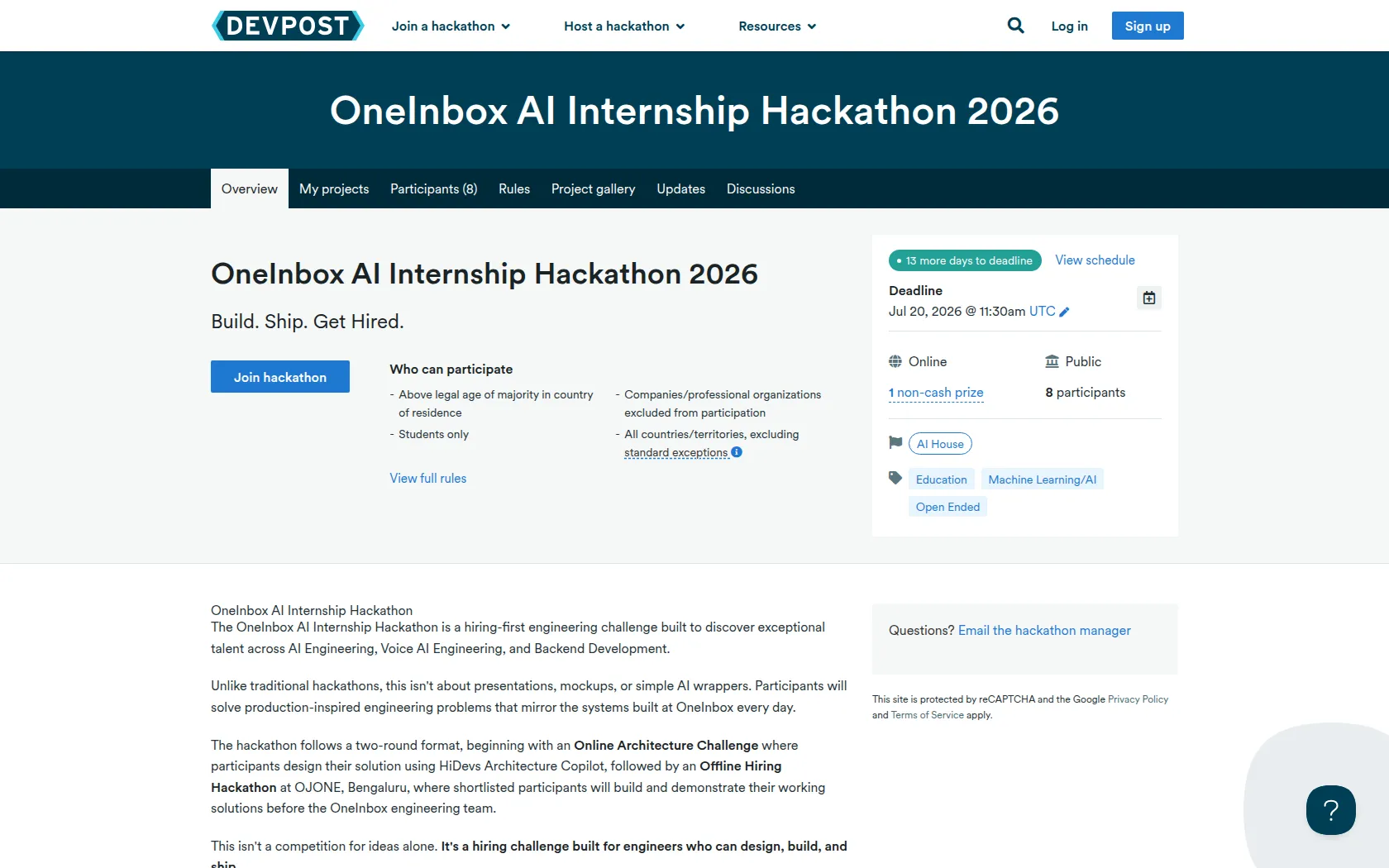
OneInbox AI Internship Hackathon 2026
OneInbox AI Internship Hackathon The OneInbox AI Internship Hackathon is a hiring-first engineering challenge built to discover exceptional talent across AI Engineering, Voice AI Engineering, and Backend Development.
Unlike traditional hackathons, this isn't about presentations, mockups, or simple AI wrappers. Participants will solve production-inspired engineering problems that mirror the systems built at OneInbox every day.
The hackathon follows a two-round format, beginning with an Online Architecture Challenge where participants design their solution using HiDevs Architecture Copilot, followed by an Offline Hiring Hackathon at OJONE, Bengaluru, where shortlisted participants will build and demonstrate their working solutions before the OneInbox engineering team.
This isn't a competition for ideas alone. It's a hiring challenge built for engineers who can design, build, and ship.
Internship Opportunities We're hiring across three engineering roles:
AI Engineer Intern Voice AI Engineer Intern Backend Developer Intern
Stipend: ₹20,000–₹25,000 per month
(Final compensation will be based on technical skills and performance during the hackathon.)
Luma: https://luma.com/ai-84kw
Requirements
Event Timeline The hackathon consists of two competitive rounds that evaluate participants on both engineering design and technical implementation.
2 July – 20 July 2026 | Registrations Open
Participants can register individually and choose the engineering role they wish to compete for.
4 July – 20 July 2026 | Round 1 – Online Architecture Challenge
Participants receive access to all problem statements and begin designing their solution using HiDevs Architecture Copilot.
Round 1 focuses entirely on architecture and product thinking. Participants must submit a Product Requirements Document (PRD) along with a complete System Architecture Diagram. No coding is required during this phase.
Round 1 Submission Requirements:
Product Requirements Document (PRD) System Architecture Diagram Selected Problem Statement Solution Overview Submissions will be evaluated on architecture quality, technical feasibility, product thinking, scalability, engineering decisions, and documentation.
22 July 2026 | Round 1 Results
Shortlisted participants will be invited to the Offline Hiring Hackathon at OJONE, Bengaluru.
25 July 2026 | Offline Hiring Hackathon
The shortlisted participants will spend the day building production-ready solutions for their chosen problem statements. Along with building their application, participants will present a live demonstration, explain their technical architecture, and interact directly with the OneInbox engineering team.
Round 2 Submission Requirements:
GitHub Repository Working Application / Deployable Demo Technical Documentation Evaluation Results Live Demonstration
Projects will be evaluated on implementation quality, engineering depth, problem-solving ability, and production readiness before internship selections are made.
Hackathon Sponsors
Prizes
1 non-cash prize Paid Internship
1 winner Internship Opportunities
We're hiring across three engineering roles:
AI Engineer Intern
Voice AI Engineer Intern
Backend Developer Intern
Stipend: ₹20,000–₹25,000 per month
(Final compensation will be based on technical skills and performance during the hackathon.)
Devpost Achievements
Submitting to this hackathon could earn you:
<%= name %>
<% if (has_levels) { %> level <%= next_level %> <% } %> Judges
OneInbox Team
Judging Criteria
Judging Criteria
Projects will be evaluated on: Engineering Design & Architecture Functionality & Correctness Technical Implementation Code Quality Performance & Scalability Robustness & Reliability Documentation Live Demonstration Overall Problem Impact -
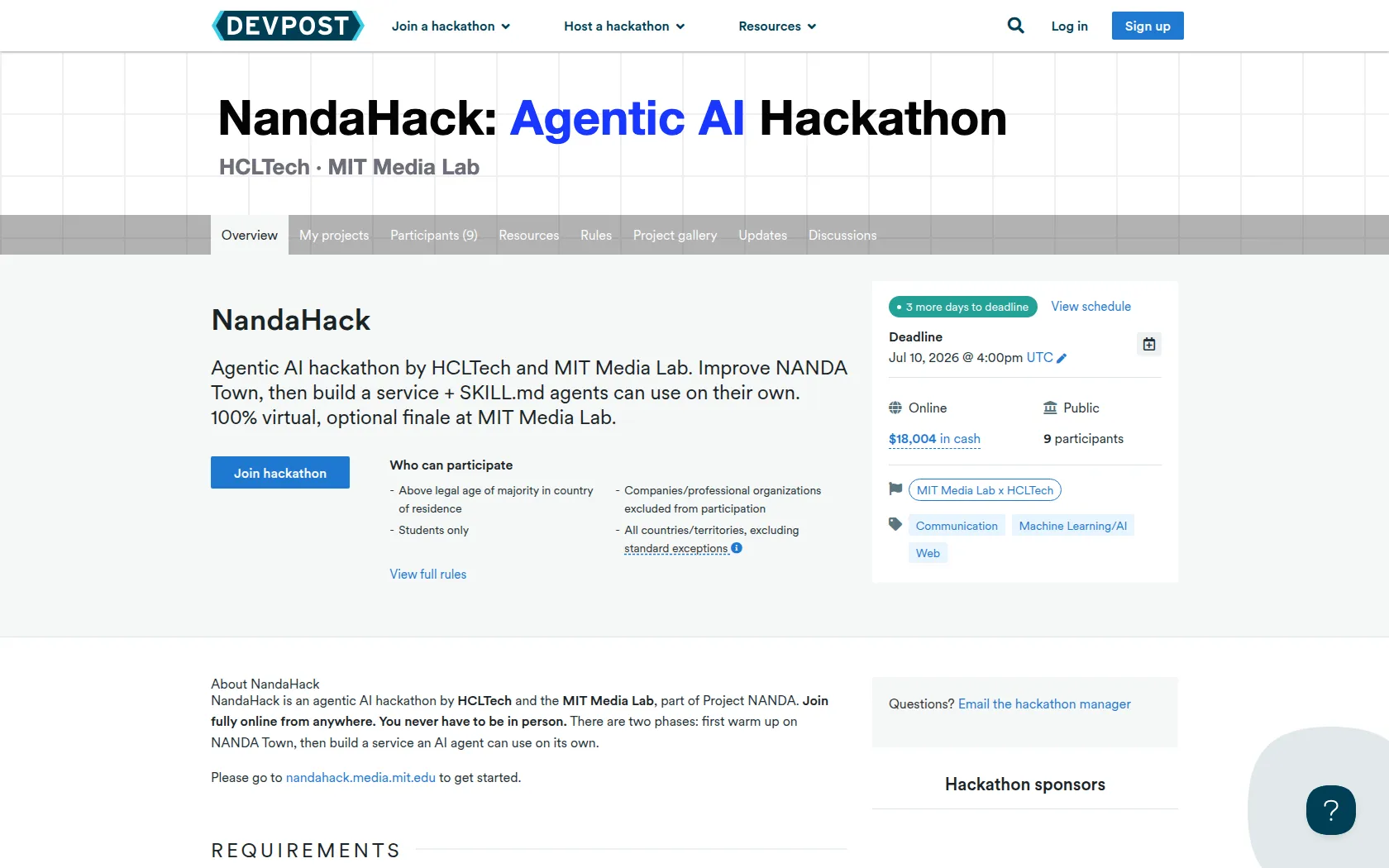
NandaHack
About NandaHack NandaHack is an agentic AI hackathon by HCLTech and the MIT Media Lab, part of Project NANDA. Join fully online from anywhere. You never have to be in person. There are two phases: first warm up on NANDA Town, then build a service an AI agent can use on its own.
Please go to nandahack.media.mit.edu to get started. Requirements
Submissions are not made on Devpost. Please get started at nandahack.media.mit.edu.
Hackathon Sponsors
Prizes
$18,004 in prizes TBD
$2,572 in cash 7 winners
Devpost Achievements
Submitting to this hackathon could earn you:
<%= name %>
<% if (has_levels) { %> level <%= next_level %> <% } %> Judges
Vedh Krishnan
Judging Criteria
Phase 1 · Improve NANDA Town (20%)
Scored on correct, well-tested code that fits NANDA Town's design and is clearly documented. Submitted as a GitHub pull request named hackathon/your-name-topic on the NANDA Town repo. Phase 2 · Service + SKILL.md (80%)
Scored on usefulness, creativity, easy setup, and whether agents can use your service from your SKILL.md alone. Submitted on the NANDA Town skills page with your live endpoint links. -
M&TSI 2026
UPenn M&T Summer Institute
Hackathon Sponsors
Prizes
1 non-cash prize Prize
1 winner Prizes Prizes Prizes!
Devpost Achievements
Submitting to this hackathon could earn you:
<%= name %>
<% if (has_levels) { %> level <%= next_level %> <% } %> Judges
Andy
Judging Criteria
M&T
-
Mobile Developers
Welcome to the Mobile Developers Challenge, a hackathon built for creators who love turning ideas into apps people can actually use. This event is all about mobile innovation, practical problem-solving, and building experiences that fit right in the palm of your hand.
Whether you are an Android developer, iOS developer, cross-platform builder, UI/UX designer, backend developer, student, freelancer, or first-time hacker, this hackathon gives you a space to create something meaningful. Participants are encouraged to build mobile apps that solve real problems, improve everyday life, entertain users, support communities, or introduce fresh ideas in mobile technology.
Your project can be a productivity app, health tool, learning platform, finance tracker, social app, game, AI-powered assistant, community service app, accessibility tool, or anything else that shows what mobile development can do. The goal is not only to write code, but to design an experience that feels useful, smooth, and thoughtful for real users.
Projects may be built using native tools like Swift, Kotlin, Java, or cross-platform frameworks like Flutter, React Native, Ionic, Unity, or any mobile-friendly technology. Teams may also use APIs, cloud services, AI tools, databases, maps, payment integrations, push notifications, or other features that make the app more powerful and complete.
Hackathon Sponsors
Prizes
1 non-cash prize Crypto
1 winner Wowowowasa
Devpost Achievements
Submitting to this hackathon could earn you:
<%= name %>
<% if (has_levels) { %> level <%= next_level %> <% } %> Judges
asd
Judging Criteria
asdw
-
305 SummerCodex Edition July 2026
305 HackShells Edition June 2026 THE EVENT IS ORGANIZED BY CAHSI AT FIU An initiative made possible by Google Developer Group at Florida International University (GDG at FIU), Code Crunch, ColorStack at FIU, CAHSI at FIU, Raspberry Pi Code Crunch, Swift Club at FIU, Hack University, and Upsilon Phi Epsilon.
Event URL: 305summercodexhack.vercel.app
Session A (In-person – Must complete a live demo to be eligible) - Friday July 24,2026
Session B (Virtual Asynchronous) - Certificate for winners - Jul 1-31, 2026
Requirements
Event URL: 305summercodexhack.vercel.app
Hackathon Sponsors
Prizes
1 non-cash prize First Place Winner for Session B (Virtual)
1 winner See details at Event URL: 305summercodexhack.vercel.app
Devpost Achievements
Submitting to this hackathon could earn you:
<%= name %>
<% if (has_levels) { %> level <%= next_level %> <% } %> Judges
CAHSI AT FIU JUDGES
Volunteer
Judging Criteria
Judging Criteria
Event URL: 305summercodexhack.vercel.app -

Brainwave 2026 – X402 Blockchain Track
Welcome to Brainwave 2026, an international hackathon where innovators, developers, designers, students, researchers, entrepreneurs, and technology enthusiasts come together to solve real-world challenges through technology.
The X402 Blockchain Track is dedicated to building the future of Agentic Payments, a new model where AI agents, applications, and digital services can securely transact through seamless blockchain-powered micropayments.
Judges, mentors, and sponsors can reach out at [email protected] for collaboration and partnership opportunities.
Requirements
Problem Statements & Themes
Track 1 — x402-Powered AI Applications:
Build AI-powered APIs and applications that monetize every request using x402 micropayments. Example ideas include AI Code Review Assistant, Bug Report Summarizer, Smart Regex Generator, Prompt Guardrail Checker, Resume-to-Job Match Scorer, Contract Risk Analyzer, Meeting Notes to Action Items, and README-to-Pitch Deck Generator.
Track 2 — Agentic Commerce & Payment Infrastructure:
Develop core infrastructure that enables secure and scalable autonomous payments between AI agents and digital services. Example ideas include x402 Payment Gateway, Multi-Tenant Payment Platform, Agent Payment Router, Spend Policy Engine, Receipt Verification Service, Payment Analytics Dashboard, Agent Reputation System, and Service Registry & Marketplace.
Track 3 — Developer Tools & SDKs:
Build tools that make developing, testing, debugging, and deploying x402 applications easier. Example ideas include x402 CLI, Next.js Starter Kit, Payment Flow Simulator, API Monetization Plugins, Transaction Debugger, Deployment Toolkit, Client SDK Extensions, and Smart Contract Templates.
Track 4 — DeFi, Web3 & Tokenized Finance:
Create decentralized financial applications and blockchain-powered systems using x402 and Web3 technologies. Example ideas include Decentralized Payment Platform, Streaming Payments, Stablecoin Payment Solutions, Cross-Border Payments, Escrow Services, Tokenized Assets Marketplace, Subscription Alternatives with x402, and Web3 Wallet Integrations.
Track 5 — Open Innovation:
Build any solution that leverages x402 and blockchain technology to solve real-world problems. Possible domains include Healthcare, Education, Sustainability, Supply Chain, Smart Cities, Cybersecurity, Gaming, Social Platforms, Creator Economy, Digital Identity, Enterprise Solutions, AI Agents, and more.
Submission Expectations:
Every project should demonstrate a clearly identified paying user or customer, a real pay-per-call business model, complete x402 payment flow (Challenge → Sign → Retry → Settle), transaction receipt included in successful responses, clean documentation and setup instructions, working MVP built during the hackathon, and mainnet-ready architecture (preferred).
Hackathon Sponsors
Prizes
₹ 100,000 in prizes Winner
₹ 50,000 in cash 1 winner The Champion will receive prizes worth 50000, including 15000 in cash, 20,000 in crypto tokens, 10,000 in API and cloud credits, and 5,000 worth of premium swag, developer goodies, and partner rewards.
Runner Up
₹ 30,000 in cash 1 winner The Runner-Up will receive prizes worth U30,000, including U10,000 in cash, 10,000 in crypto tokens, 7,000 in API and cloud credits, and 3,000 worth of premium swag, developer goodies, and partner rewards.
2nd Runner Up
₹ 20,000 in cash 1 winner The Second Runner-Up will receive prizes worth 20,000, including 5,000 in cash, 8,000 in crypto tokens, 5,000 in API and cloud credits, and 2,000 worth of premium swag, developer goodies, and partner rewards.
Devpost Achievements
Submitting to this hackathon could earn you:
<%= name %>
<% if (has_levels) { %> level <%= next_level %> <% } %> Judges
Aditya Singh
ACTS - EDC
Judging Criteria
Judging Criteria
Projects will be evaluated based on the following criteria: Innovation & Creativity – 25% Technical Implementation – 25% Impact & Problem Solving – 20% User Experience & Design – 15% Scalability & Feasibility – 10% Presentation & Demo – 5% -
Kuki Designed group
About the challenge
Get started kuki Designed group
Hackathon Sponsors
Prizes
$1,300 in prizes $100 in crypto$1,200 Kuki Designed group
$1,000 in cash 1 winner Win the program and then select
Kuki Designed group
$0 in cash 1 winner Kuki Designed group specializes building design skyscrapers
Kuki Designed group
$100 in cash 2 winners Kuki is an advanced
Kuki
$100 of BNB 1 winner Vhiojhgredj I kjolkhi
Devpost Achievements
Submitting to this hackathon could earn you:
<%= name %>
<% if (has_levels) { %> level <%= next_level %> <% } %> Judges
Yibrie Maru Ahmed
Kuki Designed group
Judging Criteria
Professional
Designed -
CockroachDB × AWS Hackathon - Build with Agentic Memory
🪳 CockroachDB × AWS Hackathon:
CockroachDB and AWS invite developers, engineers, and AI builders to create the next generation of agentic applications. Harness CockroachDB's distributed AI capabilities, fully managed MCP Server, agent-ready ccloud CLI, open-source Agent Skills Repo, LangChain integrations and Claude/Cursor plugins - all on AWS - to build AI agents with production-grade, persistent memory.
Why Agentic Memory? Why Now?
AI agents are rapidly moving from experiments into real production workflows, like writing code, running pipelines, diagnosing incidents, and driving more application traffic than any human could. But here's the problem: agents need memory that never goes down.
An agent whose memory goes offline doesn't degrade gracefully, it stops. Traditional databases were optimized for human-scale reads and writes. Agentic systems are different: they spawn autonomously, write constantly, and require memory that persists across regions, failures, and scale (with zero data loss and no maintenance windows).
CockroachDB was built for exactly this. It is the system of record for agentic memory: globally distributed, always-on, PostgreSQL-compatible, and now natively integrated into the agent toolchain through MCP, cloud, and an open-source skills ecosystem.
This hackathon is your invitation to build on that foundation.
Requirements
The Challenge
Build an agentic application that uses CockroachDB as its persistent memory layer, deployed on AWS.
Your agent should store, retrieve, and act on memory whether that's conversation history, user context, task state, embeddings, or structured transactional data. The best submissions will demonstrate that memory is not an afterthought, it is the thing that makes an agent useful in production.
All submissions must use at least two of the following CockroachDB tools:
CockroachDB Cloud Managed MCP Server — Connect AI agents directly to CockroachDB clusters with a single config snippet from the Cloud Console. Works natively with Claude Code, Cursor, and VS Code. Safe by default: read-only mode, full audit logging, zero custom proxy required. Endpoint: https://cockroachlabs.cloud/mcp CockroachDB Distributed Vector Indexing — Store and query embeddings at scale using CockroachDB's vector support with distributed indexing. Semantic search and retrieval stay fast as your data grows — no separate vector store to maintain, no reindexing pain, and no consistency gaps between your vector data and your operational database. Ideal for RAG pipelines, long-term agent memory, and semantic search applications. ccloud CLI (Agent-Ready) — Give your agent direct, secure access to the full CockroachDB Cloud control plane. Provision clusters, manage backups, configure networking, monitor audit logs — all from the terminal. Designed for AI with consistent noun-verb patterns, JSON output on every command, and granular service-account-based RBAC. CockroachDB Agent Skills Repo (Open Source) — A curated, open-source collection of machine-executable Agent Skills encoding CockroachDB expertise. Skills span onboarding, query/schema design, operations, performance, security, and observability. Portable across Claude, Cursor, LangChain, and any MCP-compatible client. All submissions must also use at least one AWS service:
Amazon Bedrock (foundation models, knowledge bases, or agents) AWS Lambda (serverless agent execution) Amazon ECS / EKS (containerized agent workloads) Amazon S3 (artifact or document storage) Amazon SageMaker (model training or inference) Amazon Bedrock Agents (multi-step agentic workflows) Any other AWS service that powers your agent's environment
What to Submit
Provide a URL to your public open source code repository for judging and testing. The repository must contain all necessary source code, clear README documentation, any required dependencies, example configurations or datasets if applicable, and setup and run instructions required for the project to be functional. The repository must be public and open source by including an open source license file (we recommend MIT or Apache 2.0). This license should be detectable and visible at the top of the repository page (in the About section). Provide a URL to your functional demo app. Include a video (less than 3 minutes) that demonstrates your submission and the CockroachDB memory layer at work. Videos must be uploaded to YouTube or Vimeo and made public. Identify which CockroachDB tools you used (MCP Server, ccloud CLI, Distributed Vector Indexing, Agent Skills) and how — what did the agent actually do with them? Identify which AWS Services tools you used (Amazon Bedrock, AWS Lambda, Amazon S3, etc.) and how. Optional: Include an architectural diagram showing how CockroachDB, AWS services, and your agent interact. Optional: Provide feedback on the CockroachDB AI tools or features. Hackathon Sponsors
Prizes
$8,750 in prizes 1st Place
$5,000 in cash 1 winner • $5,000 in USD
• Blog feature,
• Cockroach Labs Swag
2nd Place
$2,500 in cash 1 winner • $2,500 in USD
• Cockroach Labs Swag
3rd Place
$1,250 in cash 1 winner • $1,250 in USD
• Cockroach Labs Swag
Devpost Achievements
Submitting to this hackathon could earn you:
<%= name %>
<% if (has_levels) { %> level <%= next_level %> <% } %> Judges
A panel of qualified judges
Judging Criteria
Agentic Memory Design
Does CockroachDB play a meaningful, production-grade role as the agent's memory layer? Is it used for more than toy queries — state, embeddings, context, or transactional data at real scale? Technical Implementation
Is the integration with CockroachDB tools (distributed vector index, MCP Server, ccloud CLI) quality software engineering? Does the agent use the tools correctly and safely? Real-World Impact
How big of an impact could the project have on real users or workflows? Is the use case meaningful, not just technically impressive? Production Readiness
Is the design secure, observable, and scalable? Has the team thought about resilience, access control, and what happens when things go wrong? Creativity & Originality
Is this a genuinely new idea or a novel application of the technology? Does it demonstrate insight into what makes agentic systems different from traditional apps? -
ML Empowerment Build Challenge 2.0
OVERVIEW
The ML Empowerment Build Challenge is a global initiative designed to help students learn artificial intelligence and apply it to real-world projects.
Unlike traditional hackathons, this challenge combines structured learning, hands-on building, and mentorship to guide participants from beginner concepts to fully developed AI solutions.
Whether you're new to AI or already have experience, this program provides the resources and support to help you turn ideas into impactful projects.
LEARN AI (CURRICULUM ACCESS)
To support all participants, we provide a free, beginner-friendly AI curriculum developed by the ML Empowerment Foundation:
👉 Access the curriculum here: ML Empowerment Foundation Curriculum
This AI curriculum is a 12-lesson, self-paced program designed to help students understand and explore artificial intelligence step by step.
You will learn:
The fundamentals of AI and how it works Key concepts like machine learning, data, and algorithms Neural networks and modern tools like large language models and multimodal AI Practical skills such as prompt engineering The ethical implications and future impact of AI The curriculum is designed to be simple, interactive, and accessible, making it easy for anyone to start learning and building with AI.
BUILD YOUR PROJECT:
After learning the fundamentals, participants will apply their knowledge by creating a project using AI.
You can build:
AI-powered applications Chatbots or assistants Tools that solve real-world problems Creative or experimental AI projects We will also collaborate with sponsors and partner organizations to give participants the opportunity to try and learn different AI tools, platforms, and APIs, allowing for more hands-on experience and exposure to real-world technologies.
OUR MISSION
The ML Empowerment Build Challenge aims to make AI education accessible, practical, and impactful, empowering students around the world to not only learn AI but use it to create meaningful solutions.
Requirements
Build a project that addresses a real-world problem or contributes positive social impact. Your project can take any form — a web application, mobile app, AI tool, game, productivity tool, or any innovative idea that makes a difference.
Each team must submit the following on Devpost:
Project Title
Provide a clear and memorable name for your project.
Project Description
Include a detailed description that covers:
Problem Statement: What challenge or need does your project address? Solution Overview: How does your project solve this problem? Key Features: What are the main functionalities of your project? Technologies Used: Platforms, frameworks, APIs, or tools used to build your project. Target Users: Who will benefit from your project? A well-written description helps judges understand your project and highlights the effort your team has invested.
Project Files
Upload screenshots, videos, or other files that demonstrate your project.
Include at least one file showing functionality or design. Tip for beginners: A simple prototype, wireframe, or mockup is sufficient. Project Link / Repository (Optional but Recommended)
Provide a GitHub, GitLab, or similar repository link if available.
If your project is a web or mobile app, include a live demo link if possible.
Team Details
List all team members and their roles. Solo submissions are allowed.
Hackathon Sponsors
Prizes
12 non-cash prizes Best Overall Project
1 winner Awarded to the project that best demonstrates creativity, technical skill, and real-world impact.
Most Innovative Project
1 winner For projects with a unique idea, novel approach, or creative solution.
Most Impactful Project
1 winner Awarded to the project that has the potential to make the greatest social or community impact.
Best Use of Machine Learning
1 winner For projects demonstrating strong application of machine learning models to solve real-world problems effectively.
AI for Education
1 winner Awarded to tools that enhance learning experiences, accessibility, or educational outcomes through intelligent systems.
Best Web AI App
1 winner For the best AI-powered web application with strong functionality, usability, and real-world relevance.
Most Scalable Solution
1 winner Recognizes projects with strong potential to scale, handle growth, and be deployed in real-world environments.
Sustainability AI
1 winner For projects using AI to address environmental challenges, climate change, or promote sustainable practices.
Conversational AI
1 winner Awarded to the best chatbot or voice assistant delivering intelligent, natural, and helpful interactions.
Data-Driven Insights
1 winner Recognizes projects that use data analysis and AI to generate meaningful, actionable insights for users.
Productivity Booster
1 winner For AI tools that significantly improve efficiency, automate workflows, or enhance daily productivity for users.
AI for Health
1 winner Recognizes AI solutions improving healthcare, wellness, diagnostics, or access to medical information and support.
Devpost Achievements
Submitting to this hackathon could earn you:
<%= name %>
<% if (has_levels) { %> level <%= next_level %> <% } %> Judges
ML Empowerment Foundation
Judging Criteria
Technical Implementation (30%)
Creativity & Innovation (20%)
Real-World Impact (20%)
Project Design & User Experience (15%)
Presentation & Documentation (15%)
-
Technoviz Summer of Code
About Technoviz Summer of Code 2026 Welcome to Technoviz Summer of Code (TSOC) 2026 Technoviz Summer of Code (TSOC) 2026 is a community-driven open-source program designed to help students discover the exciting world of software development through collaboration, mentorship, and hands-on project building. Our vision is to create an environment where beginners and experienced developers can work together, learn modern technologies, and contribute meaningful solutions to real-world problems.
Unlike traditional coding competitions that focus on solving algorithmic questions within a limited time, TSOC is a long-duration development program that emphasizes continuous learning, teamwork, and practical implementation. Participants will have the opportunity to explore different domains of technology, including web development, mobile applications, artificial intelligence, machine learning, cybersecurity, cloud computing, blockchain, DevOps, Internet of Things, and open-source software.
The primary objective of Technoviz Summer of Code is to bridge the gap between classroom learning and real-world software engineering. Many students begin their programming journey with theoretical concepts but often struggle to apply those concepts in practical projects. TSOC aims to solve this problem by providing structured mentorship, collaborative development opportunities, and exposure to professional software development practices.
Throughout the program, participants will work on innovative projects either individually or in teams while receiving guidance from experienced mentors, senior students, and industry professionals. Weekly mentor sessions, technical workshops, project reviews, and community discussions will ensure that every participant has access to valuable learning resources throughout the event.
One of the unique aspects of TSOC is its focus on open-source culture. Participants will learn how to use Git and GitHub effectively, manage version control, collaborate with contributors from different backgrounds, write clean and maintainable code, document their projects professionally, and participate in code reviews. These are essential skills expected from modern software engineers and are highly valued by employers and open-source organizations alike.
Beyond technical learning, TSOC also aims to build a strong developer community where students can network, exchange ideas, and support one another. By bringing together learners from different colleges and academic backgrounds, the program encourages knowledge sharing and long-term collaboration. Whether someone is writing their very first line of code or already has experience contributing to open-source projects, Technoviz Summer of Code provides an inclusive platform to learn, innovate, and grow.
Our goal is simple: empower students to become confident developers, inspire them to contribute to impactful technology projects, and prepare them for future hackathons, internships, research opportunities, and professional software engineering careers. We welcome every curious learner to join us on this exciting journey of innovation, creativity, and continuous growth.
Theme & Vision Building the Next Generation of Open-Source Innovators The theme of Technoviz Summer of Code (TSOC) 2026 is "Learn, Build, Contribute, and Inspire." Our vision is to create a collaborative environment where students transform their curiosity into practical skills by developing software that solves real-world problems. Rather than limiting participants to a single technology stack or domain, TSOC encourages innovation across diverse fields and welcomes ideas that have the potential to make a positive impact on society.
Technology has become an essential part of every industry, from healthcare and education to finance, agriculture, transportation, and environmental sustainability. Students entering the software development ecosystem should not only learn programming languages but also understand how technology can improve lives. TSOC aims to cultivate this mindset by encouraging participants to identify meaningful problems, design thoughtful solutions, and build high-quality software with the guidance of experienced mentors.
Participants are free to work on projects in a wide variety of domains, including Artificial Intelligence and Machine Learning, Data Science, Web Development, Mobile Application Development, Cybersecurity, Blockchain, Cloud Computing, DevOps, Internet of Things (IoT), AR/VR, Robotics, Educational Technology, Healthcare Technology, FinTech, Climate Tech, Smart Cities, Productivity Tools, Open Source Infrastructure, and Developer Utilities. We also encourage interdisciplinary projects that combine multiple technologies to create innovative solutions.
Another important aspect of our vision is promoting the culture of open source. Open-source software powers much of the modern digital world, and learning to contribute to it equips students with valuable technical and collaborative skills. Throughout TSOC, participants will be encouraged to write clean, maintainable, and well-documented code, use Git and GitHub effectively, participate in code reviews, and share knowledge with the broader developer community. These experiences prepare students for future internships, research opportunities, and professional software engineering roles.
Innovation is not measured only by complexity. A simple application that addresses a genuine need can be just as impactful as a technically advanced project. Participants are encouraged to focus on usability, accessibility, performance, and long-term maintainability in addition to technical excellence. Projects should demonstrate thoughtful design, clear documentation, and a commitment to solving real challenges.
TSOC also emphasizes continuous learning. The program includes workshops, technical talks, mentorship sessions, community discussions, and project reviews that allow participants to expand their knowledge beyond coding. By interacting with mentors and fellow developers, students gain confidence, improve communication skills, and develop a deeper understanding of collaborative software development.
Ultimately, the vision of Technoviz Summer of Code is to build a vibrant community of learners, creators, and contributors who are passionate about technology and eager to make a meaningful difference. We hope that every participant leaves the program with stronger technical skills, lasting friendships, valuable project experience, and the confidence to continue contributing to the global open-source ecosystem long after the program concludes.
Requirements
You are free to submit your own projects or Building a Complete and Professional Project The final submission for Technoviz Summer of Code (TSOC) 2026 should reflect not only the technical quality of your project but also your ability to communicate, document, and present your work effectively. Judges will evaluate projects based on the complete submission package, so participants are encouraged to dedicate time to documentation, testing, and presentation in addition to writing code.
Every participating individual or team must submit their project before the official submission deadline through the designated hackathon platform. Late submissions may not be considered for judging unless explicitly approved by the organizing team under exceptional circumstances.
1. Source Code Repository Every project must have a publicly accessible GitHub repository unless your project contains confidential data or proprietary code approved by the organizers. The repository should clearly demonstrate the development process throughout the program with meaningful commits, proper version control practices, and an organized project structure.
Your repository should include:
Well-structured source code
Meaningful commit history
Clear folder organization
Proper licensing (recommended)
No unnecessary or sensitive files
No hardcoded API keys, passwords, or private credentials
Repositories that appear to have been copied, plagiarized, or generated without meaningful participant contribution may be disqualified.
2. Comprehensive README A detailed README file is mandatory. It should enable anyone reviewing your project to understand its purpose and use it without additional assistance.
Your README should include:
Project title
Problem statement
Solution overview
Features
Technology stack
Installation instructions
Usage guide
Screenshots
Future scope
Team member details
License (if applicable)
Good documentation reflects good engineering practices and will positively influence project evaluation.
3. Project Description Participants must provide a concise yet informative description of their project. The description should explain:
What problem the project solves
Why the problem is important
Who benefits from the solution
How the solution works
What makes the project unique or innovative
Judges should be able to understand the motivation and impact of the project without reading the source code.
4. Demonstration Video Every submission must include a demonstration video between 3 and 5 minutes in length.
The demo should cover:
Introduction to the project
Problem statement
Live demonstration of key features
Technical architecture (brief)
Future improvements
Conclusion
The video should clearly showcase the working application rather than relying solely on presentation slides.
5. Live Demo (Recommended) Participants are strongly encouraged to deploy their applications whenever possible.
Examples include:
Web applications deployed on cloud platforms
Android APK or Play Store links
Desktop application installers
Public APIs
Hosted machine learning models
Interactive dashboards
If deployment is not possible due to technical limitations, provide detailed instructions for running the project locally.
6. Presentation Slides (Optional but Recommended) Teams may submit a short presentation summarizing:
Project overview
Motivation
Technical implementation
System architecture
Challenges faced
Lessons learned
Future enhancements
A well-designed presentation helps judges quickly understand the project's overall vision.
7. Original Work All submitted projects must represent original work completed primarily during the TSOC program. Participants may use open-source libraries, frameworks, APIs, SDKs, and publicly available tools, provided they comply with their respective licenses and are properly acknowledged.
Projects that substantially reuse previously completed work without significant new development during TSOC should clearly disclose the reused components. Failure to disclose prior work may result in penalties or disqualification.
8. AI-Assisted Development The responsible use of AI coding assistants and developer tools is permitted. However, participants are expected to understand the code they submit and should be able to explain their implementation during evaluations if requested. AI-generated code does not replace originality, creativity, or technical understanding.
9. Submission Checklist Before submitting, ensure that your project includes:
✅ Public GitHub repository
✅ Complete source code
✅ Detailed README
✅ Installation guide
✅ Project description
✅ Demo video (3–5 minutes)
✅ Screenshots
✅ Live deployment or execution instructions
✅ List of team members
✅ Technology stack
✅ Required acknowledgements and licenses
10. Final Note A successful submission is more than just working software. It demonstrates thoughtful problem-solving, clean engineering practices, effective collaboration, and clear communication. We encourage every participant to focus on creating projects that are innovative, maintainable, well-documented, and impactful. Remember, a polished submission not only improves your chances during judging but also serves as a valuable portfolio project that you can proudly showcase to future employers, internship recruiters, and the open-source community.
Hackathon Sponsors
Prizes
7 non-cash prizes Winner (1st Place Overall)
1 winner * Winner Certificate
* TSOC Champion Title
* Featured in Hall of Fame
* Social Media Spotlight
* Priority for future mentorship/organizing roles
* Premium TSOC Swag Kit
1st Runner-Up (2nd Place Overall)
1 winner * Runner-Up Certificate
* Featured Project Showcase
* TSOC Swag Kit
* Community Recognition
2nd Runner-Up (3rd Place Overall)
1 winner * 2nd Runner-Up Certificate
* Community Showcase Feature
* TSOC Digital Swag Pack
Theme-Wise Awards (1 Winner per Theme)
10 winners
Each theme will have **one best project winner**.
## AI / ML Winner
* Theme Winner Certificate
* Featured AI Project Spotlight
* Exclusive Digital Badge
## Web Development Winner
* Theme Winner Certificate
* Featured Showcase
* UI/UX Recognition Badge
## Mobile Development Winner
* Theme Winner Certificate
* App Showcase Feature
* Mobile Innovator Badge
## Cloud / DevOps Winner
* Theme Winner Certificate
* Infrastructure Spotlight
* DevOps Badge
## Cybersecurity Winner
* Theme Winner Certificate
* Security Excellence Badge
## Blockchain / Web3 Winner
* Theme Winner Certificate
* Decentralized Innovation Badge
## Data Science Winner
* Theme Winner Certificate
* Analytics Excellence Badge
## Social Impact Winner
* Theme Winner Certificate
* Impact Recognition Badge
## UI/UX Design Winner
* Theme Winner Certificate
* Design Excellence Badge
## Open Source Contribution Winner
* Theme Winner Certificate
* Open Source Hero Badge
Special Awards
7 winners Special Awards
* Most Innovative Idea
* Best Beginner Project
* Best Documentation
* Best Team Collaboration
* Fastest Progress Project
* Judges’ Special Mention
* Community Choice Award
Referral Rewards
200 winners
## 5 Referrals
* Appreciation Certificate
* Community Supporter Badge
## 10 Referrals
* TSOC Official Swag Kit
* Featured Recognition in Community
## 20+ Referrals
* Campus Ambassador Certificate
* Premium Swag Kit
* Official Social Media Feature
* Priority for future leadership roles
Participant Rewards
500 winners
## All Participants
* Participation Certificate
* Completion Badge
* TSOC Contributor Certificate
* Digital Swag Pack (badges, wallpapers, stickers)
* Community Access
## Selected Participants (Top Projects)
* Featured Project Showcase
* Judge Feedback Report
* Priority Internship/Opportunity Alerts (if available)
* Exclusive Community Recognition
Devpost Achievements
Submitting to this hackathon could earn you:
<%= name %>
<% if (has_levels) { %> level <%= next_level %> <% } %> Judges
TSOC Professional Jury Panel
If you want to judge then mail us !!
Judging Criteria
Problem Solving
Presentation
-
Code API
Code API is a dynamic day event designed to bring together passionate developers, innovators, and learners under one roof to collaborate, build, and create tech solutions.
Register Here : https://events.mlh.com/events/14422-code-api
Requirements
Teams must build a working prototype or project created during event that demonstrates creativity and technical skill. Submissions should include:
A short project description
The GitHub repository link
A demo video or screenshots
Details on how the Gemini API was used
Hackathon Sponsors
Prizes
2 non-cash prizes Best Use of Gemini API
2 winners Swags and credits
Best App Deployed on Google Cloud
2 winners Cloud Credits
Devpost Achievements
Submitting to this hackathon could earn you:
<%= name %>
<% if (has_levels) { %> level <%= next_level %> <% } %> Judges
Mr. Gaurav J
NE Solutions
Judging Criteria
Judging Criteria
Projects will be judged on creativity, technical execution, Gemini API use, impact, and presentation. Judges seek projects that showcase originality, solid implementation, and meaningful collaboration in solving real-world problems. -
LUMA Hackathon (August 30th - September 7th)
The competition will begin on August 30th. Submissions made before this date will not be considered.
What is a Hackathon? A hackathon is a technical sprint. You will execute a functional project like an app, website, or software tool that solves a real world problem through code.
Round 1: Project Submission Submit a 5 minute video demonstration covering:
The Problem: What specific technical or social challenge are you tackling?
The Build: A walkthrough of your codebase, architecture, and the stack used.
The Demo: A screen share recording of the project functioning in real time.
Scalability: How is this project suited to handle more data or more users?
Round 2: Live Finals The top technical projects will advance to a Live Demonstration and Q&A. Finalists will run their code live for a panel of judges and defend their technical logic and architecture in a real time discussion.
All Participants: Subscription bundle
Who Can Participate? Any high school or middle schooler student. Teams of 1 to 5.
Requirements
Submit a 5 minute video of your product make sure to hit all key points on this rubric!
Technical Execution (25%) Is the code clean, efficient, and well-documented? Does the project actually work, and did the team demonstrate a strong grasp of their tech stack?
Innovation & UX (25%) Did the team come up with an original or clever idea? Is the interface intuitive and the user flow seamless for the end user?
Business & Finance (25%) Does the submission include a realistic business model, revenue streams, and a clear path to financial sustainability?
Communication (25%) Did the video and live Q&A demonstrate a deep understanding of the product, its technical architecture, and its target consumers?
Hackathon Sponsors
Prizes
1 non-cash prize Prize
1,000 winners Sponsorship prizes + subscriptions for everyone
Devpost Achievements
Submitting to this hackathon could earn you:
<%= name %>
<% if (has_levels) { %> level <%= next_level %> <% } %> Judges
Jash Vohra
Ekansh Jain
Judging Criteria
Technical Execution
Is the code clean, efficient, and well-documented? Does the project actually work, and did the team demonstrate a strong grasp of their tech stack? Innovation & UX
Did the team come up with an original or clever idea? Is the interface intuitive and the user flow seamless for the end user? Business & Finance
Does the submission include a realistic business model, revenue streams, and a clear path to financial sustainability? Communication
Did the video and live Q&A demonstrate a deep understanding of the product, its technical architecture, and its target consumers? -
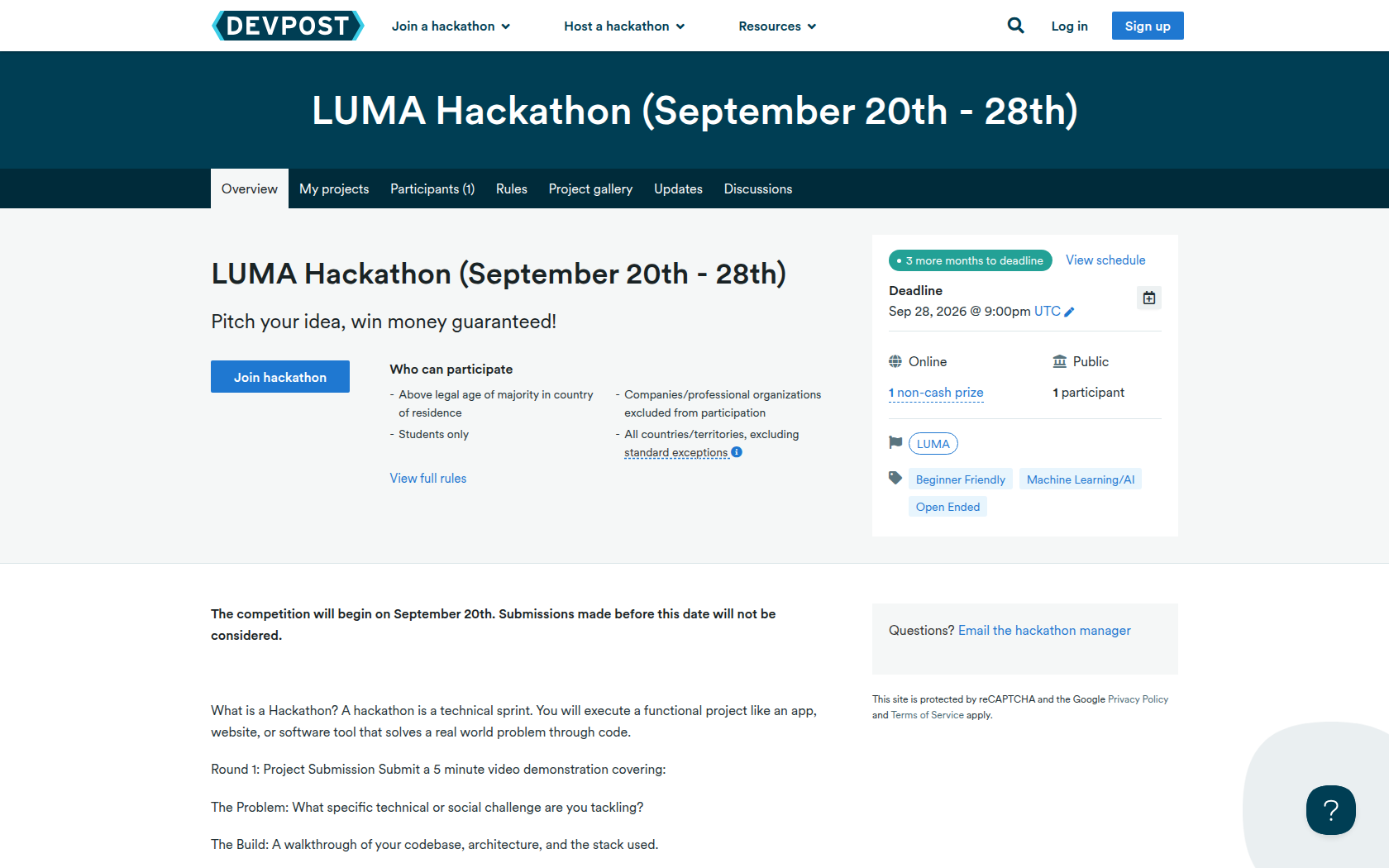
LUMA Hackathon (September 20th - 28th)
The competition will begin on September 20th. Submissions made before this date will not be considered.
What is a Hackathon? A hackathon is a technical sprint. You will execute a functional project like an app, website, or software tool that solves a real world problem through code.
Round 1: Project Submission Submit a 5 minute video demonstration covering:
The Problem: What specific technical or social challenge are you tackling?
The Build: A walkthrough of your codebase, architecture, and the stack used.
The Demo: A screen share recording of the project functioning in real time.
Scalability: How is this project suited to handle more data or more users?
Round 2: Live Finals The top technical projects will advance to a Live Demonstration and Q&A. Finalists will run their code live for a panel of judges and defend their technical logic and architecture in a real time discussion.
All Participants: Subscription bundle
Who Can Participate? Any high school or middle schooler student. Teams of 1 to 5.
Requirements
Submit a 5 minute video of your product make sure to hit all key points on this rubric!
Technical Execution (25%) Is the code clean, efficient, and well-documented? Does the project actually work, and did the team demonstrate a strong grasp of their tech stack?
Innovation & UX (25%) Did the team come up with an original or clever idea? Is the interface intuitive and the user flow seamless for the end user?
Business & Finance (25%) Does the submission include a realistic business model, revenue streams, and a clear path to financial sustainability?
Communication (25%) Did the video and live Q&A demonstrate a deep understanding of the product, its technical architecture, and its target consumers?
Hackathon Sponsors
Prizes
1 non-cash prize Prize
1,000 winners Sponsorship prizes + subscriptions for everyone
Devpost Achievements
Submitting to this hackathon could earn you:
<%= name %>
<% if (has_levels) { %> level <%= next_level %> <% } %> Judges
Jash Vohra
Ekansh Jain
Judging Criteria
Technical Execution
Is the code clean, efficient, and well-documented? Does the project actually work, and did the team demonstrate a strong grasp of their tech stack? Innovation & UX
Did the team come up with an original or clever idea? Is the interface intuitive and the user flow seamless for the end user? Business & Finance
Does the submission include a realistic business model, revenue streams, and a clear path to financial sustainability? Communication
Did the video and live Q&A demonstrate a deep understanding of the product, its technical architecture, and its target consumers? -
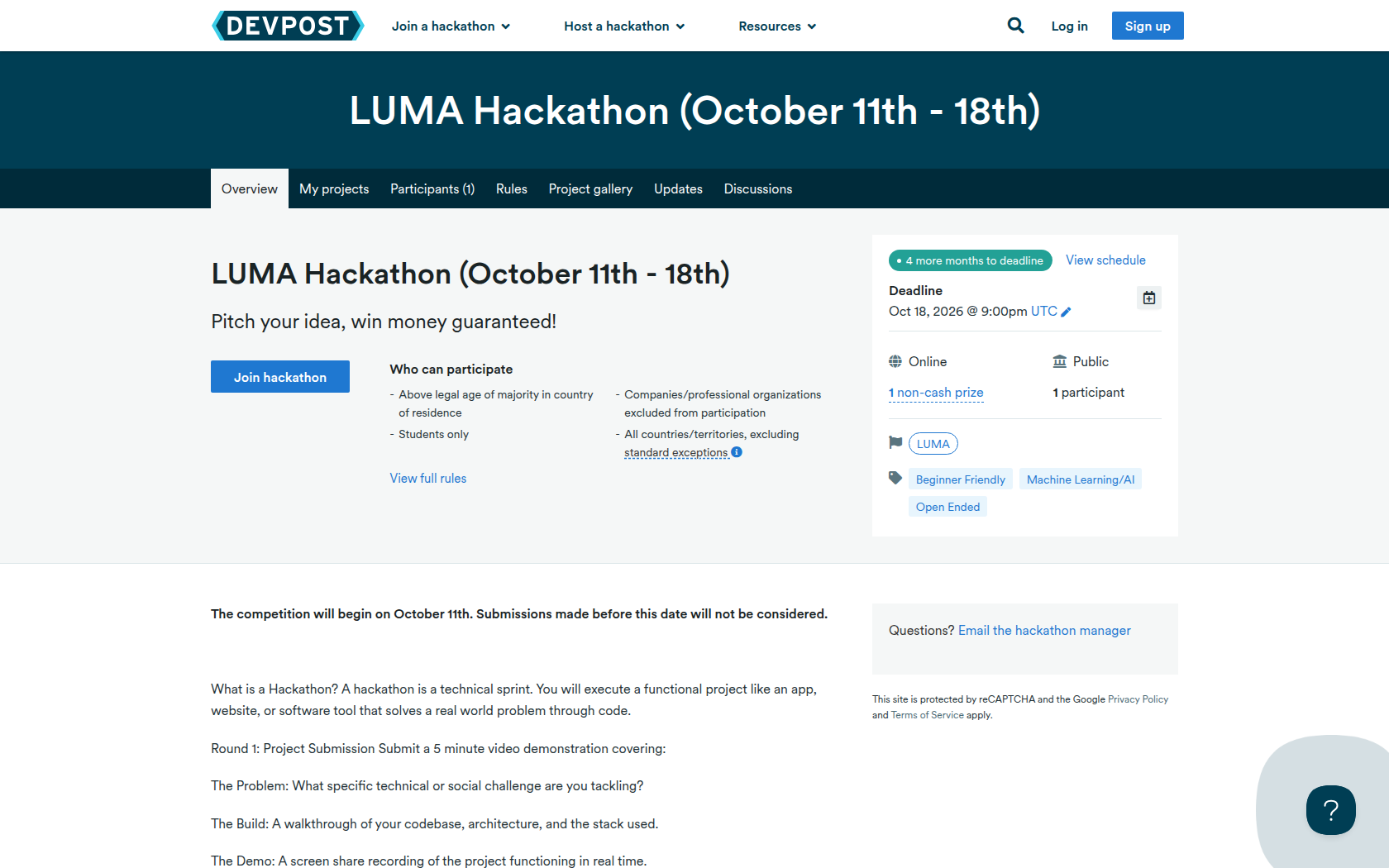
LUMA Hackathon (October 11th - 18th)
The competition will begin on October 11th. Submissions made before this date will not be considered.
What is a Hackathon? A hackathon is a technical sprint. You will execute a functional project like an app, website, or software tool that solves a real world problem through code.
Round 1: Project Submission Submit a 5 minute video demonstration covering:
The Problem: What specific technical or social challenge are you tackling?
The Build: A walkthrough of your codebase, architecture, and the stack used.
The Demo: A screen share recording of the project functioning in real time.
Scalability: How is this project suited to handle more data or more users?
Round 2: Live Finals The top technical projects will advance to a Live Demonstration and Q&A. Finalists will run their code live for a panel of judges and defend their technical logic and architecture in a real time discussion.
All Participants: Subscription bundle
Who Can Participate? Any high school or middle schooler student. Teams of 1 to 5.
Requirements
Submit a 5 minute video of your product make sure to hit all key points on this rubric!
Technical Execution (25%) Is the code clean, efficient, and well-documented? Does the project actually work, and did the team demonstrate a strong grasp of their tech stack?
Innovation & UX (25%) Did the team come up with an original or clever idea? Is the interface intuitive and the user flow seamless for the end user?
Business & Finance (25%) Does the submission include a realistic business model, revenue streams, and a clear path to financial sustainability?
Communication (25%) Did the video and live Q&A demonstrate a deep understanding of the product, its technical architecture, and its target consumers?
Hackathon Sponsors
Prizes
1 non-cash prize Prize
1,000 winners Sponsorship prizes + subscriptions for everyone
Devpost Achievements
Submitting to this hackathon could earn you:
<%= name %>
<% if (has_levels) { %> level <%= next_level %> <% } %> Judges
Jash Vohra
Ekansh Jain
Judging Criteria
Technical Execution
Is the code clean, efficient, and well-documented? Does the project actually work, and did the team demonstrate a strong grasp of their tech stack? Innovation & UX
Did the team come up with an original or clever idea? Is the interface intuitive and the user flow seamless for the end user? Business & Finance
Does the submission include a realistic business model, revenue streams, and a clear path to financial sustainability? Communication
Did the video and live Q&A demonstrate a deep understanding of the product, its technical architecture, and its target consumers? -
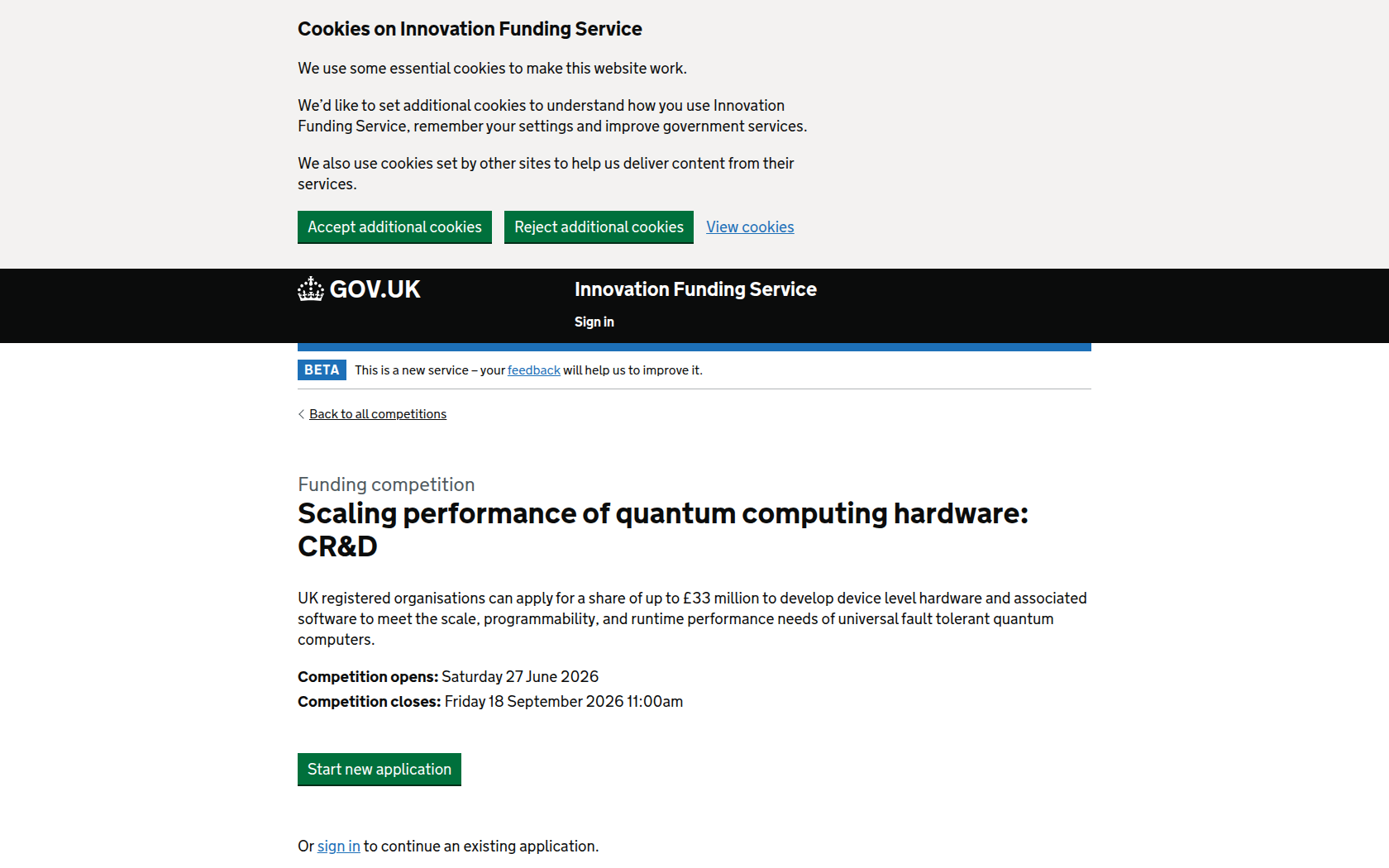
Scaling performance of quantum computing hardware: CR&D
Scaling performance of quantum computing hardware: CR&D
UK registered organisations can apply for a share of up to £33 million to develop device level hardware and associated software to meet the scale, programmability, and runtime performance needs of universal fault tolerant quantum computers. Eligibility
This competition is open to collaborations only. To lead a collaborative project your organisation must be a UK registered business of any size or a research and technology organisation (RTO). Open now
Opened: 27 June 2026 Closes: 18 September 2026 -
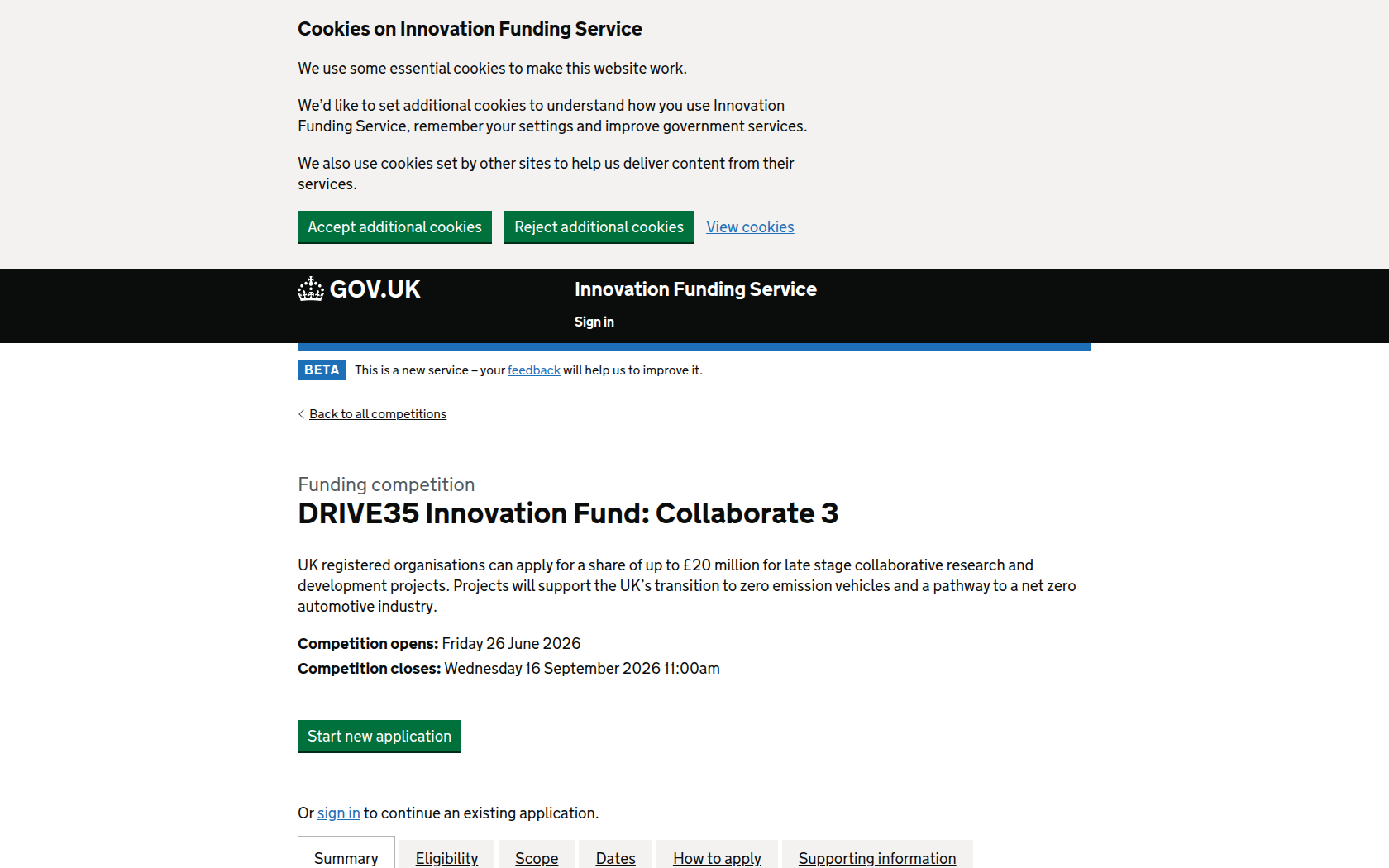
DRIVE35 Innovation Fund: Collaborate 3
DRIVE35 Innovation Fund: Collaborate 3
UK registered organisations can apply for a share of up to £20 million for late stage collaborative research and development projects. Projects will support the UK’s transition to zero emission vehicles and a pathway to a net zero automotive industry. Eligibility
This competition is open to collaborations only. To lead a collaborative project your organisation must be a UK registered business of any size. Open now
Opened: 26 June 2026 Closes: 16 September 2026 -
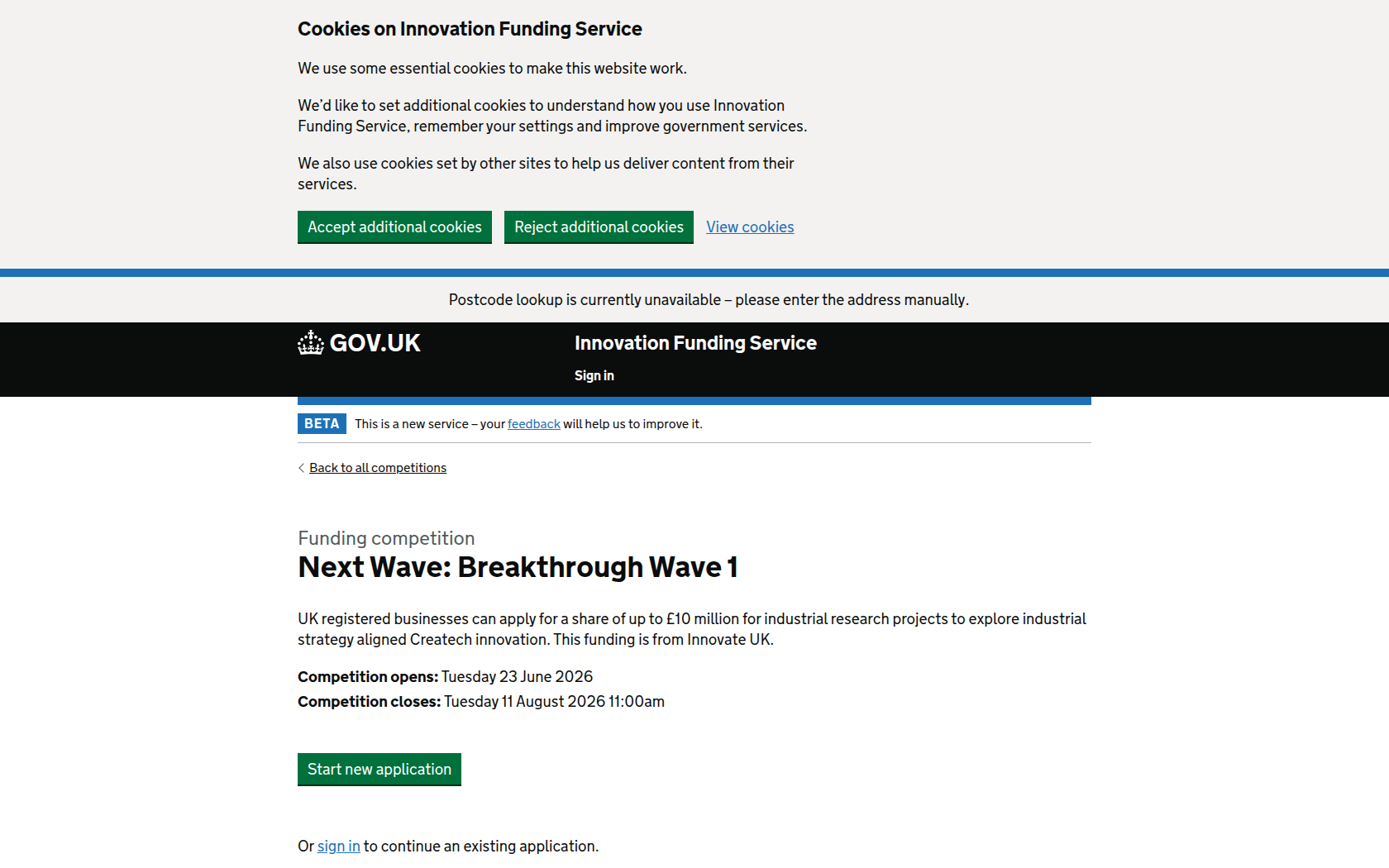
Next Wave: Breakthrough Wave 1
Next Wave: Breakthrough Wave 1
UK registered businesses can apply for a share of up to £10 million for industrial research projects to explore industrial strategy aligned Createch innovation. This funding is from Innovate UK. Eligibility
This competition is open to single applicants or collaborations.
To lead a collaborative project your organisation must be a UK registered micro, small or medium sized enterprise (SME) claiming grant funding on this application.
To work alone your organisation must be a UK registered SME.
Open now
Opened: 23 June 2026 Closes: 11 August 2026 -
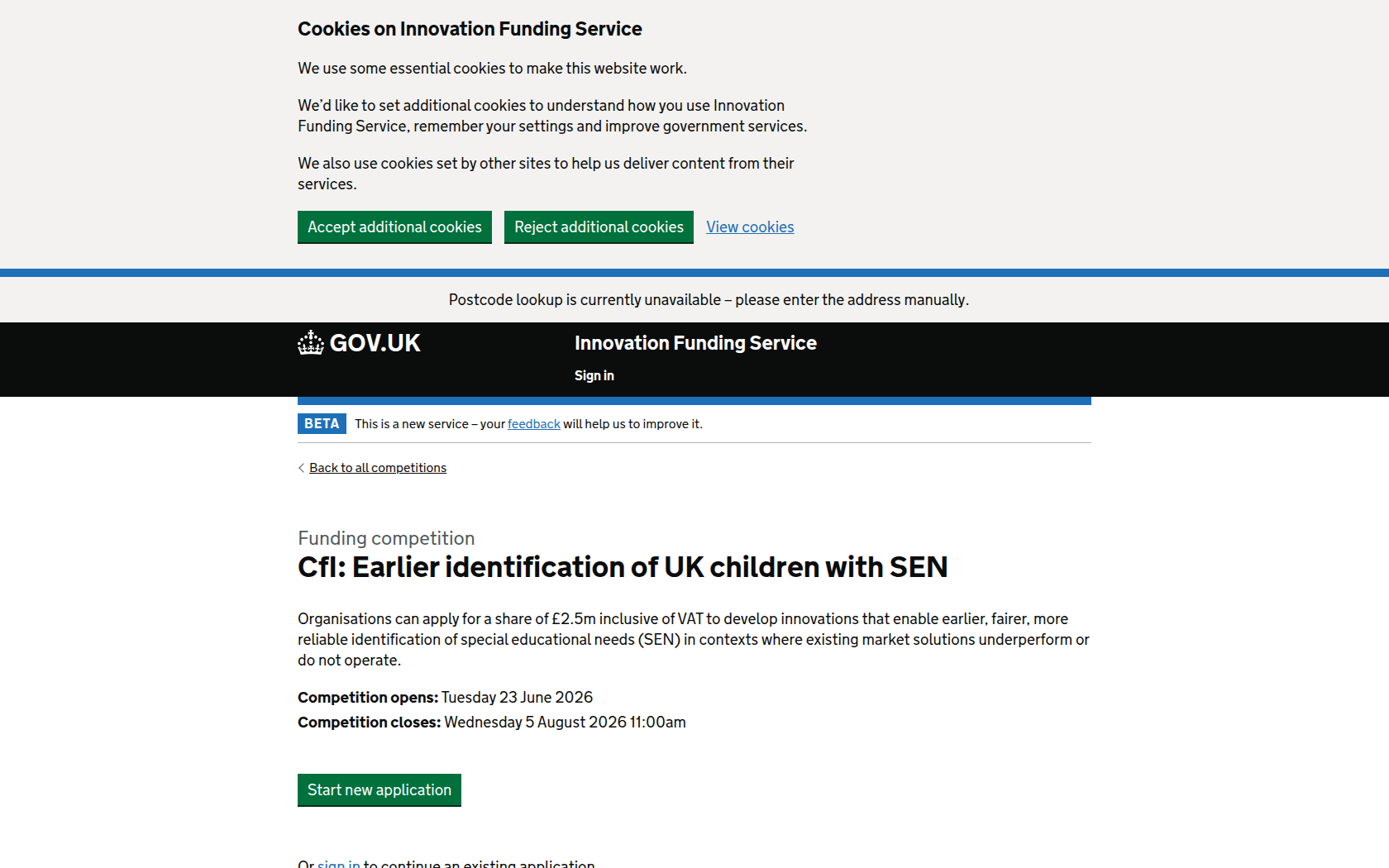
CfI: Earlier identification of UK children with SEN
CfI: Earlier identification of UK children with SEN
Organisations can apply for a share of £2.5m inclusive of VAT to develop innovations that enable earlier, fairer, more reliable identification of special educational needs (SEN) in contexts where existing market solutions underperform or do not operate. Eligibility
To lead a project, you can:
be an organisation of any size, including those based in the EU, EEA or internationally work alone or with other organisations as subcontractors
Contracts will be awarded to a single legal entity only. Open now
Opened: 23 June 2026 Closes: 5 August 2026 -
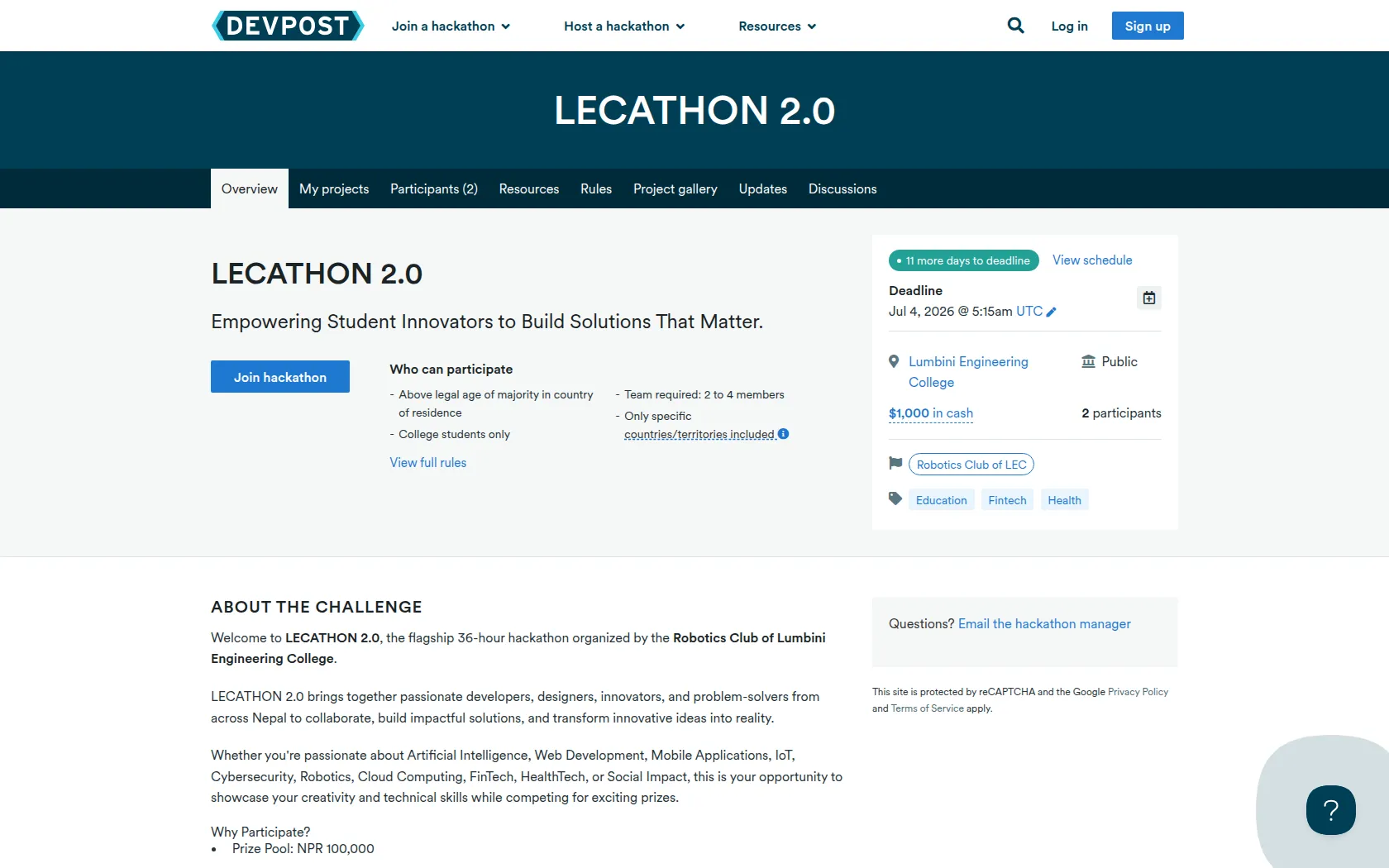
LECATHON 2.0
About the challenge
Welcome to LECATHON 2.0, the flagship 36-hour hackathon organized by the Robotics Club of Lumbini Engineering College.
LECATHON 2.0 brings together passionate developers, designers, innovators, and problem-solvers from across Nepal to collaborate, build impactful solutions, and transform innovative ideas into reality.
Whether you're passionate about Artificial Intelligence, Web Development, Mobile Applications, IoT, Cybersecurity, Robotics, Cloud Computing, FinTech, HealthTech, or Social Impact, this is your opportunity to showcase your creativity and technical skills while competing for exciting prizes.
Why Participate? 🏆 Prize Pool: NPR 100,000
⏰ 36 Hours of Innovation
🤝 Mentorship from industry professionals
🌐 Networking with fellow innovators
🎁 Swags, certificates, and exciting goodies
🚀 Opportunity to build real-world solutions
The event begins with an online preliminary round, where teams submit their project ideas. The Top 10 teams will then be invited to compete in the 36-hour onsite Grand Finale at Lumbini Engineering College.
Whether you're an experienced hacker or participating for the first time, LECATHON 2.0 is designed to inspire innovation, collaboration, and learning.
Join us and help shape the future through technology.
Get started
Registration Process Register your team through the official registration form.
Submit your project idea during the online preliminary round.
Our judging panel will evaluate all submissions.
The Top 10 teams will be selected for the onsite finale.
Selected teams will confirm participation by completing the NPR 2,000 per team finalist registration.
Build your solution during the 36-hour onsite hackathon.
Present your project to our judging panel and compete for the prize pool.
Important Dates
📅 Online Registration: Open Now
📅 Preliminary Submission Deadline: (To be announced)
📅 Finalist Announcement: (To be announced)
📅 Onsite Hackathon: Asar 19–20
📍 Venue: Lumbini Engineering College, Butwal
👥 Team Size: 2–4 Members
Requirements
What to Build?
Build an original and innovative solution that addresses a real-world problem using technology.
Projects may focus on areas including (but not limited to):
Artificial Intelligence & Machine Learning
Web Development
Mobile Applications
Internet of Things (IoT)
Robotics
Cybersecurity
Cloud Computing
HealthTech
EdTech
AgriTech
FinTech
Sustainability & Social Impact
Projects should demonstrate creativity, technical implementation, usability, and real-world impact.
What to Submit?
Project Name Short Project Description Problem Statement Proposed Solution Features Technology Stack GitHub Repository Live Demo (if available) Demo Video (3–5 minutes) Presentation Slides (optional) Team Members Any additional supporting documents Hackathon Sponsors
Prizes
$1,000 in prizes Winner
$500 in cash 1 winner 500$ for the winner of the event.
1st Runner-up
$300 in cash 1 winner 300$ for the 1st runner-up
2nd Runner-up
$200 in cash 1 winner 200$ for the 2nd runner-up
Devpost Achievements
Submitting to this hackathon could earn you:
<%= name %>
<% if (has_levels) { %> level <%= next_level %> <% } %> Judges
NOT REVEALED
Judging Criteria
NOT REVEALED
-
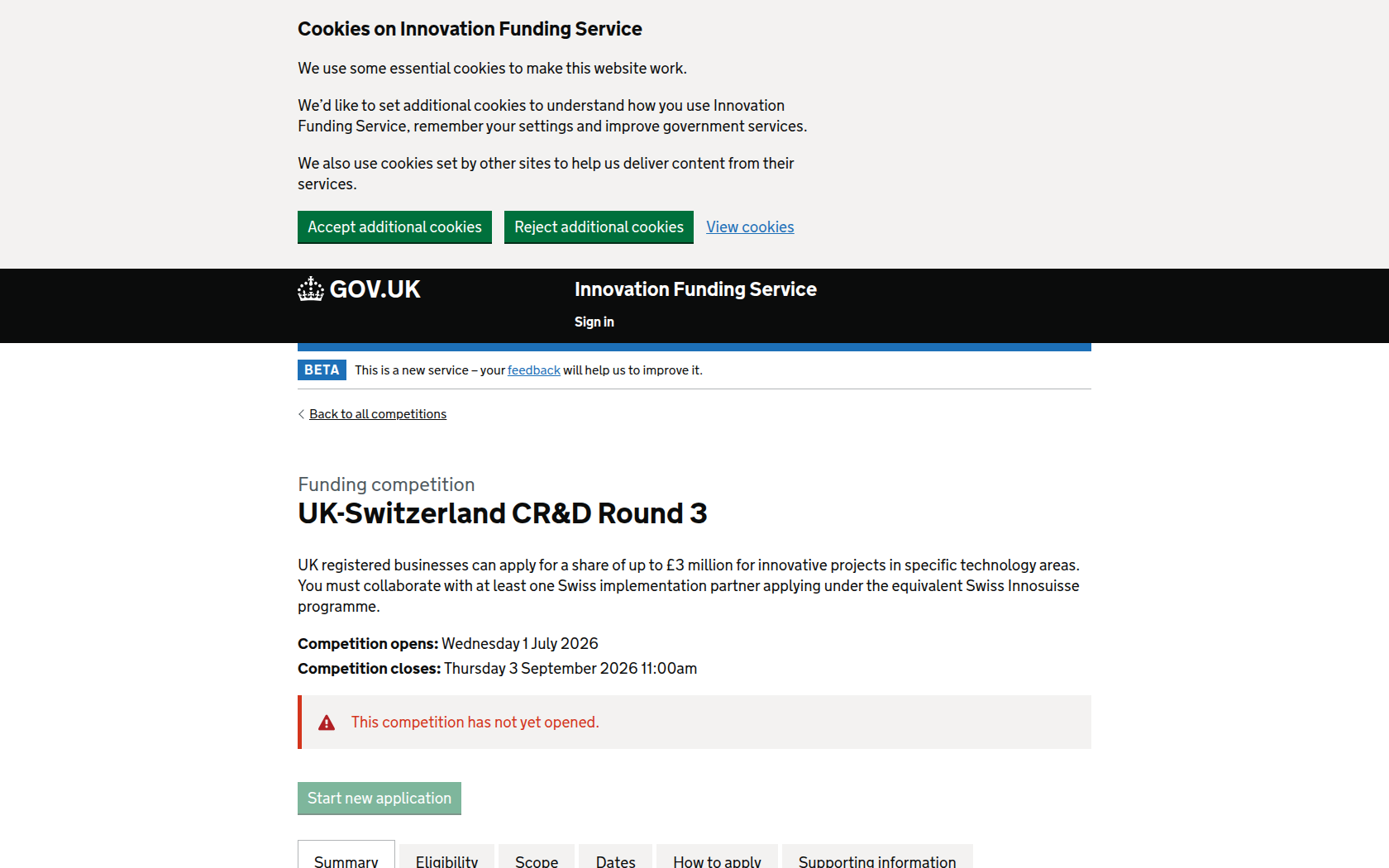
UK-Switzerland CR&D Round 3
UK-Switzerland CR&D Round 3
UK registered businesses can apply for a share of up to £3 million for innovative projects in specific technology areas. You must collaborate with at least one Swiss implementation partner applying under the equivalent Swiss Innosuisse programme. Eligibility
This competition is open to UK and Swiss collaborations only.
To lead a project your organisation must be a UK registered:
business of any size must be or involve at least one grant claiming UK registered micro, small or medium sized enterprise (SME) collaborate with a Swiss implementation partner and at least one research institute
Opening soon
Opens: 1 July 2026 Closes: 3 September 2026