


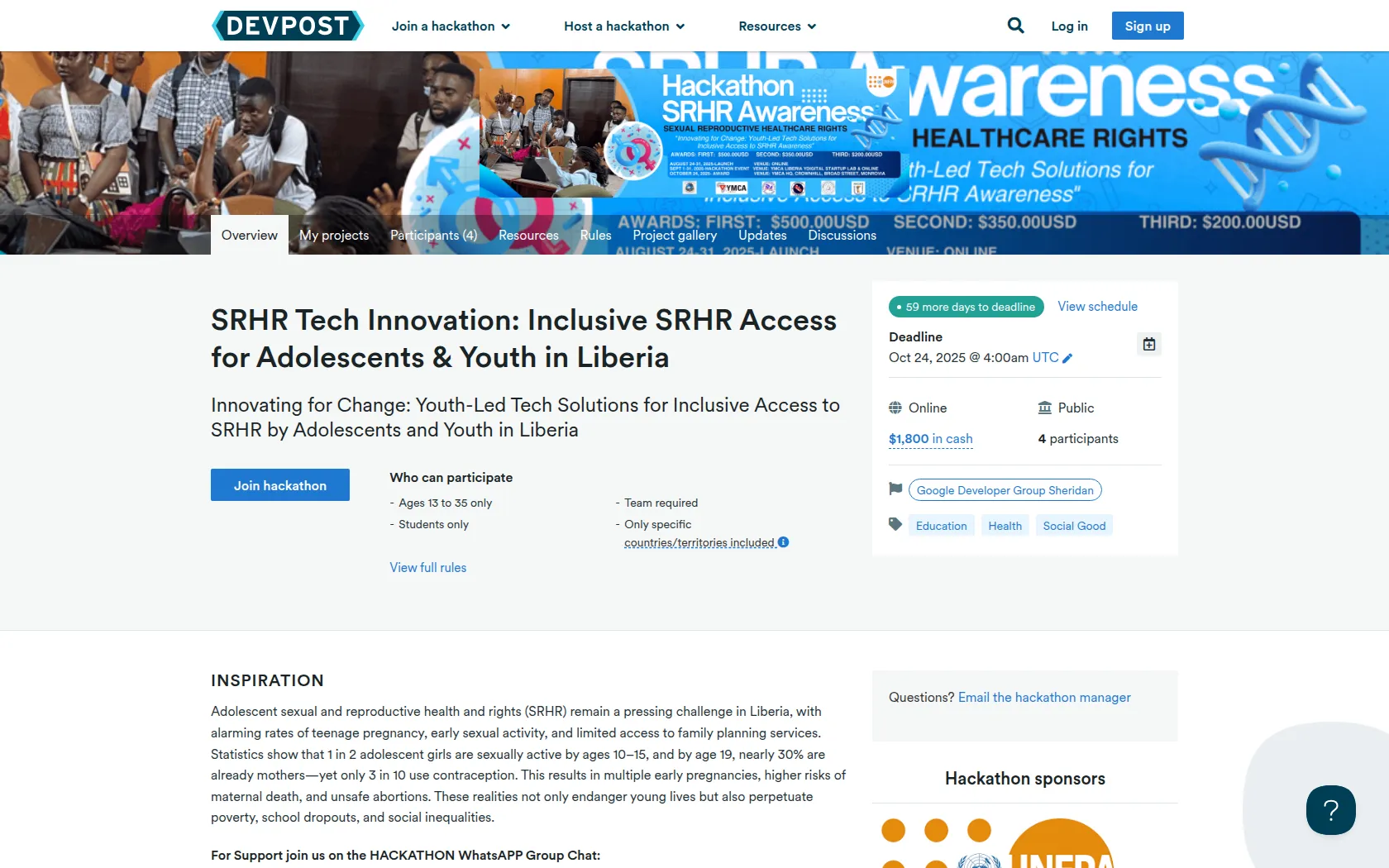

Inspiration
Adolescent sexual and reproductive health and rights (SRHR) remain a pressing challenge in Liberia, with alarming rates of teenage pregnancy, early sexual activity, and limited access to family planning services. Statistics show that 1 in 2 adolescent girls are sexually active by ages 10–15, and by age 19, nearly 30% are already mothers—yet only 3 in 10 use contraception. This results in multiple early pregnancies, higher risks of maternal death, and unsafe abortions. These realities not only endanger young lives but also perpetuate poverty, school dropouts, and social inequalities.
For Support join us on the HACKATHON WhatsAPP Group Chat:
SRHR Hackathon Live Chat Support
To address these barriers, the innovation challenge “Innovating for Change: Youth-Led Tech Solutions for Inclusive Access to SRHR” seeks to empower young Liberian innovators to design technology-driven solutions that improve access, awareness, and behavioral change in SRHR. The initiative will bridge the gap between supply points such as clinics and pharmacies and the adolescents who need them most, while fostering scalable, sustainable, and impactful approaches to reduce teenage pregnancy and improve family planning outcomes.
The Solution and Application Features:- (Guiding The Hackathon Expectation)
A. Relevance to Youth Needs
Solutions address pressing SRHR issues like access to contraception, sexual health education, or stigma reduction.
-
SRHR Chatbot: A multilingual chatbot providing accurate, age-appropriate information on contraception, STIs, and consent, tailored to local cultural contexts.
-
Peer-to-Peer Education Platform: A digital platform connecting trained youth ambassadors with peers to discuss SRHR topics, reducing stigma through relatable storytelling.
-
Menstrual Health Tracker: An app offering menstrual cycle tracking, education on reproductive health, and links to affordable menstrual products for low-income youth.
-
Safe Space Locator: A mobile tool mapping nearby SRHR clinics and safe spaces for youth facing gender-based violence or seeking counseling.
-
Consent Education Game: An interactive mobile game teaching adolescents about consent, healthy relationships, and boundaries through engaging scenarios.
B. User-Centered Design
Solutions are accessible, user-friendly, and tailored to youth (ages 10-24), considering cultural sensitivities, digital literacy, and privacy.
-
Offline SRHR App: A low-data app with downloadable SRHR content, designed for youth in low-connectivity areas, with simple navigation and privacy features.
-
Voice-Activated SRHR Assistant: A voice-based tool in simple English (Liberian English) for low-literacy youth, ensuring discreet access to SRHR information.
-
Gamified SRHR Quiz: A quiz-based app with culturally relevant content, rewarding users with points for learning about SRHR topics, designed for engagement.
-
Anonymous Tele-Health Platform: A tele-health service with encrypted chat for youth to consult SRHR experts privately, respecting cultural sensitivities.
-
Customizable SRHR Dashboard: An app allowing users to personalize content (e.g., language, topics) to suit their comfort level and cultural background.
C. Innovative Use of Technology
Solutions leverage technology creatively, such as mobile apps, AI, or geo-fencing, to improve access to SRHR services.
-
AI-Powered SRHR Counselor: An AI chatbot using natural language processing to provide personalized SRHR advice and mental health support.
-
Geo-Fenced Clinic Finder: A mobile app using geo-fencing to notify users of nearby SRHR clinics offering free or subsidized services.
-
Augmented Reality (AR) Education Tool: An AR app visualizing reproductive anatomy and contraception methods for interactive learning.
-
Blockchain-Based Health Records: A secure platform for youth to store and share SRHR medical records anonymously with providers.
-
SMS-Based SRHR Alerts: A text-message service delivering reminders for contraception refills or STI testing, ideal for low-tech environments.
D. Feasibility and Scalability
Solutions are practical, implementable, and adaptable for broader impact, with cost-effective models.
-
Low-Cost SRHR Kiosk: A community-based kiosk with tablets providing SRHR education and tele-health access, deployable in rural areas.
-
Crowdsourced SRHR Content Platform: A platform where youth contribute localized SRHR content, scalable across regions with minimal cost.
-
Partnership-Driven Telemedicine Network: A telemedicine service partnering with local NGOs to provide free SRHR consultations, scalable to multiple countries.
-
Modular SRHR Curriculum App: A digital curriculum adaptable to different school systems, offering SRHR education at low cost.
-
Franchise Model for Youth Clinics: A scalable model for youth-friendly SRHR clinics, using standardized protocols to replicate in underserved areas.
E. Ethical and Inclusive Approach
Solutions align with ethical principles, respect youth rights, and include marginalized communities.
-
LGBTQ+ Inclusive SRHR App: An app offering tailored SRHR resources for LGBTQ+ youth, ensuring inclusive language and safe access.
-
Disability-Friendly SRHR Portal: A web platform with screen-reader compatibility and sign-language videos for youth with disabilities.
-
Culturally Sensitive SRHR Toolkit: A toolkit with customizable SRHR materials for ethnic minorities, respecting local traditions and languages.
-
Trauma-Informed Counseling App: A tele-counseling app trained in trauma-informed care, ensuring ethical support for survivors of violence.
Gender-Neutral SRHR Education: A digital campaign promoting SRHR education that avoids gender stereotypes, inclusive of all identities.
Requirements
#Target Audience The hackathon will target: Adolescents and Youth (10-35 years old): Students, recent graduates, Students in high school (school with computer lab) and young professionals with backgrounds in technology, computer science, engineering, design, public health, and entrepreneurship.
Share the link with your network so they can register for SRHR Tech Innovation: Inclusive SRHR Access for Adolescents & Youth in Liberia implemented by YMCA, Liberia and funded by UNFPA, Liberia.
A. Take a moment to double-check and make sure everything looks right to you:
Step 1:
https://srhrtechhackathonliberia.devpost.com/
Step 2:
Click the Blue Tab (Join hackathon)
B. Just in case you goto the Hackathon website at https://devpost.com/
Step 1: Goto https://devpost.com/
Step 2: Goto Search box , enter any of the below in the search box and enter
SRHR
SRHR Liberia
SRHR Liberia Awareness
C. After you search the Hackathon either by SRHR, SRHR Liberia or SRHR Liberia Awareness
Step 1: Click on the Join Hackathon
Step 2: Complete the Registration using the Google Email Account
Note: Create a team or do solo participants
Step 3. Add a project, update the Project details and click submit the project
For Support join us on the HACKATHON WhatsAPP Group Chat:
SRHR Hackathon Live Chat Support
We've created some resources to help you manage the next stages of your hackathon:
· 📩 Tips to marketing and promoting your hackathon
· 👏 Community and forming teams during online hackathons
· 📣 Communicating with hackathon participants
· 📊 Accessing your metrics and reports
Digital Innovators & Developers: Individuals with coding skills (web, mobile, AI, etc.), data science expertise, and experience in building digital products.
Entrepreneurs: Aspiring or early-stage entrepreneurs interested in developing social impact ventures.
Health Professionals & Advocates: Individuals with knowledge of SRHR issues who can provide critical insights and guidance. Design Thinkers: Individuals focused on user experience (UX) and user interface (UI) design to ensure solutions are intuitive and engaging.


Prizes
First Price
Price plus Post-Hackathon Incubation Support: Potentially offering incubation or acceleration programs for winning teams, leveraging their network and resources.
Award prizes to winners (first, second, and third place) to support further
development of their solutions.
First winner Award prize to support further development of their solutions
@ $500.00
Second Price
Price plus Post-Hackathon Incubation Support: Potentially offering incubation or acceleration programs for winning teams, leveraging their network and resources.
Award prizes to winners (first, second, and third place) to support further
development of their solutions.
First winner Award prize to support further development of their solutions
@ $300.00USD
Third Price
Price plus Post-Hackathon Incubation Support: Potentially offering incubation or acceleration programs for winning teams, leveraging their network and resources.
Award prizes to winners (first, second, and third place) to support further
development of their solutions.
First winner Award prize to support further development of their solutions
@ $200.00
Devpost Achievements
Submitting to this hackathon could earn you:
Judges

Caesar R. Morris
Tech Panelist
Judging Criteria
-
Coding
Judge can support with Coding Demo -
Mentor
Judge can support Mentorship