


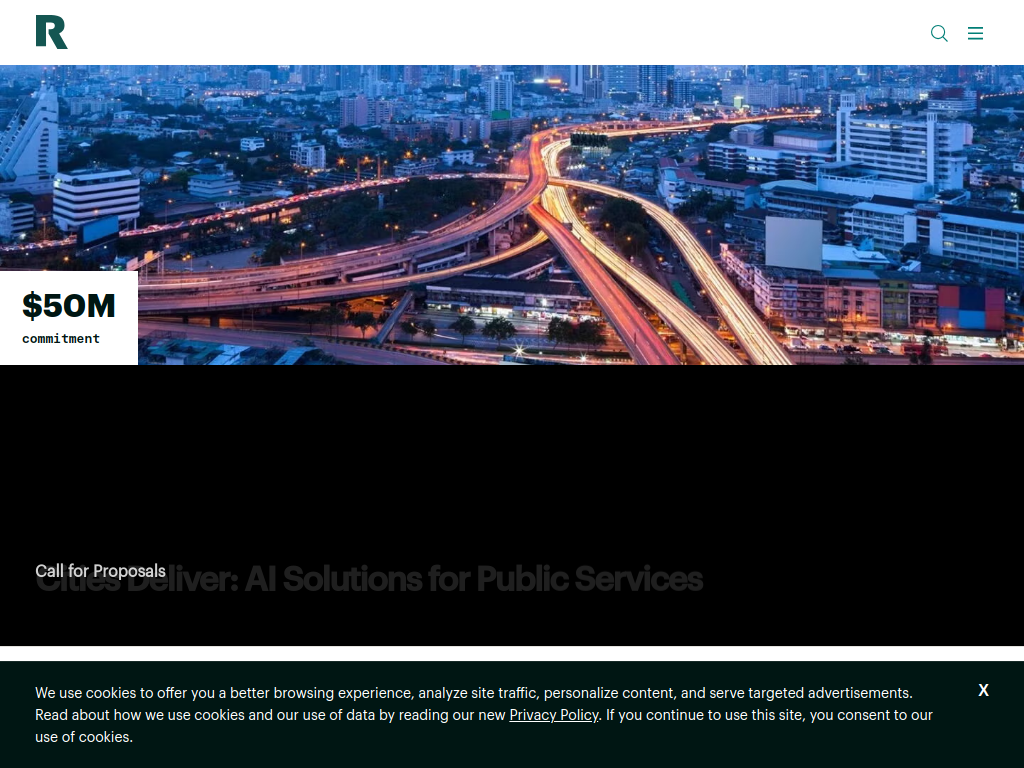

The Rockefeller Foundation and OpenAI Foundation are offering $500,000–$2 million in grant funding through their new Cities Deliver: AI Solutions for Public Services initiative.
With $50 million in total funding, the programme supports organisations working alongside city governments to develop and expand AI-powered solutions that improve public services, particularly for underserved communities.
The initiative aims to help projects collectively reach up to 100 million city residents worldwide.
Here's what you can expect:
$500,000–$2 million in grant funding per project
Funding for projects lasting 24 months
Support for developing, testing and scaling AI solutions
Opportunities to collaborate with city governments
Mentoring, peer learning and evaluation support
Access to networks of city leaders, funders and technical partners
Potential AI product and engineering support, subject to availability
Opportunities to showcase projects at international events
What funding is available?
1. 🌱 Seed Funding – $500,000 to Under $1 Million
For early-stage AI solutions ready to be tested in a city environment.
Funding can support:
Developing and refining innovative ideas
Building AI-powered prototypes
Testing solutions with city government partners
Running pilot projects
Gathering evidence of effectiveness
Preparing successful solutions for future expansion
2. 🚀 Scale Funding – $1 Million to $2 Million
For AI solutions that have already been piloted and demonstrated early results.
Funding can support:
Expanding existing AI solutions
Reaching additional residents
Scaling projects across city departments
Introducing successful solutions in other cities
Strengthening long-term financial sustainability
What projects can be funded?
The programme focuses on four priority areas.
1. 🏥 Public Health
AI solutions improving access to healthcare and public health services.
Examples include:
Disease surveillance and outbreak prediction
Improving access to frontline healthcare
Disability support services
Public health prevention programmes
Food access and nutrition initiatives
2. 💼 Economic Mobility
Projects helping residents access employment, training and financial opportunities.
Examples include:
AI-powered career guidance
Employment and skills matching
Improving access to public benefits
Supporting unemployed and underemployed residents
Connecting people with relevant training opportunities
3. 🌱 Environmental Resilience
AI technologies helping cities prepare for and respond to environmental challenges.
Examples include:
Flood prediction and early-warning systems
Emergency response technologies
Climate risk monitoring
Energy infrastructure management
Environmental disaster preparedness
Land management and resilience planning
4. 🏙️ Civic Engagement
Projects improving communication and interaction between residents and local government.
Examples include:
AI-powered public service assistants
Digital access to government services
Multilingual resident support
Public feedback and communication systems
Improving permitting and regulatory processes
Increasing participation in local decision-making
Important: Projects relating to voting or elections are excluded.
Who can apply?
Eligible lead applicants include:
Registered nonprofit organisations
Charities and civil society organisations
University laboratories and research organisations
Fiscally sponsored organisations
Public benefit corporations
Certain for-profit organisations delivering qualifying charitable projects
Important eligibility requirements:
Every application must:
Be submitted by an eligible lead organisation.
Include a committed city government partner.
Deliver a clear charitable or public-benefit purpose.
Focus on improving services for underserved or vulnerable communities.
Demonstrate how advanced AI technology is central to the proposed solution.
Show that the project addresses a genuine public service challenge.
Demonstrate the ability to deploy technology responsibly.
Include plans for privacy, safety, evaluation and long-term sustainability.
City governments cannot apply directly. They must collaborate with an eligible lead organisation.
Applicants are not required to use OpenAI technology. They may select the AI models and tools most appropriate for their project.
How is funding distributed?
Grants are awarded over 24 months.
50% of the approved funding is provided at the beginning of the project.
The remaining 50% is released after a documented mid-project milestone.
Applicants should demonstrate that their project can achieve its objectives within the grant period.
How does the application process work?
Stage 1 – Initial Application
Applicants complete an eligibility screening and submit their first-round proposal, including a short video.
Stage 2 – Interviews
Shortlisted applicants are invited to participate in interviews.
Stage 3 – Full Proposal
Successful applicants from the interview stage are invited to submit a detailed second-round proposal.
Stage 4 – Final Selection
Selected organisations receive funding and programme support to deliver their projects.
Key dates
Funding: $500,000–$2 million per project
Total Programme Funding: $50 million
Project Duration: 24 months
Geographic Eligibility: International
Applications Opened: 14 October 2026
Initial Application Deadline: 🚨 29 November 2026 at 11:59 pm US Eastern Time
Recommended Comments
Join the conversation
You can post now and register later. If you have an account, sign in now to post with your account.
Note: Your post will require moderator approval before it will be visible.