


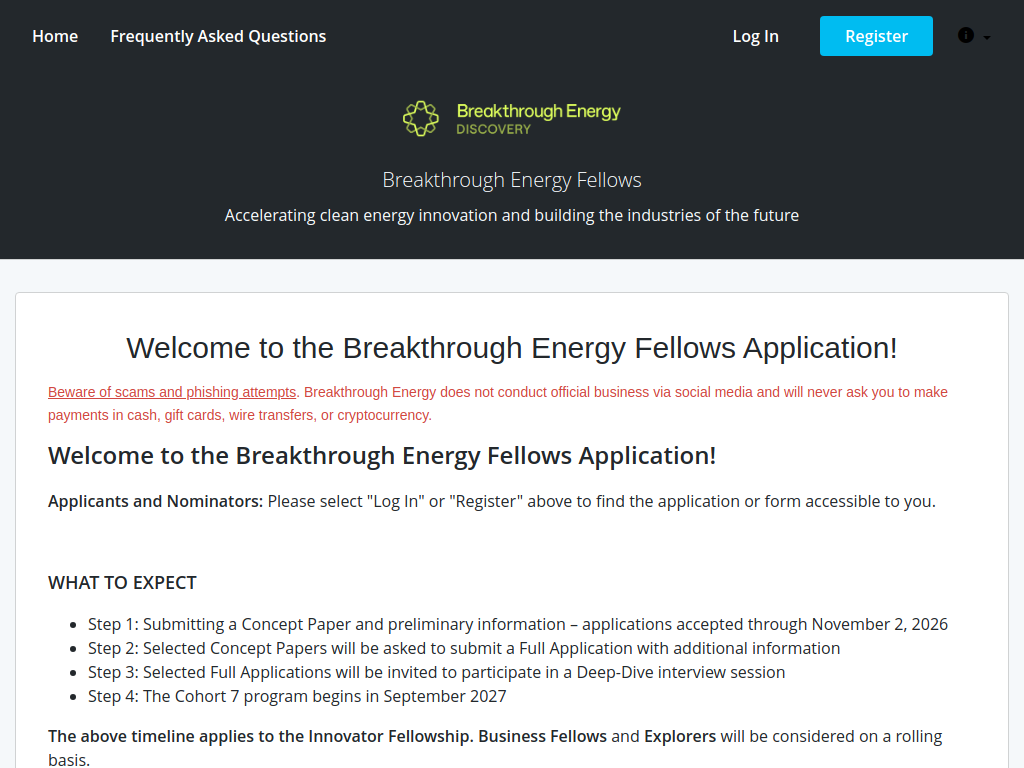

The Breakthrough Energy Fellows Programme is offering up to $500,000 in early-stage investment to support scientists, engineers and entrepreneurs developing breakthrough technologies to tackle climate change.
Delivered through Breakthrough Energy Discovery, the programme helps promising early-stage technologies progress from scientific development towards commercialisation.
The 2027 programme welcomes applications from innovators worldwide, including the United Kingdom.
Alongside financial support, successful applicants receive expert mentorship, technical guidance, business development assistance and access to an international network of investors and industry partners.
Applications are open for Cohort 7 and close on 2 November 2026.
Here's what you can expect:
Up to $500,000 in early-stage investment for Innovator Fellows
Approximately $50,000–$250,000 in research funding for Explorers
A 12-month Innovator Fellowship
Technical development and commercialisation support
Expert mentoring and business guidance
Access to investors and industry partners
Support with research and development expenses
Opportunities to develop and validate new climate technologies
Access to specialist expertise and professional networks
International participation, including UK applicants
What technologies are supported?
The programme focuses on breakthrough technologies capable of delivering significant climate benefits.
1. Clean Energy and Electricity
Innovations that could transform energy generation, storage and distribution.
Examples include:
Advanced energy storage
Next-generation electricity technologies
Innovative grid technologies
Breakthrough energy generation systems
2. Sustainable Manufacturing
Technologies addressing emissions from industrial production.
Examples include:
Low-carbon industrial processes
Cleaner manufacturing technologies
Alternative production methods
Innovations reducing emissions from hard-to-decarbonise industries
3. Transportation and Mobility
Technologies with the potential to significantly reduce transport-related emissions.
Examples include:
Advanced transportation technologies
Low-carbon fuels
Innovative propulsion systems
New approaches to transport decarbonisation
4. Food and Agriculture
Innovations reducing emissions from food production and agriculture.
Examples include:
Low-emission agricultural technologies
Alternative production processes
Innovative food technologies
Breakthrough approaches to agricultural emissions
5. Buildings and Construction
Technologies reducing emissions associated with buildings and construction.
Examples include:
Low-carbon building materials
Innovative heating and cooling technologies
Advanced building systems
Technologies improving the environmental performance of buildings
The programme also considers high-impact innovations outside these categories where they meet its climate impact requirements.
What funding routes are available?
1. Innovator Fellowship – Up to $500,000
The Innovator Fellowship supports scientists, engineers and entrepreneurs developing early-stage climate technologies with commercial potential.
Successful applicants receive:
Up to $500,000 in catalytic investment
Support with research and development costs
Business and commercialisation mentoring
Technical project management
Access to investors and industry experts
Professional development and networking
Important: Innovator funding is typically provided through a SAFE or similar investment agreement. It is not a non-repayable grant.
The programme also provides substantial in-kind support, including mentoring, specialist services and industry access.
2. Explorer Programme – Approximately $50,000–$250,000
The Explorer Programme supports earlier-stage, higher-risk climate technology research.
It is particularly relevant to:
University researchers
Scientists
Research institutions
Laboratory-based innovators
Teams developing proof-of-concept technologies
Funding can support:
Laboratory expenses
Equipment
Research materials
Technical consultants
Staff and personnel costs
Other eligible research and development expenses
Explorers can generally remain employed by their existing institution.
Who can apply?
The programme welcomes international applicants, including:
Scientists
Engineers
Climate technology entrepreneurs
Early-stage startup founders
University researchers
Research teams
Innovators developing breakthrough climate technologies
Key eligibility requirements
Innovator Fellowship applicants should typically:
Be developing a novel climate technology.
Have a technology readiness level of approximately 1–4.
Demonstrate significant potential to reduce or capture greenhouse gas emissions.
Typically have raised less than $2 million in dilutive investment.
Be prepared to work full-time on commercialising their technology.
Have a legally incorporated company before the programme begins in September 2027.
Demonstrate credible technical progress and supporting evidence.
Applicants do not need to have incorporated a company before applying.
Explorer applicants should typically:
Be developing a high-risk, early-stage climate technology.
Have a technology readiness level of approximately 0–2.
Be undertaking applied research with commercial potential.
Demonstrate the potential for substantial climate impact.
Be able to deliver agreed technical milestones.
What climate impact is required?
Breakthrough Energy focuses on technologies with the potential to reduce or capture greenhouse gas emissions by at least 500 million tonnes annually at scale.
The programme also welcomes technologies that meaningfully address adaptation to climate change.
Applicants must demonstrate why their technology represents a significant advance rather than an incremental improvement.
What costs can be supported?
Depending on the funding route, financial support may cover:
Laboratory space
Office space
Equipment
Research supplies
Technical consultants
Staff costs
Technology development
Testing and validation
Other agreed research and development expenses
Funding arrangements differ between Innovator and Explorer applicants.
How does the application process work?
Stage 1 – Concept Paper
Applicants submit a technology proposal and pitch deck through the online application portal.
The proposal should explain:
The technology being developed
The problem it addresses
Its potential climate impact
Technical innovation and feasibility
Current development progress
Planned research and development activities
Stage 2 – Full Application
Selected Innovator applicants are invited to submit additional information about:
Their technology
Commercialisation strategy
Business model
Potential climate impact
Development plans
Stage 3 – Deep-Dive Interview
Shortlisted Innovator applicants participate in an interview with the programme team.
Stage 4 – Selection
Successful applicants are selected for the 2027 programme.
Explorer applications follow a related process, with later stages arranged by invitation and on a rolling basis.
Key dates
Applications Opened: 22 September 2026
Innovator Concept Paper Deadline: 2 November 2026
Closing Time: 11:59pm Eastern Time
Full Application Invitations: Late 2026 to early 2027
Interviews: Early to mid-2027
Innovator Selection: Mid-2027
Programme Begins: September 2027
Explorer Applications: Considered on a rolling basis
Funding information
Innovator Investment: Up to $500,000
Explorer Research Funding: Approximately $50,000–$250,000
Funding Type: Early-stage investment, research funding and fellowship support
Location: Worldwide, including the United Kingdom
Programme Duration: Approximately 12 months
Target Audience: Climate technology innovators, scientists, engineers and researchers
Innovator Deadline: 2 November 2026
Recommended Comments
Join the conversation
You can post now and register later. If you have an account, sign in now to post with your account.
Note: Your post will require moderator approval before it will be visible.