


The #1 free startup community and business forum for founders who want real answers, not corporate fluff.


Startup Networks
Robots
-
Joined
-
Last visited
-
 IFundWomen (IFW by Honeycomb) is offering a $5,000 unrestricted grant to help an early-stage entrepreneur launch, develop or grow their business. The IFW Startup Accelerator Grant supports entrepreneurs with promising business ideas, including founders who are still in the planning stages, pre-revenue startups and established businesses looking to reach their next milestone. The funding is non-repayable, requires no equity and can be used towards business development, marketing, equipment or other growth-related expenses. Applications are open until 30 November 2026. Here's what you can expect:$5,000 in unrestricted business funding One entrepreneur will receive the grant No repayment or equity requirements Open to idea-stage, pre-revenue and established businesses Funding for product development, marketing and business growth Applications welcomed from different industries A short online application process Winner expected to be selected in December 2026 What can the funding support?The grant can help entrepreneurs achieve an important business milestone, including: Business Launch and Development Supporting the costs of launching a new business, developing products or bringing services to market. Marketing and Customer Acquisition Investing in marketing campaigns, branding, promotional materials and activities that help businesses attract customers. Equipment and Technology Purchasing essential equipment, software or technology needed to operate or expand a business. Business Growth Supporting operational improvements, expansion plans or new opportunities that strengthen the business. Applicants should clearly explain how the $5,000 would help them achieve their next business goal. Who can apply?Applicants must: Be legal residents of the United States, aged 18 or over. Own at least 50% of the business named in their application. Operate a business based in the United States. Have a business idea, pre-revenue startup or existing business. Submit a complete application before the deadline. Pay the $5 application fee or obtain an approved waiver. Important: This programme is restricted to US-based entrepreneurs and businesses. UK-only businesses are not eligible. How are applications assessed?Applications are evaluated based on: Business Vision: The founder's story, motivation and long-term goals. Use of Funding: How the grant would support a meaningful business milestone. Potential for Success: The business's potential to grow, succeed and create a positive impact. How much funding is available?Grant Amount: $5,000 USD Number of Awards: One Funding Type: Unrestricted, non-repayable grant Equity Requirement: None Application Fee: $5, with fee waivers available on request Geographic Eligibility: United States only How to applyReview the eligibility requirements and official programme rules. Prepare a description of your business and its goals. Explain how you would use the $5,000 grant. Complete the online application form. Pay the $5 application fee or arrange a waiver before applying. Submit your application before the deadline. Key datesApplications Opened: 15 October 2026 Application Deadline: 30 November 2026 at 11:59pm Eastern Time Expected Winner Announcement: Around 15 December 2026
-
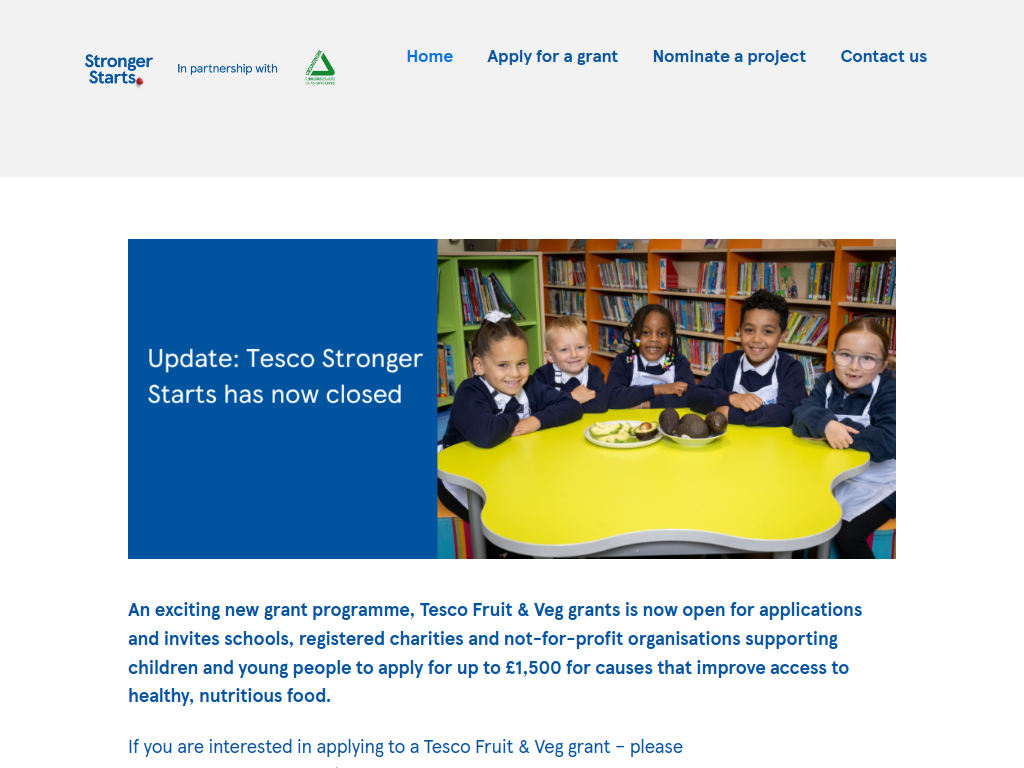 Tesco, working with community charity Groundwork UK, is offering grants of up to £1,500 to schools, registered charities and not-for-profit organisations helping children and young people access healthy, nutritious food. The Tesco Fruit & Veg Grants Programme, which replaces Tesco Stronger Starts, supports local projects providing fruit, vegetables, healthy meals and opportunities for children to learn about nutrition. From breakfast clubs and school food initiatives to community gardening, cooking workshops and holiday food programmes, the funding aims to help children develop healthier eating habits while reducing barriers to nutritious food. Applications are currently open on a rolling basis. Here's what you can expect:Grants of up to £1,500 per project Funding available across the United Kingdom Support for schools, charities and community organisations Funding for breakfast and after-school clubs Support for healthy snacks and nutritious meals Funding for cooking and gardening initiatives Support for holiday food programmes Grants covering up to 100% of eligible project costs Community voting through participating Tesco stores No fixed national application deadline What projects can be funded?1. School Breakfast and After-School Clubs Projects providing fruit, vegetables and nutritious food to children during school activities. 2. Holiday Food Programmes Initiatives helping children access healthy meals and snacks during school holidays, particularly where families experience food insecurity. 3. Community Gardening and Food Growing Projects teaching children how to grow fruit and vegetables through school gardens, allotments and community growing activities. 4. Cooking and Nutrition Education Workshops helping children and families learn how to prepare affordable, nutritious meals. 5. Youth and Sports Clubs Community clubs and sports teams providing fruit, vegetables and healthy snacks alongside their activities. 6. SEND and Inclusive Activities Projects supporting children and young people with special educational needs and disabilities through healthy food provision and inclusive food-related activities. 7. Community Food Support Food banks and community organisations providing nutritious food to families with children. Who can apply?The programme welcomes applications from eligible UK organisations supporting children and young people. These may include: Schools and nurseries Parent-teacher associations Registered charities Voluntary and community organisations Youth clubs Sports clubs and teams Scouts, Guides and other uniformed youth groups Eligible community interest companies Other not-for-profit organisations The programme is available across England, Scotland, Wales and Northern Ireland. Key eligibility requirementsProjects should: Benefit children or young people. Improve access to healthy food, particularly fruit and vegetables. Deliver a clear benefit to the local community. Demonstrate how the funding will be spent. Be delivered by an eligible organisation. Meet the programme's funding and application requirements. Priority is given to projects incorporating healthy food provision. Who cannot apply?The programme does not accept applications from: Individuals Profit-making businesses Community interest companies limited by shares Community interest companies limited by guarantee that have operated for less than two years Other restrictions may apply under the official grant guidance. What cannot be funded?The programme excludes: Activities that have already taken place General organisational running costs and overheads Political donations Fundraising events or challenges Conferences and seminars Overseas appeals and travel Religious or political promotion Marketing activities Research projects Activities that statutory bodies are legally required to provide How much funding is available?Shortlisted projects participate in Tesco's customer voting programme. Three local projects are selected for each voting round, with the final funding amount determined by customer votes. First Place: Up to £1,500 Second Place: Up to £1,000 Third Place: Up to £500 All three shortlisted projects receive funding. Maximum Grant: £1,500 Funding Type: Community project grant Match Funding: Not required Geographic Eligibility: United Kingdom Application Deadline: Rolling How does the application process work?Step 1 – Review the Guidance Read Tesco's grant guidance and check that the proposed project supports children's access to healthy food. Step 2 – Find a Local Tesco Store Use Tesco's store locator to identify the relevant store for the project. Step 3 – Prepare the Application Explain: What the project will deliver Which children and young people will benefit How the funding will improve access to nutritious food What the grant will pay for How the project will benefit the local community Step 4 – Submit the Application Complete the online application through the official Tesco Fruit & Veg Grants programme. Step 5 – Shortlisting Applications are assessed, and Tesco colleagues help select projects for local customer voting. Step 6 – Customer Voting Three shortlisted projects are featured in participating Tesco stores. Customers use blue tokens to vote for their preferred local cause. Step 7 – Funding Award Each shortlisted project receives a grant based on its voting position. Funding informationFunder: Tesco Delivery Partner: Groundwork UK Programme: Tesco Fruit & Veg Grants Funding Amount: Up to £1,500 Grant Awards: £500, £1,000 or £1,500 Funding Type: Community grant Geographic Eligibility: United Kingdom Eligible Applicants: Schools, charities and eligible not-for-profit organisations Priority Area: Children's healthy eating and access to fruit and vegetables Application Deadline: Rolling
-
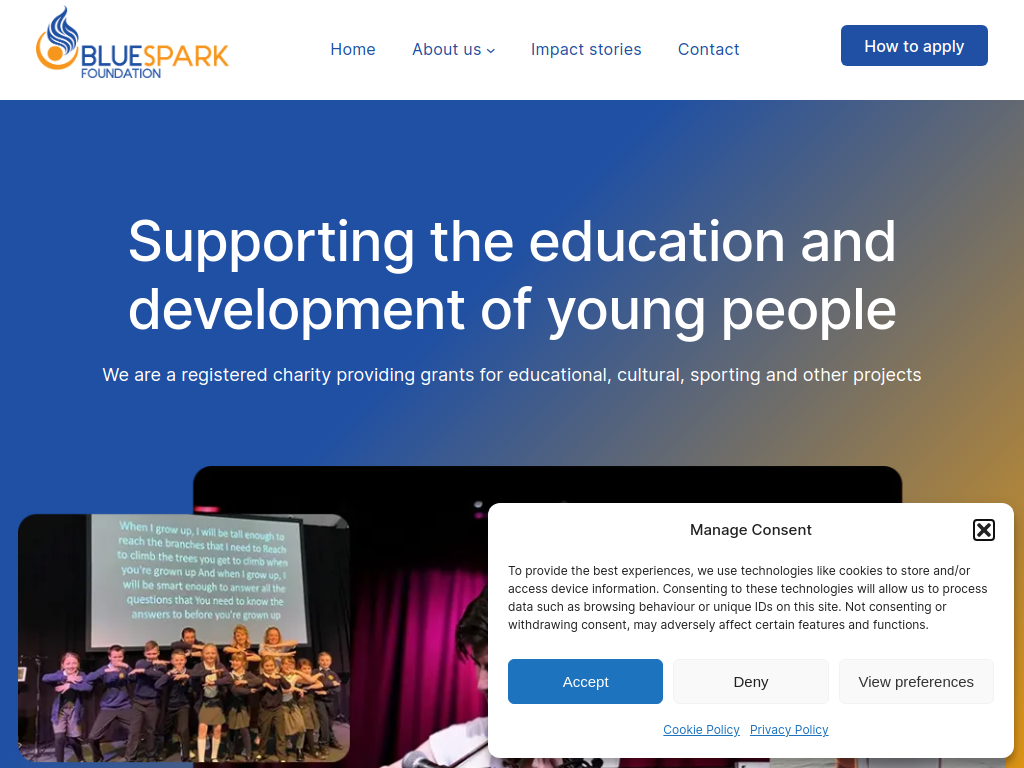 The BlueSpark Foundation is offering grants of up to £5,000 to support projects that improve the education, confidence, skills and personal development of children and young people aged 5–22 in England. The Foundation funds educational, cultural, sporting and creative activities that help young people develop independence, teamwork, self-confidence and future employability. Funding is available to schools, community groups, clubs, societies, other not-for-profit organisations and individuals. Applications are currently being accepted, with the next review scheduled for February 2027. Here's what you can expect:Grants of up to £5,000 per project Most awards are below £2,000 Funding for educational and creative activities Support for music, drama, dance and sporting projects Funding for educational trips and outdoor experiences Support for equipment, tuition and participation costs Applications from organisations and individuals No requirement for applicants to provide match funding Online applications accepted throughout the year What projects can be funded?1. Music, Drama and Performing Arts Projects encouraging creativity, confidence and self-expression, including: Music and singing workshops Musical instruments Drama productions Theatre activities Dance tuition Performance opportunities 2. Sport and Outdoor Activities Activities developing physical skills, resilience and teamwork, including: Sports equipment Sporting competitions Outdoor adventure programmes Camping and climbing Kayaking and sailing Team-building experiences 3. Education and Academic Development Projects improving learning opportunities and educational achievement, including: STEM clubs Academic competitions Debating and public speaking Educational materials Enrichment activities Enterprise projects 4. Educational Visits and Excursions Funding for experiences outside the classroom, such as: Museum visits Theatre trips Nature reserves Educational farms Cultural visits Residential educational experiences 5. Skills and Personal Development Projects helping young people develop: Independence Self-confidence Teamworking skills Creativity Communication skills Future employability Educational aspirations Who can apply?The programme accepts applications from individuals and organisations resident in England. Eligible applicants may include: Schools and colleges Community groups Youth clubs Sports clubs Music and drama groups Societies Other not-for-profit organisations Individuals Applicants do not necessarily need to be registered charities. Projects must benefit children or young people aged 5–22. There is no minimum number of beneficiaries. The Foundation may support projects benefiting a group or a single young person where the potential impact is significant. Key eligibility requirementsApplicants must demonstrate that: The project supports the education or development of young people. The funding will make a significant difference to whether the project can proceed. The project has clearly defined activities and objectives. The requested amount is supported by appropriate costings. The grant will fund a specific project rather than general organisational expenditure. The proposed activity meets the Foundation's grant policy. The Foundation gives particular consideration to projects that improve confidence, teamwork and future employability. What cannot be funded?The Foundation does not provide grants for: Projects benefiting children under 5 or young people over 22 General organisational running costs Life-skills mentoring services Counselling services Holiday clubs or playgroups Building construction, maintenance or repairs Training adults who work with children and young people Student tuition fees or maintenance costs The Foundation also does not normally fund organisations providing their own commercial services to third parties free of charge or at a discount. In those circumstances, the intended beneficiary organisation should normally apply directly. How much funding is available?Maximum Grant: £5,000 Typical Award: Below £2,000 Funding Type: Project grant Match Funding: Not compulsory Geographic Eligibility: England Beneficiary Age Range: 5–22 Funding must represent a significant contribution towards the proposed project. Applicants should request only the amount genuinely required, as the Foundation normally awards the amount requested rather than offering a reduced grant. For applications above £2,000, an applicant's ability to contribute some project funding may be viewed favourably, although it is not mandatory. How does the application process work?Step 1 – Review the Grant Policy Check that the proposed activity and intended beneficiaries meet the Foundation's criteria. Step 2 – Prepare the Project Proposal Identify: What the project will deliver Who will benefit How the activity will support young people's development Why the funding is necessary What the requested grant will pay for Step 3 – Prepare Project Costings Provide accurate costs for equipment, services, activities or experiences. Step 4 – Complete the Online Application Applications must be submitted through the BlueSpark Foundation's official online application form. The person leading the project should complete the application. Applicants can save their progress and return to the form later. Step 5 – Trustee Review The Foundation's trustees assess applications against the grant policy and may request a meeting to discuss the project. Step 6 – Funding Decision Successful applicants receive confirmation of their grant award. Key datesApplications: Accepted online Next Application Review: February 2027 Expected Grant Payments: Around 1 April 2027 Application Deadline: No fixed submission deadline published Application Status: OPEN Funding informationFunder: BlueSpark Foundation Funding Amount: Up to £5,000 Typical Grants: Under £2,000 Funding Type: Project grant Geographic Eligibility: England only Eligible Applicants: Schools, community groups, clubs, not-for-profit organisations and individuals Beneficiaries: Children and young people aged 5–22 Eligible Activities: Education, music, drama, sport, outdoor learning and creative development Next Review: February 2027 Expected Payments: April 2027 Deadline: Rolling applications
-
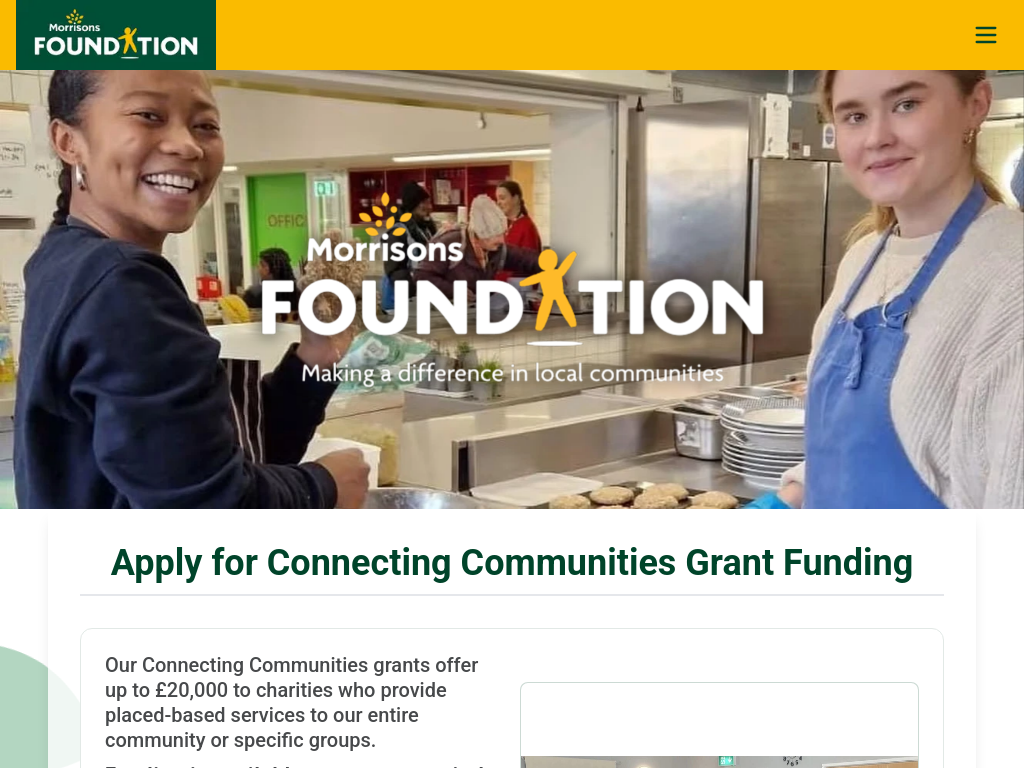 The Morrisons Foundation is offering grants of up to £20,000 through its Connecting Communities Grants Programme, supporting registered charities working to improve essential community spaces and facilities. The programme provides funding for capital projects that help bring people together, reduce social isolation and ensure that important local services remain accessible for years to come. From community centres and village halls to disability support facilities, youth clubs and community gardens, the funding aims to strengthen the spaces that local communities rely on. Applications are currently open, with no fixed deadline. Here's what you can expect:Grants of up to £20,000 per project Potential to fully fund eligible capital projects Funding for building renovations and refurbishment Support for accessibility improvements Funding for essential equipment and facilities Improvements to outdoor community spaces Priority given to smaller charities with annual income below £1 million Rolling applications throughout the year What projects can be funded?1. Community Centres and Shared Spaces Funding to improve facilities that bring local people together, including: Village halls and community centres Community hubs Youth clubs Community gardens Managed recreation facilities 2. Disability and Therapeutic Facilities Support for organisations providing specialist services, including: Disability support centres Neurodivergent day centres Independent living facilities Therapeutic centres Accessible recreation spaces 3. Youth and Education Funding for facilities supporting children and young people, including: School PTA projects Community playgrounds Special educational needs facilities Scout and Guide buildings Outdoor learning spaces 4. Crisis Support Facilities Capital improvements to buildings supporting vulnerable people, including: Women's refuges Domestic abuse shelters Homeless shelters Supported accommodation Rehabilitation and recovery centres 5. Health and Wellbeing Support for facilities such as: Hospices Bereavement support centres Respite care facilities Hospital charity facilities Community wellbeing centres 6. Social Isolation and Community Inclusion Funding for spaces that reduce loneliness and strengthen community connections, including: Warm hubs Elderly support centres Men's sheds Veteran support facilities Community safe spaces What costs are eligible?The Foundation supports capital improvements that provide lasting community benefits. Examples include: Repairing leaking roofs Installing accessible toilets Refurbishing kitchens Installing heating systems or boilers Purchasing fixed sensory room equipment Installing stairlifts Improving building security Constructing community garden facilities Creating accessible outdoor pathways Installing playground equipment Projects must demonstrate a clear, long-term benefit to the people using the facilities. Who can apply?The programme is intended for registered charities delivering place-based services. Applicants must: Be registered with an eligible charity regulator. Own the property where the project will take place or hold a lease with at least three years remaining. Have at least one set of accounts filed with their charity regulator. Have submitted their accounts on time. Demonstrate that the project will provide lasting community benefits. Apply for a clearly defined capital project. The Foundation prioritises charities with an annual income below £1 million. The published grant policy covers projects in England, Scotland and Wales. Organisations registered in Crown Dependencies or Gibraltar should check the Foundation's additional geographic requirements before applying. Who cannot apply?The Foundation does not support: Community interest companies (CICs) Unregistered community organisations Exempt or excepted charities Individuals Charities whose primary purpose is animal welfare Charities promoting religious or political messages Charities with overdue or recently late-filed accounts Charities whose accounts have been qualified within the past three years Additional restrictions apply to previous grant recipients and unsuccessful applicants. What cannot be funded?The programme does not normally support: Salaries and staff costs Rent and utility bills General running costs Fundraising events Marketing and advertising Sponsorship Individual bursaries or financial assistance Overseas travel Short-term activities Contributions towards larger fundraising targets Projects that are primarily the responsibility of statutory bodies Important: The programme is designed to fully fund eligible capital projects rather than provide partial contributions towards larger projects. How much funding is available?Maximum Grant: £20,000 Funding Type: Restricted capital grant Funding Contribution: Up to 100% of eligible project costs Priority Applicants: Registered charities with annual income below £1 million Application Deadline: Rolling Application Status: OPEN How does the application process work?Step 1 – Review Eligibility Read the Connecting Communities Grant Policy and FAQs to confirm that the organisation and proposed project meet the funding criteria. Step 2 – Prepare Project Information Gather details of the proposed improvements and supporting evidence of the costs involved. Applicants should obtain quotations, supplier estimates or other suitable proof of price. Step 3 – Start the Application Visit the Morrisons Foundation website and select the online application form. The application system is hosted by Plinth. Step 4 – Submit Supporting Information Provide the charity's registration details, financial information, project description and cost evidence. Step 5 – Application Assessment The Foundation reviews applications and may request additional information. Applicants should allow up to three months for the assessment process. Step 6 – Funding Decision Successful charities receive confirmation of their grant award and instructions for payment. Grant funding must be used for the approved project. Funding informationFunder: Morrisons Foundation Programme: Connecting Communities Grants Funding Amount: Up to £20,000 Funding Type: Capital grant Geographic Eligibility: England, Scotland and Wales, with additional registration jurisdictions referenced in the programme guidance Eligible Applicants: Registered charities Priority: Smaller charities with annual income below £1 million Eligible Activities: Building improvements, accessibility, equipment and community facilities Deadline: No fixed deadline
-
 The Freemasons' Charity, formerly known as the Masonic Charitable Foundation, is offering grants of up to £60,000 to registered charities supporting disadvantaged children and young people. The programme provides financial support to organisations working in three priority areas: early years, domestic abuse, and special educational needs and disabilities (SEND). Two funding options are available, including unrestricted grants for smaller charities and project-specific funding for larger organisations. Applications are currently open, with no fixed deadline. Here's what you can expect:Small grants of £1,000–£5,000 per year, for up to three years Large grants of £10,000–£60,000 in total, usually over one to three years Unrestricted funding for eligible smaller charities Project funding for larger registered charities Support for children experiencing poverty, disadvantage or domestic abuse Funding for children and young people with SEND Eligible project costs including salaries, equipment, training and administration Rolling applications throughout the year What projects can be funded?1. Early Years (Ages 0–5) Support for charities improving outcomes for young children, particularly those experiencing disadvantage, poverty or neglect. 2. Children Affected by Domestic Abuse Funding for organisations supporting children and young people aged 0–18 who have experienced or been affected by domestic abuse. Projects may also provide support to families and carers where the ultimate beneficiaries are children. 3. Special Educational Needs and Disabilities (SEND) Support for charities working with children and young people with SEND, up to the age of 25. Projects should demonstrate how their activities improve opportunities, wellbeing or outcomes for the intended beneficiaries. Who can apply?Eligible applicants must: Be a registered charity with the Charity Commission for England and Wales or the relevant registry in Guernsey, Jersey or the Isle of Man. Support beneficiaries in England, Wales, Guernsey, Jersey or the Isle of Man. Have at least one year of independently examined or audited published accounts. Have an annual income between £25,000 and £5 million. Work within one of the programme's three priority areas. Have their own charity bank account. Meet the funder's previous application and grant requirements. Community interest companies, social enterprises, unregistered community groups, individuals and exempt charities are not eligible. Applicants do not need a connection to Freemasonry. Small Grants – Up to £15,000Small grants are available to charities with an annual income between £25,000 and £500,000. Funding available: £1,000–£5,000 per year Up to three years of funding Maximum potential award of £15,000 Unrestricted funding These grants can support an organisation's general activities and running costs. The total grant requested must not exceed 20% of the charity's average annual income over the previous two years. Large Grants – Up to £60,000Large grants are intended for charities with an annual income between £500,000 and £5 million. Funding available: Usually £10,000–£60,000 in total Funding over one to three years Restricted funding for defined projects Preference for multiyear projects Eligible expenditure may include: Staff salaries Project equipment Training Monitoring and evaluation Project administration A proportionate contribution towards organisational overheads One-year grants are generally considered only in exceptional circumstances. What cannot be funded?The programme does not normally support: Large-scale capital building projects Building repairs and maintenance Academic research Political or lobbying activities Religious promotion Retrospective costs General fundraising appeals Routine statutory obligations Projects outside the three priority areas How does the application process work?Step 1 – Check Eligibility Complete the eligibility questionnaire on the Freemasons' Charity website. Step 2 – Submit an Expression of Interest Eligible organisations can submit a short online expression of interest. The Foundation aims to respond within approximately two weeks. Step 3 – Full Application Successful applicants are invited to complete a full application within four weeks. Large grant applicants may also be invited to a virtual meeting before progressing. Step 4 – Funding Decision The Foundation aims to provide decisions approximately: Three months after the initial expression of interest for Small Grants Five months after the initial expression of interest for Large Grants Funding informationFunder: Freemasons' Charity (Masonic Charitable Foundation) Small Grants: £1,000–£5,000 annually, up to £15,000 over three years Large Grants: £10,000–£60,000 total Funding Type: Unrestricted small grants and restricted project grants Geographic Eligibility: England, Wales, Guernsey, Jersey and Isle of Man Eligible Applicants: Registered charities meeting income and eligibility requirements Priority Areas: Early Years, Domestic Abuse and SEND Deadline: Rolling – No fixed closing date
-
 The European Commission has announced a funding opportunity offering €3 million to €4 million per project through the Horizon Europe programme. The Space Critical Equipment for EU Non-Dependence call supports research and innovation projects developing essential technologies for European space missions. Its primary objective is to reduce Europe's reliance on critical equipment sourced from outside the European Union, strengthen secure supply chains and improve the competitiveness of the European space industry. Approximately two projects are expected to receive funding. Applications are scheduled to open on 7 October 2027. Here's what you can expect:€3 million–€4 million in funding per project Approximately two projects expected to receive awards Research and innovation funding for critical space technologies Support for developing European manufacturing capabilities Funding to reduce reliance on non-European suppliers Support for resilient and secure supply chains Opportunities for collaboration between research institutions and industry Funding for technologies intended to reach Technology Readiness Level 6 What projects can be funded?1. Critical Space Equipment Development Projects developing or improving technologies essential to European space missions. 2. European Supply Chain Independence Research and innovation activities reducing dependence on equipment and technologies subject to non-EU export restrictions. 3. Advanced Space Manufacturing Projects strengthening European manufacturing capabilities and developing competitive alternatives to equipment sourced internationally. 4. Technology Development and Validation Projects advancing critical space technologies towards Technology Readiness Level 6, demonstrating their performance in relevant environments. 5. Cross-Industry Collaboration Initiatives encouraging cooperation between space and non-space industries to accelerate technology development. Projects should complement existing national and European space research activities. Who can apply?Participation is restricted to eligible legal entities established in: European Union Member States Norway Iceland Potential applicants include: Aerospace and space technology companies Research institutions Universities Advanced manufacturing businesses Eligible SMEs Industrial research partnerships Applicants must satisfy the programme's technical, financial, consortium and security requirements. Important: UK-established organisations are not eligible for this particular funding opportunity. The call contains additional restrictions affecting organisations controlled by entities in countries outside the permitted geographic area. Key project requirementsSuccessful proposals should demonstrate how their activities will: Reduce European dependence on critical non-EU space technologies. Strengthen access to essential equipment for European space missions. Develop reliable and secure supply chains. Improve the performance and competitiveness of European technologies. Support long-term European industrial capabilities. Achieve the expected technological maturity. Projects using satellite-based Earth observation, navigation or positioning data must comply with the programme's requirements concerning Copernicus and Galileo/EGNOS. How much funding is available?Expected EU Contribution Per Project: €3 million–€4 million Expected Number of Awards: 2 Funding Type: Horizon Europe Research and Innovation Action Funding Rate: Up to 100% of eligible costs, subject to programme rules Geographic Eligibility: EU Member States, Norway and Iceland How does the application process work?Step 1 – Review Eligibility Confirm that all participating organisations meet the geographic and security requirements. Step 2 – Develop the Project Identify the critical space equipment or technology to be developed and explain how the project will strengthen European independence. Step 3 – Establish a Consortium Where required, develop a research and innovation partnership that meets the Horizon Europe participation rules. Step 4 – Prepare the Proposal Complete the technical and administrative documentation through the European Commission's Funding & Tenders Portal. Step 5 – Submit the Application Applications can be submitted once the call opens. Step 6 – Evaluation Proposals will be assessed against the programme's evaluation criteria, including their technical quality, impact and implementation. Key datesApplication Opening Date: 7 October 2027 Application Deadline: 20 January 2028
-
 The National Lottery Community Fund is offering grants of £2.5 million to £7 million through its Climate Action Fund – Food Systems programme. The fund supports ambitious partnerships working to transform the UK's food system, improve access to healthy and affordable food, and create lasting environmental benefits. It aims to address the underlying causes of food insecurity while supporting sustainable food production, distribution and community-led solutions. Funding is available across England, Scotland, Wales and Northern Ireland. Applications are currently open, with no fixed closing date published. Here's what you can expect:Grants of £2.5 million to £7 million Typical awards of £3 million to £5 million Funding for projects lasting approximately 5–7 years Support for partnerships involving multiple organisations Funding for sustainable food production and distribution Support for projects tackling food poverty and inequality Funding for community engagement and organisational development Support for long-term environmental improvements Up to 10 projects expected to receive funding in the first year What projects can be funded?The programme focuses on three areas. 1. Sustainable Food Production Projects supporting environmentally responsible food production through agroecological approaches. Potential activities include: Community-led food production Sustainable farming practices Regenerative agriculture Improving biodiversity Developing resilient local food systems Reducing the environmental impact of food production 2. Fairer Food Distribution Projects transforming how food reaches communities. Potential activities include: Improving access to affordable food Developing fairer food distribution systems Strengthening local and regional supply chains Reducing barriers to nutritious food Creating more equitable food networks 3. Community Food Access Projects helping communities access healthier and more sustainable food options. Potential activities include: Community-led food initiatives Tackling structural barriers to food access Improving food security Supporting disadvantaged communities Increasing community involvement in food systems Projects must demonstrate a long-term approach to changing how food systems operate, rather than providing only short-term assistance. Who can apply?Applications must be submitted through a partnership involving eligible organisations. These can include: Registered charities Community interest companies (CICs) Charitable incorporated organisations (CIOs) Scottish charitable incorporated organisations (SCIOs) Eligible companies limited by guarantee Community benefit societies Eligible cooperative societies Public bodies and local authorities Schools, colleges and universities, where projects benefit the wider community Partnerships may operate locally, regionally or nationally. Eligible partnerships can work across more than one UK nation. Key eligibility requirementsApplicants must demonstrate that their project will: Involve a formal partnership with complementary expertise. Deliver lasting benefits for the climate, environment and nature. Significantly improve access to healthy and affordable food. Prioritise communities experiencing poverty, disadvantage or discrimination. Meaningfully involve communities in planning and delivery. Establish clear plans to measure and evaluate impact. Share learning and outcomes with other organisations. Address the underlying causes of food insecurity. Partnerships should bring together expertise in areas such as food systems, climate action, community engagement and evaluation. Who cannot apply?The programme does not accept applications from: Individuals Sole traders Organisations based outside the UK Profit-distributing businesses Companies limited by shares Organisations applying independently without a partnership Private businesses may contribute to partnerships through match funding or pro bono support, but the fund does not support projects that distribute profits for private gain. What costs can be funded?Eligible costs may include: Staff salaries and sessional workers Community engagement Support for smaller partner organisations Partnership management Staff training Organisational development Transport Utilities and running costs Volunteer expenses Monitoring and evaluation Equipment Translation and interpretation Proportionate organisational overheads Certain capital costs Some land-related costs, such as leasing or restoration, may also be considered. What projects are unlikely to receive funding?The Foundation is unlikely to support: Standalone community gardens or allotments Projects focused solely on food banks Food surplus redistribution without wider systems change Projects benefiting individual commercial farms Activities without measurable environmental benefits Projects that do not demonstrate long-term change Capital-only projects are not eligible. How much funding is available?Minimum Grant: £2,500,000 Maximum Grant: £7,000,000 Typical Award: £3 million–£5 million Typical Project Duration: 5–7 years Minimum Project Duration: 3 years Expected First-Year Awards: Up to 10 projects Funding Type: Multi-year partnership grant How does the application process work?Step 1 – Develop a Partnership Applicants must establish a partnership with organisations bringing relevant skills, expertise and community representation. Step 2 – Contact the Fund The Foundation recommends an initial discussion to assess whether the proposed project is suitable. Email: [email protected] Include the lead contact's details and organisation name. Step 3 – Complete the Online Application Applicants explain: What the partnership wants to achieve Why the project is needed How it meets the funding aims How it will satisfy the programme criteria What impact it expects to create How learning will be captured and shared Step 4 – Initial Assessment The Foundation reviews the proposal. A first-stage decision may take up to four months. Step 5 – Detailed Assessment Shortlisted partnerships provide additional information, including financial details and a more comprehensive project proposal. This stage may take up to five additional months. Step 6 – Final Funding Decision Successful partnerships receive a funding agreement and begin planning delivery. The overall assessment process may take up to nine months. Funding informationFunder: National Lottery Community Fund Programme: Climate Action Fund – Food Systems Funding Amount: £2.5 million–£7 million Typical Grant: £3 million–£5 million Funding Type: Multi-year partnership grant Geographic Eligibility: United Kingdom Target Audience: Charities, CICs, community organisations and eligible public bodies working in partnership Project Duration: Typically 5–7 years Deadline: No fixed deadline published
-
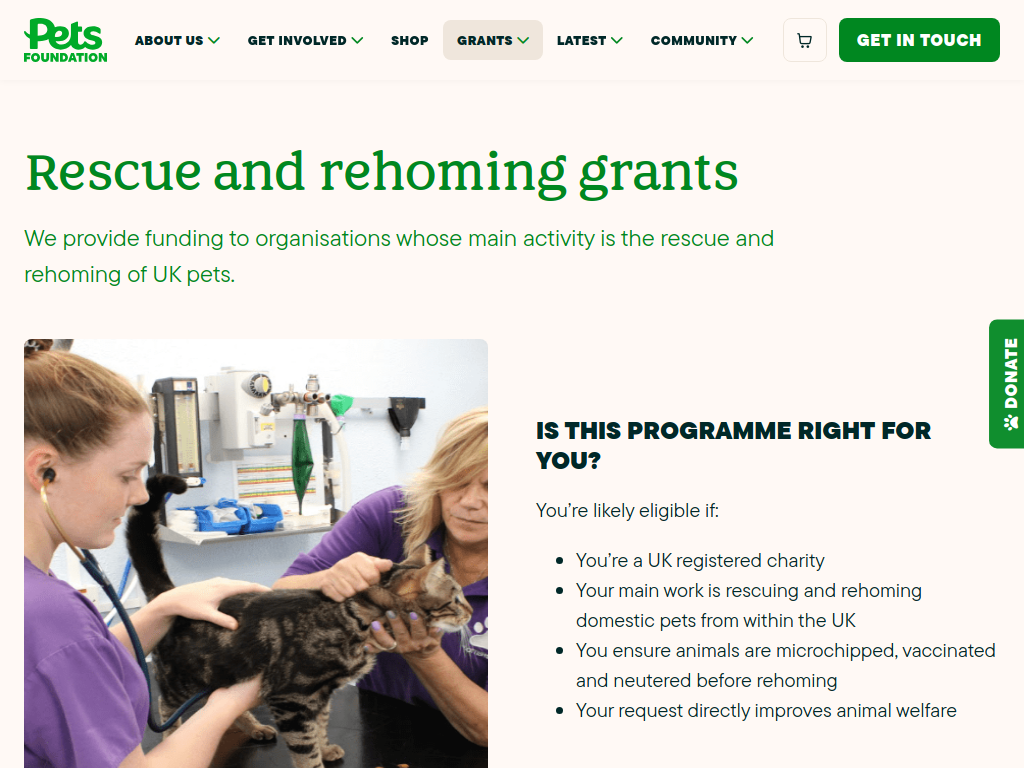 The Pets Foundation Rescue and Rehoming Grants Programme provides funding to UK charities whose main activity is rescuing, caring for and rehoming domestic pets. The Foundation supports organisations working to improve animal welfare, helping them cover essential running costs, purchase equipment, improve facilities and provide veterinary care. One-off grants of up to £100,000 are generally considered, although this is guidance rather than a guaranteed maximum award. Applications are accepted throughout the year, with no fixed deadline. Here's what you can expect:One-off grants, with awards above £100,000 considered unlikely Funding for essential animal rescue and rehoming activities Support with veterinary bills and animal care Funding for food, bedding and boarding costs Equipment purchases Vehicles used for animal welfare Building improvements and animal accommodation Applications accepted on a rolling basis Monthly reviews for requests under £50,000 What can be funded?1. Veterinary Care Funding towards veterinary treatment for rescued animals, helping organisations maintain their health and welfare before rehoming. 2. Essential Running Costs Support for eligible operational expenses, including: Utility bills Animal food Bedding Boarding fees Other eligible animal care costs 3. Equipment Funding for equipment used in rescue and rehoming activities, such as: Animal trapping cages Microchip scanners Washing machines Incubators Other essential animal care equipment 4. Vehicles Support towards purchasing suitable vehicles, including animal ambulances and horse boxes. 5. Building Improvements Funding for projects improving animal accommodation and welfare facilities, including suitable building works and onsite veterinary facilities. All funding requests must demonstrate a direct benefit to animal welfare. Who can apply?The programme is intended for eligible UK animal rescue and rehoming organisations. Applicants should: Be an appropriately registered UK charity or other eligible charitable organisation under the current grant criteria. Have rescuing and rehoming domestic pets as their main activity. Primarily rescue animals originating from within the UK. Follow appropriate vaccination, microchipping and neutering practices before rehoming. Demonstrate how the proposed funding will directly improve animal welfare. Meet the Foundation's organisational and financial requirements. The Foundation prioritises small and medium-sized charitable organisations. Organisations primarily operating as animal sanctuaries or rehoming pets from overseas should check the exclusions carefully. How much funding is available?Funding Amount: One-off grants, generally up to £100,000 Requests Under £50,000: Reviewed monthly Requests Over £50,000: Applicants should contact the Foundation before applying Funding Type: Charitable grant Geographic Eligibility: United Kingdom Application Deadline: Rolling The Foundation advises that awards above £100,000 are unlikely, although exceptional projects may be considered. What information is required?Applicants must provide: Recent organisational accounts Updated draft financial figures if the latest accounts are more than 12 months old Evidence supporting the requested costs Relevant quotations, invoices or supplier information Details of the proposed project or activity Examples of supporting evidence include veterinary bills, utility bills, vehicle listings and equipment quotations. How does the application process work?Step 1 – Review Eligibility Read the Foundation's 2026 Rescue and Rehoming Grant Criteria and Grant Programme FAQs. Step 2 – Request an Application Form Eligible organisations should complete the application form request on the official programme webpage. Step 3 – Prepare Supporting Information Gather recent accounts, project details and evidence of the proposed costs. Step 4 – Submit the Application Complete the application form provided by the Foundation. Step 5 – Application Review The Foundation assesses applications and may request additional information or arrange a virtual or in-person meeting. Step 6 – Funding Decision Applications under £50,000 are reviewed monthly. The Foundation advises that decisions can take approximately four to five months, depending on application volumes and any additional information required. Funding informationFunder: Pets Foundation Funding Amount: Generally up to £100,000 Funding Type: One-off charitable grant Geographic Eligibility: United Kingdom Target Audience: Animal rescue and rehoming charities Eligible Activities: Animal care, running costs, equipment, vehicles and facilities Application Deadline: No fixed deadline Application Status: OPEN – Rolling Applications
-
 The National Fund for Women (NFW) provides monthly microgrants ranging from US$100 to US$5,000 to help individuals manage everyday expenses, overcome financial barriers and build greater economic stability. The programme is designed to provide accessible financial assistance without lengthy applications or complicated paperwork. Grant opportunities change each month and may support personal wellbeing, household expenses, education, family activities or entrepreneurial ambitions. November 2026 applications are now open, with three grants worth between $100 and $1,000 available. Here's what you can expect:Microgrants ranging from $100 to $5,000 across the wider programme New funding opportunities every month A short online application Financial support for personal needs Opportunities to apply for up to three grants each month One grant award per successful applicant per month Digital payment for approved applications No requirement to operate a registered business November 2026 funding opportunities1. $1,000 Home for the Holidays Grant This grant provides financial assistance to help recipients travel during the holiday season. Funding Amount: $1,000 Deadline: 22 November 2026 2. $500 Gathering Grant This grant supports individuals hosting gatherings with family or friends. Potential uses include family dinners, holiday celebrations and other gatherings. Funding Amount: $500 Deadline: 22 November 2026 3. $100 Gift Budget Grant This grant provides additional financial support towards seasonal gift expenses. Funding Amount: $100 Deadline: 22 November 2026 What other funding opportunities are available?The National Fund for Women organises its monthly grants into three general categories. Everyday Support – $100 to $500 Smaller grants designed to help individuals manage everyday expenses or improve their wellbeing. Get Ahead Support – $500 to $2,500 Funding intended to help recipients overcome financial barriers and make progress towards personal goals. Build Something Bigger – $2,500 to $5,000 Larger grants that may support personal development, economic opportunities or ambitions such as starting a small business. Not every category or funding amount is available in every monthly round. Who can apply?Applicants must: Be at least 18 years old. Be a US citizen or permanent resident. Hold an eligible National Fund for Women membership. Apply for funding that addresses their own needs. Meet the requirements of the specific monthly grant. Although the programme prioritises women, the organisation states that it considers all eligible applicants without discrimination based on sex. UK residents without qualifying US citizenship or permanent residency are not eligible. Can businesses apply?No. The National Fund for Women provides microgrants directly to individuals rather than companies or organisations. Some future grants may help individuals develop business ideas or pursue entrepreneurial ambitions, but this does not make them direct business grants. The November 2026 grants focus on personal and seasonal expenses. Is membership required?Yes. Applicants must be members of the National Fund for Women to access its microgrants. Standard Membership: $15 per year Membership includes access to: Monthly microgrant applications Member discounts Other member benefits and resources The organisation also offers a waitlist for sponsored memberships for individuals unable to afford the annual fee. Important: Membership does not guarantee that an applicant will receive funding. How does the application process work?Step 1 – Become a Member Create an account and select an eligible membership option. Step 2 – Review Available Grants Visit the microgrants page to see the opportunities available during the current month. Step 3 – Complete the Application Applicants answer a short series of questions explaining their circumstances and intended use of the funding. Step 4 – Submit Before the Deadline Applications close on the 22nd of each month. Applicants may submit applications for up to three different grants during the same month. Step 5 – Application Review The National Fund for Women reviews completed applications, considering the applicant's circumstances and the potential impact of the financial support. Step 6 – Funding Decision Applicants are notified whether their application has been approved. Step 7 – Payment Successful applicants complete identity verification and provide the required payment information. Funds are then transferred securely. Key datesNovember Applications Opened: 1 November 2026 November Application Deadline: 22 November 2026 November Funding Available: $100, $500 and $1,000 grants Next Monthly Round: Expected 1 December 2026 Application Status: OPEN Funding informationProgramme Funding Range: US$100–US$5,000 November 2026 Award Range: US$100–US$1,000 Funding Type: Personal microgrants Geographic Eligibility: United States Minimum Age: 18 Membership Required: Yes Annual Membership Cost: From US$15 Businesses Eligible: No Application Deadline: 22 November 2026
-
 Dubai Cares provides funding and strategic partnerships to organisations delivering education programmes that improve opportunities for children and young people in developing countries. Established in 2007 and based in the United Arab Emirates, Dubai Cares works with international organisations, NGOs and local implementation partners to improve access to quality education. The organisation supports initiatives addressing educational inequality, early childhood development, school infrastructure, teacher training, youth skills and education during humanitarian emergencies. Organisations can currently submit partnership proposals through the official Dubai Cares website. Unlike a traditional grant competition, there is no publicly advertised fixed funding amount or application deadline. Here's what you can expect:Opportunities to propose education programmes for funding consideration Potential financial support for eligible projects Collaboration with an international philanthropic organisation Support for education initiatives in developing countries Opportunities for partnerships with NGOs and development organisations Funding consideration for programmes addressing educational inequality Support for sustainable and scalable education solutions An online process for submitting programme proposals Important: Funding is discretionary. Submission of a proposal does not guarantee an award. What projects can be considered?Dubai Cares supports a range of education and development priorities. 1. Early Childhood Education Projects improving access to quality early childhood education and development opportunities. Examples include: Early learning programmes Preschool education Child development initiatives Support for vulnerable young children 2. Primary and Secondary Education Projects improving access to quality education. Examples include: School infrastructure Literacy and numeracy Curriculum development Learning assessments Improving teaching quality 3. Teacher Training and Development Projects supporting educators and strengthening education systems. Examples include: Teacher training Professional development Teaching resources Capacity-building programmes 4. Youth Skills and Employment Projects helping young people develop practical skills and improve their future opportunities. Examples include: Technical education Vocational training Youth skills development Career preparation 5. Education in Emergencies Projects supporting children and young people affected by humanitarian crises. Examples include: Education for displaced children Learning opportunities during emergencies Safe learning environments Education continuity programmes 6. School Health and Nutrition Projects improving the conditions that enable children to learn. Examples include: School feeding Hygiene education Water and sanitation facilities School health initiatives Nutrition support 7. Girls' Education Projects reducing barriers to education for girls and young women. Examples include: Improving school access Supporting educational participation Addressing gender-related barriers Improving learning opportunities Who can apply?Dubai Cares works with organisations involved in international education and development. Potential partners include: Non-governmental organisations International development organisations Registered nonprofit organisations Education-focused charities Local implementing organisations Organisations with relevant experience delivering education programmes The organisation has previously partnered with international NGOs and United Nations agencies. Individuals are not eligible to receive programme funding. Can UK organisations apply?UK-registered charities and international development organisations may be able to submit partnership proposals. However, applicants should demonstrate how their proposed programme would benefit children or young people in developing countries. This is not a general funding opportunity for education projects delivered exclusively within the United Kingdom. Dubai Cares assesses potential partnerships according to its priorities and programme requirements. How much funding is available?Funding Amount: Not publicly specified Funding Type: Programme funding and strategic partnerships Funding Duration: Determined by the proposed programme and any subsequent agreement Geographic Focus: Developing countries Application Deadline: No fixed deadline published There is no confirmed minimum or maximum grant amount. Organisations must provide a proposed programme budget when submitting their partnership enquiry. How does the application process work?Step 1 – Review the Organisation's Priorities Applicants should familiarise themselves with Dubai Cares' education and development objectives. Step 2 – Prepare a Programme Concept Note Organisations must prepare a concept note explaining their proposed programme. Dubai Cares indicates that concept notes should generally be approximately 3–4 pages long. Step 3 – Prepare a Programme Budget Applicants must complete the official programme budget template. Step 4 – Complete the Partnership Form The online form requests information about: Organisation name Organisation location Organisation type Date of establishment Organisation description Legal registration documentation Proposed programme themes Programme budget Programme duration Target education level Step 5 – Upload Supporting Documents Applicants must upload the required concept note, programme budget and organisational documentation. Step 6 – Submit for Consideration Dubai Cares reviews submissions to identify potential partnerships aligned with its priorities. Further discussions or documentation may be requested. Submission does not guarantee that an organisation will receive funding. Funding informationFunder: Dubai Cares Funding Amount: Not specified Funding Type: Education programme funding and partnerships Geographic Focus: Developing countries UK Organisations: May submit relevant international programme proposals Target Audience: NGOs, charities and international development organisations Individual Applications: Not accepted
-
 The Irish Aid Global Citizenship Education Grant Scheme 2027 is offering €10,000 to €180,000 to support Irish-based organisations delivering educational projects that increase public understanding of global development issues. The programme aims to help people understand the causes of global poverty, inequality and injustice while encouraging meaningful action towards a more equitable and sustainable world. Funding is available for eligible organisations working in education, youth development, community engagement and related sectors. Applications are currently open, with an initial eligibility deadline of 6 November 2026. Here's what you can expect:Grants ranging from €10,000 to €180,000 Funding for one-year projects in 2027 Support for innovative educational initiatives Opportunities to engage new audiences Funding for global development education Support for community participation and awareness Opportunities to develop educational resources Funding for projects encouraging informed action on global issues What projects can be funded?The programme supports global citizenship education activities that encourage critical thinking, understanding and engagement. Relevant project areas may include: 1. Global Development Education Projects helping people understand international development challenges. Examples include: Global poverty awareness International inequality Human rights education Sustainable development Global economic justice 2. Climate and Environmental Education Projects exploring environmental challenges and their relationship with global development. Examples include: Climate justice Environmental sustainability Sustainable consumption Climate impacts on vulnerable communities Education about global environmental responsibility 3. Youth and Community Engagement Projects encouraging young people and community groups to engage with global issues. Examples include: Youth education programmes Community workshops Participatory learning activities Educational events Community-led awareness initiatives 4. Innovative Education Approaches Projects developing new ways to engage audiences with global development issues. Examples include: Digital learning resources Interactive educational tools Creative education programmes Multimedia learning activities Innovative community engagement methods Projects must align with the objectives and assessment criteria of Irish Aid's Global Citizenship Education Grant Scheme. Who can apply?The programme is open to eligible organisations based in Ireland. Potential applicants include: Registered charities Nonprofit organisations Community organisations Educational organisations Youth organisations Development education organisations Other eligible Irish-based organisations delivering global citizenship education Applicants should consult the official guidance to confirm their organisational eligibility. Important: The programme is restricted to Irish-based organisations. UK-only organisations are not eligible. Key eligibility requirementsApplicants must: Be based in Ireland. Meet Irish Aid's organisational eligibility requirements. Propose activities aligned with global citizenship education. Demonstrate the capacity to deliver the proposed project. Submit the required eligibility form before the initial deadline. Complete the full application if confirmed as eligible. Provide the required organisational and project information. Organisations that miss the eligibility deadline cannot proceed to the full application stage. How much funding is available?Minimum Grant: €10,000 Maximum Grant: €180,000 Funding Type: Project grant Project Duration: One year Eligible Location: Ireland Funding Year: 2027 The exact award depends on the proposed project, its budget and the outcome of the assessment process. How does the application process work?Step 1 – Request an Eligibility Form Organisations must contact the Irish Aid Global Citizenship Education team to obtain the eligibility form. Step 2 – Submit the Eligibility Form Completed eligibility forms must be submitted by: Friday 6 November 2026 at 12 noon This is a mandatory first stage. Step 3 – Eligibility Confirmation Organisations will be notified of their eligibility by: Monday 9 November 2026 Eligible applicants will receive the full application form. Step 4 – Prepare the Full Application Applicants must provide information about: The proposed project Target audiences Educational objectives Planned activities Expected outcomes Delivery arrangements Project budget The application must be signed by an authorised legal representative of the organisation. Step 5 – Submit the Full Application Completed applications must be emailed to the Irish Aid Global Citizenship Education team. Deadline: Wednesday 9 December 2026 at 12 noon Late applications will not be considered. Step 6 – Assessment and Funding Decisions Applications are expected to be assessed during the first quarter of 2027. Funding decisions are anticipated in March or April 2027, although the timetable may change. Key datesApplication Status: OPEN Eligibility Form Deadline: 6 November 2026 at 12 noon Eligibility Notifications: 9 November 2026 Full Application Deadline: 9 December 2026 at 12 noon Expected Funding Decisions: March–April 2027 Project Year: 2027 Funding informationFunding Amount: €10,000–€180,000 Funding Type: Global citizenship education project grants Geographic Eligibility: Ireland only Target Audience: Irish-based educational, charitable and nonprofit organisations Project Duration: One year Initial Deadline: 6 November 2026 Final Application Deadline: 9 December 2026
-
 The Sellars Company Government Contracting Growth Grant is offering one US small business 12 months of free professional government contracting support, valued at approximately US$7,800. The programme is designed to help small businesses overcome barriers to entering the government procurement market, identify suitable contracting opportunities and strengthen their ability to compete for public sector contracts. Successful applicants receive practical assistance with business positioning, contract opportunities, proposal development and ongoing contracting guidance. Applications are currently open and close on 20 November 2026. Here's what you can expect:US$7,800 worth of professional services 12 months of government contracting support Assistance identifying suitable government contracts Guidance on preparing and submitting proposals Support with government contracting readiness Advice on registrations and certifications Assistance identifying subcontracting opportunities Ongoing account management Monthly progress updates Potential partial scholarships for additional applicants Important: This is an in-kind professional services award. No cash funding is provided. What support is available?1. Government Contracting Readiness The programme helps businesses assess their readiness to compete for government contracts. Support may include: Reviewing business capabilities Identifying suitable contracting opportunities Understanding government procurement requirements Developing a government contracting strategy 2. Contract Opportunity Identification Selected businesses receive assistance finding government procurement opportunities relevant to their products or services. Support may include: Identifying relevant contract opportunities Reviewing government solicitations Assessing suitable procurement pathways Exploring subcontracting opportunities 3. Proposal Development The programme provides guidance on preparing competitive government contract proposals. Support may include: Reviewing solicitation requirements Developing proposal responses Preparing supporting documentation Guidance on proposal submissions 4. Government Contracting Guidance Businesses receive ongoing advice to help them navigate government procurement. Support may include: Understanding relevant registrations Identifying appropriate certifications Reviewing contracting requirements Developing longer-term government contracting plans Who can apply?The Growth Grant is open to legally formed US-based small businesses. Eligible applicants may include: Early-stage small businesses Established small businesses Businesses exploring government contracting for the first time Companies seeking to expand their government contracting activities Businesses requiring additional procurement guidance Key eligibility requirementsApplicants must: Be based in the United States. Operate a legally formed small business. Provide accurate and complete application information. Demonstrate an interest in pursuing government contracting opportunities. Be willing to participate in the programme if selected. Applicants do not need to: Have previously won a government contract. Have prior government contracting experience. Be registered with SAM.gov when applying. Hold a government contracting certification. Meet a minimum revenue requirement. UK-based businesses are not eligible unless they independently meet the programme's US business requirements. How much support is available?Award Value: US$7,800 Number of Full Awards: One Support Duration: 12 months Monthly Service Value: US$650 Award Type: In-kind professional services Cash Funding: None The award covers services included in the Sellars Company's Foundation government contracting support package. Additional services, third-party costs, filing fees, certification fees, legal services and other external expenses are not automatically included. The award cannot be exchanged for cash, transferred or sold. Are additional awards available?Yes. Applicants who do not receive the full Growth Grant may be considered for partial scholarships towards 12 months of government contracting services. However: Partial scholarships cover only part of the service costs. Recipients may need to pay the remaining balance. The number and value of scholarships are not fixed. Applicants are not required to accept an offer. Declining a scholarship does not create a financial obligation. How are applicants selected?The Sellars Company reviews applications based on several factors, including: Business viability Potential to compete for government contracts Need for professional support Business goals for the next 12 months Current barriers to government contracting Readiness to participate Potential impact of receiving support Only one business will receive the full 12-month award. Selection does not guarantee that the business will subsequently secure a government contract. How does the application process work?Step 1 – Review the Programme Rules Applicants should read the official Growth Grant eligibility requirements and award conditions. Step 2 – Complete the Online Application Visit the official Growth Grant webpage and complete the application form. Step 3 – Explain Your Business Needs Applicants should provide accurate information about their business, goals and government contracting support requirements. Step 4 – Submit Before the Deadline Applications must be received by 20 November 2026. Late, incomplete, duplicate or ineligible applications may be excluded. Step 5 – Selection and Notification The Sellars Company reviews applications and selects the successful business. Step 6 – Programme Onboarding The selected recipient must complete the required onboarding documents and participate in the programme. Key datesApplication Deadline: 20 November 2026
-
 The Sir Bernard & Lady Schreier Foundation is offering grants of £500–£5,000 to UK charities providing direct support to people experiencing mental health difficulties. The Foundation aims to improve mental health outcomes by supporting charitable organisations delivering essential services, particularly those helping children, young people and vulnerable communities. Funding is generally awarded as a one-off contribution towards specific activities, with trustees usually covering up to 50% of the total project cost. Applications are accepted throughout the year, with no fixed deadline. Here's what you can expect:Grants typically ranging from £500 to £5,000 Funding for UK mental health charities Support for projects providing direct services to beneficiaries Particular interest in children and young people's mental health Funding for prevention and early intervention activities Support for initiatives promoting mental wellbeing One-off grants for specific activities Applications accepted on a rolling basis Funding decisions considered at quarterly trustee meetings What projects can be funded?The Foundation focuses on three main priorities. 1. Supporting Children and Young People Projects empowering children and young people affected by mental illness. Relevant activities may include: Youth mental health support Emotional wellbeing programmes Community-based support services Activities helping young people manage mental health challenges 2. Supporting People Experiencing Mental Health Difficulties Projects providing practical support to individuals affected by mental illness. Relevant activities may include: Direct mental health support services Community-based mental health programmes Activities reducing isolation Support for people experiencing mental health difficulties 3. Prevention, Early Intervention and Wellbeing Projects helping charities prevent mental illness, intervene earlier and promote wellbeing. Relevant activities may include: Early intervention programmes Mental health awareness and support activities Preventative services Wellbeing initiatives for vulnerable communities All proposed activities must directly support people facing mental health issues. Who can apply?The Foundation normally awards grants to UK-registered mental health charities. It is particularly interested in: Small and medium-sized charities Local charities Community-based organisations Charities supporting children and young people Organisations providing direct mental health services Charities delivering prevention and early intervention activities Applicants should demonstrate how the proposed funding will benefit people experiencing mental health difficulties. How much funding is available?Typical Grant Amount: £500–£5,000 Funding Type: One-off charitable grants Usual Funding Contribution: Up to 50% of project costs Geographic Eligibility: United Kingdom Application Deadline: Rolling Each application is considered individually, and trustees may exercise discretion when determining grant amounts and funding contributions. What is unlikely to be funded?The Foundation's grant-making policy places restrictions on certain activities and costs. These include: Applications from individuals Projects with a political element General fundraising appeals Sponsorship requests Activities delivered by public bodies or organisations contracted to provide public services on their behalf Salary costs, capital expenditure and overheads are generally excluded unless they are essential and directly linked to the proposed activity. Applicants should review the full grant-making policy before submitting a request. How does the application process work?Step 1 – Review the Funding Criteria Visit the Foundation's website and read its grant-making policy. Step 2 – Download the Application Form The application form is available on the official grants page. Step 3 – Prepare Your Proposal Applicants should explain: Their organisation's charitable purpose The mental health needs being addressed The proposed activities Who will benefit How the grant will be used The project budget Any additional funding secured or requested How the activities will be managed Step 4 – Submit by Email Complete the application form and email it to: [email protected] Step 5 – Trustee Review The Board of Trustees normally meets quarterly to review grant applications. Meetings take place in: January April July October The Foundation also aims to consider urgent requests outside its normal meeting schedule where possible. Step 6 – Funding Decision Applicants are notified of the outcome by email. Funding informationGrant Amount: £500–£5,000 Funding Type: Mental health charity grants Usual Funding Rate: Up to 50% of project costs Location: United Kingdom Target Audience: UK mental health charities Application Deadline: No fixed deadline
-
 The Horizon Europe Springboard Scheme for Cluster 4 Industry Themes is offering up to £5,000 in grant funding to help UK organisations prepare competitive applications for Horizon Europe research and innovation funding. Delivered by Innovate UK and Innovate UK Business Connect, the scheme supports organisations developing proposals under eligible topics within the Horizon Europe Cluster 4 Industry and Horizontal Activities Work Programme 2027. The programme aims to increase UK participation in European research and innovation by helping organisations establish international partnerships, strengthen project proposals and undertake preliminary research. Applications are OPEN and close on 2 February 2027, or earlier if the available funding is exhausted. Here's what you can expect:Up to £5,000 in grant funding per organisation, excluding VAT Funding for up to 20 eligible UK organisations Support for preparing Horizon Europe funding applications Funding for international partnership development Support for external proposal-writing expertise Funding for preliminary feasibility studies Opportunities to develop international research collaborations Support for project development workshops Funding awarded on a rolling, first-come, first-served basis What activities can be funded?The programme supports three main types of activities. 1. International Partnership Building Funding can help organisations establish the international relationships needed to develop collaborative Horizon Europe proposals. Eligible activities include: Joining relevant European partnerships Attending international consortium-building events Participating in brokerage and networking events Visiting prospective research partners Developing international collaborations 2. Horizon Europe Proposal Development Organisations can use funding to strengthen the quality of their funding applications. Eligible activities include: Engaging external proposal-writing specialists Allocating dedicated internal staff time Developing project proposals Preparing technical application documents Organising proposal development workshops Finalising applications for eligible Horizon Europe calls 3. Feasibility Studies and Project Scoping Funding can support early-stage activities needed to develop a credible research and innovation proposal. Examples include: Preliminary feasibility studies Market opportunity assessments Project scoping activities Technical planning Project development workshops What sectors are supported?Applications must relate to eligible topics within the specified Horizon Europe 2027 work programmes. Relevant innovation areas include: Advanced manufacturing Materials and production technologies Industrial innovation Digital technologies Artificial intelligence Robotics Clean industrial technologies Sustainable manufacturing Other eligible Cluster 4 Industry and Horizontal Activities topics Important: Not every Horizon Europe Cluster 4 topic qualifies. Applicants must check the scheme's eligible topic list before applying. Who can apply?The programme is open to eligible UK-established organisations interested in participating in Horizon Europe. Potential applicants include: Startups and SMEs Established businesses Universities Research organisations Research and technology organisations Other eligible organisations preparing Horizon Europe proposals Applicants must demonstrate that their proposed activities directly support the development of an application under an eligible 2027 Horizon Europe topic. Key eligibility requirementsApplicants must: Be legally established in the United Kingdom. Be developing a proposal for an eligible Horizon Europe 2027 topic. Explain how the requested funding will strengthen their application. Identify appropriate partnership-building, proposal-development or feasibility activities. Obtain written eligibility confirmation from the UK Cluster 4 Industry National Contact Point before applying. Submit no more than one application per organisation. Important: Contact the National Contact Point FirstBefore submitting an application, organisations must contact the UK Cluster 4 Industry National Contact Point (NCP). Applicants need to: Identify their intended Horizon Europe funding topic. Explain their proposed project concept. Outline the activities they want the Springboard funding to support. Request confirmation of eligibility. Receive written approval before submitting the application. National Contact Point Email: [email protected] A phone call or meeting alone does not count as approval. The NCP aims to respond within 10 working days, so applicants should allow sufficient time before the deadline. How much funding is available?Maximum Grant: £5,000 per organisation Number of Awards: Up to 20 Funding Type: Proposal development and international collaboration grants VAT: The £5,000 maximum excludes VAT. Only one grant is available per eligible organisation. If proposed activities cost more than £5,000, applicants must explain how the additional costs will be funded. How is funding paid?Successful applicants must complete the relevant Innovate UK Innovation Funding Service onboarding process. Grant funding is paid through reimbursement of eligible expenditure. Applicants must: Retain evidence of eligible costs. Submit the required financial documentation. Comply with their Grant Offer Letter. Complete the relevant grant claims process. Payments are expected between 1 and 15 April 2027, subject to the grant conditions. Important: Applicants should not assume their costs will be reimbursed before receiving formal confirmation of funding. How does the application process work?Step 1 – Identify an Eligible Horizon Europe Topic Review the eligible Cluster 4 Industry and Horizontal Activities topics for 2027. Step 2 – Contact the National Contact Point Email [email protected] with your proposal concept and intended activities. Step 3 – Obtain Written Confirmation Wait for written confirmation that your organisation and proposed activities are eligible. Step 4 – Prepare Your Application Applicants will need to explain: Their proposed Horizon Europe project The relevant funding topic Their organisation's expertise Existing or planned international partnerships How the requested funding will be used Expected outcomes Proposed activities and costs Step 5 – Submit Online Complete the official Springboard Scheme application form. Step 6 – Complete Grant Onboarding Successful applicants will be invited to complete the Innovate UK funding administration process. Key datesApplications Opened: 10 August 2026 Application Deadline: 2 February 2027
-
 The 100x Impact Accelerator, based at the London School of Economics and Political Science (LSE), is offering £150,000 in grant funding to support ambitious social ventures developing solutions to major global challenges. The programme supports established organisations with proven solutions that have the potential to reach significantly more people and create lasting social or environmental change. Applications are welcomed from both for-profit and nonprofit ventures worldwide, including the United Kingdom. Successful applicants receive funding alongside a tailored 16-week accelerator programme, expert guidance and access to an international network of funders, advisers and social entrepreneurs. Applications are currently open and close on 2 November 2026. Here's what you can expect:£150,000 in catalytic grant funding A tailored 16-week accelerator programme Support with scaling strategies and business development Guidance on impact measurement Leadership development and mentoring Access to LSE's research expertise Connections to international funders and advisers Networking with other social entrepreneurs Long-term strategic support beyond the accelerator Potential follow-on funding for selected ventures, subject to availability What types of ventures are supported?The programme supports organisations tackling major social and environmental challenges. 1. Climate and Environment Innovations addressing climate change and environmental sustainability. Examples include: Climate solutions Environmental protection Sustainable resource management Technologies reducing environmental impact 2. Health and Social Care Solutions improving healthcare accessibility, affordability and outcomes. Examples include: Digital health innovations Improved access to healthcare Community health solutions Social care innovations 3. Education Projects transforming access to learning and educational opportunities. Examples include: Educational technology Inclusive learning solutions Innovative teaching approaches Programmes addressing educational inequality 4. Equitable Economies Solutions improving economic inclusion and opportunities for underserved communities. Examples include: Financial inclusion Economic empowerment Innovative financial services Business models addressing inequality 5. Happiness and Wellbeing Initiatives improving mental health, wellbeing and quality of life. Examples include: Mental health support Community wellbeing initiatives Accessible wellbeing services Innovative support models 6. Refugees and Social Cohesion Projects supporting displaced communities and strengthening social inclusion. Examples include: Refugee integration Access to essential services Community cohesion Innovative support for displaced populations 7. Democracy Initiatives strengthening democratic participation and civic engagement. Examples include: Civic technology Public participation Access to information Democratic accountability 8. New Frontiers Innovative technologies and business models addressing major global challenges. Examples include: Emerging technologies Breakthrough social innovations Scalable technology platforms New approaches to systemic problems Who can apply?The accelerator welcomes: Social enterprises Impact-driven startups Registered charities Nonprofit organisations For-profit businesses with a clear social mission Established ventures developing scalable solutions Applications are open internationally, including to UK-based organisations. Key eligibility and selection criteriaApplicants should demonstrate: A clearly defined social or environmental problem. An established solution with evidence that it works. A distinctive approach offering advantages over existing alternatives. A track record of adoption, measurable outcomes and growth. Strong leadership and organisational capabilities. A credible strategy for significantly expanding impact. The potential to create long-term, systemic change. A clear understanding of the communities they serve. The programme is particularly interested in ventures whose impact could eventually reach hundreds of millions or billions of people. Geographic prioritiesApplications are welcomed from organisations worldwide. However, 100x aims for approximately 70% of its portfolio to come from emerging markets. The programme also values organisations whose founders or senior leaders are based in the communities or regions where they operate. UK organisations remain eligible to apply. What stage should applicants be at?The accelerator is designed for ventures that have moved beyond the earliest stages of development. Competitive applicants should already have: A working solution Evidence of effectiveness Demonstrated adoption Measurable impact A credible plan for expansion The programme is not primarily intended for organisations with only an initial idea or an untested concept. How much funding is available?Grant Amount: £150,000 Funding Type: Catalytic grant funding Accelerator Duration: 16 weeks Geographic Eligibility: Worldwide The funding is intended to strengthen the organisation's ability to scale its impact. Selected ventures may also be considered for additional funding, depending on their circumstances and available resources. Follow-on funding is not guaranteed. What additional support is available?Successful applicants receive a long-term partnership with 100x Impact. Support includes: Scaling Strategy Developing practical approaches to expanding an organisation's impact. Impact Measurement Strengthening how ventures measure and demonstrate their outcomes. Leadership Development Supporting founders and senior teams as their organisations grow. Research Expertise Access to relevant knowledge and research expertise from LSE. Strategic Partnerships Connections to advisers, funders and organisations that could support future growth. Peer Learning Opportunities to collaborate with other social entrepreneurs tackling major global challenges. How does the application process work?Stage 1 – Online Application Applicants complete the official application form explaining: The problem they are addressing Their solution Evidence of impact Their organisational model Their leadership team Their strategy for scaling Stage 2 – Initial Review The 100x team reviews applications and selects up to 50 teams to progress. Applicants who do not progress are expected to be notified in December 2026. Stage 3 – Initial Interview Selected applicants participate in a short online interview. The interview typically lasts approximately 20 minutes and focuses on the founders, their solution and future ambitions. Stage 4 – Detailed Due Diligence Shortlisted teams participate in more detailed discussions and provide additional organisational information. Due diligence is expected to take place between January and April 2027. Stage 5 – Final Selection An independent selection committee reviews the shortlisted ventures. Successful applicants are expected to be notified in July 2027. Stage 6 – Accelerator Programme Selected ventures begin their programme in September 2027. Key datesApplications Opened: 29 September 2026 Application Deadline: 2 November 2026
