


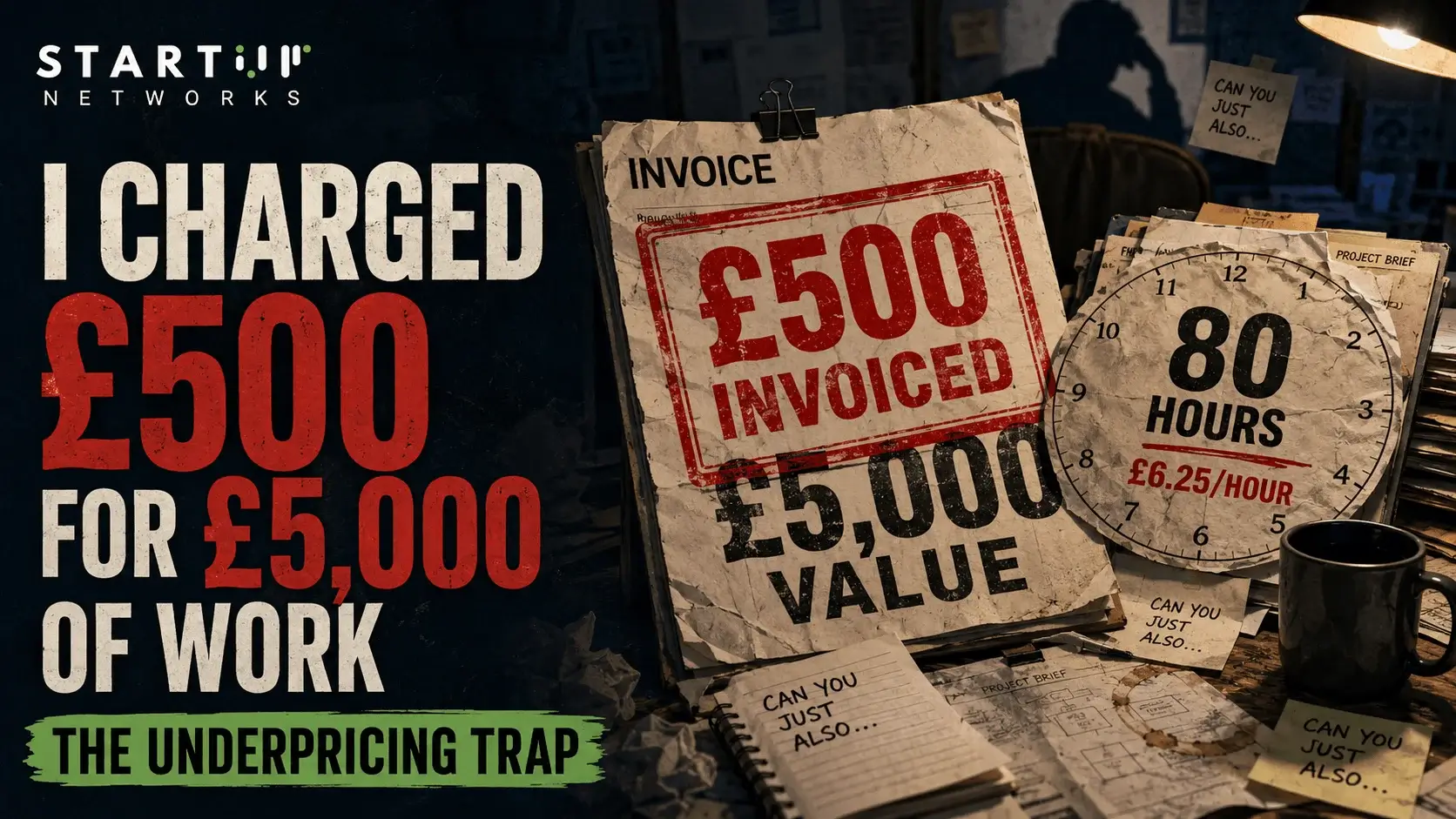
I Charged £500 for Work Worth £5,000 and It Nearly Killed My Business

The most expensive mistake I've made as a founder wasn't a bad investment, a failed product, or a missed opportunity. It was charging £500 for a project that was worth £5,000. Then doing it again. And again. Until I was working 14-hour days, resenting every client, and earning less per hour than the teenager serving coffee at the cafe downstairs.
I need to tell you this story because I see founders in our community making the exact same mistake every week. They quote low to "win the client." They discount their rates because they're scared of hearing no. They tell themselves it's a strategic decision when actually it's a fear-based one. And by the time they realise what they've done, they're trapped in a pricing hole they can't climb out of without losing the clients they undercharged to win.
I was that founder. For longer than I'd like to admit.
How It Started
Early days. No portfolio to speak of. No testimonials. No track record. Just me, a laptop, and the desperate need to prove that someone, anyone, would pay money for what I could do.
A business contacted me about an SEO project. They needed a full site audit, keyword research, content strategy, technical fixes, and monthly reporting. In any agency setting, this was a £4,000-5,000 job. Minimum. I'd done this work white-labelling for agencies who charged exactly that. I knew the value. I knew the hours. I knew what it was worth.
I quoted £500.
Not because I'd calculated a competitive rate. Not because I'd assessed the market and positioned myself strategically. Because I was terrified they'd say no. Because I thought if I charged what the work was actually worth, they'd laugh, go to someone else, and I'd have nothing. Zero clients. Zero revenue. Zero validation that this business was real.
So I picked a number that felt "safe." A number so low that saying no to it would mean they didn't want the work done at all. A number that guaranteed a yes.
They said yes. Obviously. They'd have been insane not to. They were getting £5,000 of work for a tenth of the price.
And I felt great. For about a week.
What Actually Happened
The project took three times longer than it should have. Not because it was complex. Because £500 buys you a certain attitude toward scope. When a client pays £5,000, they respect the scope. They understand that additional requests cost additional money. There's a professional boundary built into the price.
When a client pays £500, the boundary doesn't exist. "Can you just also look at this page?" "Can you just also check our social media?" "Can you just also write a few blog posts?" "Can you just also..." became the soundtrack of my working life. And I couldn't say no because what was I going to do, invoice them for extras on a £500 project? The power dynamic was gone. I'd given it away with the quote.
Here's something I've never seen anyone else articulate about this. When you underprice, you create an invisible contract that's different from the written one. The written contract says "SEO audit and keyword research." The invisible contract says "I'll do whatever you ask because we both know you're overpaying me in attention and underpaying me in money, and that imbalance means I owe you." You become grateful for the work instead of proud of it. Grateful people don't enforce boundaries. They absorb scope creep like a sponge absorbs water, until they're waterlogged and heavy and can't move.
I spent roughly 80 hours on that project. Eighty hours. At £500, that's £6.25 an hour. National minimum wage in 2026 is £12.21. I was earning half of what I'd have made stacking shelves at Tesco. But I was doing senior-level SEO work for a client who thought they were getting a bargain. Because they were.
The worst part? I couldn't even be angry at them. They didn't do anything wrong. They got quoted a price, they accepted it, and they asked for what they thought was included. The problem wasn't the client. The problem was me.
Then I Did It Again
You'd think I'd have learned. I didn't. I took on another client at a similarly stupid rate. Then another. Each time telling myself "this one will be different" or "this is just to build the portfolio" or "once I have three clients I'll raise my prices."
Three became five. Five became eight. Each one anchored to the original rates. Each one expecting the same volume of work for the same negligible fee. I was fully booked and barely earning. Working constantly and building resentment toward every single project on my desk.
I'd sit down to work on a client's content strategy and feel a knot in my stomach. Not because the work was hard. Because the work was worth ten times what I was being paid and I knew it. Every hour I spent on a £500 project was an hour I wasn't spending on a £5,000 project. But I didn't have any £5,000 clients because I'd positioned myself as the £500 person. And the £500 clients were filling every available hour.
That's the trap. Underpricing doesn't just cost you money on the projects you underprice. It costs you every higher-value project you don't have time to pursue because you're buried in cheap work.
There's something darker nobody talks about though. The resentment changes the quality of your work. Not deliberately. You don't consciously do a worse job. But you stop going the extra mile. You stop caring about the details. You deliver what was asked, not what was needed, because the gap between what you're being paid and what you're giving makes generosity feel like self-harm. I was producing B+ work for clients who deserved A+ work, because my subconscious had decided that A+ effort at £6.25/hour was a form of self-punishment. The clients didn't get my best. And they didn't even know they weren't getting it because they'd never seen what my best looked like at a fair rate.
That's the bit that still bothers me. The underpricing didn't just hurt my business. It hurt the clients. They thought they were getting a great deal. They were getting a resentful version of someone who could have been brilliant for them if the economics hadn't been poisonous.
The Breaking Point
I calculated my effective hourly rate one Sunday night. I had a spreadsheet with every project, every hour logged, every invoice sent. The number came back at £8.40 an hour. Before tax. Before expenses. Before software subscriptions. Before the cost of actually running a business.
After deductions, I was earning roughly £5 an hour for work that agencies charge £75-150 an hour for. Work I was good at. Work clients were happy with. Work that was generating real results for their businesses. And I was being paid less than I'd earn delivering pizzas.
Something snapped. Not dramatically. Quietly. I just looked at the spreadsheet and thought: "I can't do another month of this."
I remember closing the laptop and sitting in the dark for about ten minutes. Not thinking about strategy. Not planning the price increase. Just sitting with the realisation that I'd spent months building a business that was making me miserable, and the reason it was making me miserable was entirely within my control. I'd done this to myself. Every quote, every "yes" to scope creep, every time I'd said "that's fine" when it wasn't fine. All me.
That was the worst part and the best part simultaneously. Worst because I couldn't blame anyone else. Best because it meant I could fix it.
The Conversation Nobody Prepares You For
Here's the bit that actually matters. Because the problem isn't realising you're undercharging. Most founders know they're undercharging. The problem is the conversation where you fix it.
I sat down and wrote an email to every client. Not a template. Individual emails. Each one explained that my rates were increasing. Not doubling overnight. But moving to a level that reflected the actual value of the work. I gave them a month's notice. I was transparent about why.
I was sick with anxiety sending them. Physically nauseous. I was convinced every single one would leave. That I'd go from eight underpaying clients to zero clients overnight. That the "strategic" low pricing had been the only thing keeping the business alive and I was about to kill it.
Three left. Out of eight. Three.
And here's what happened to the three who left: nothing. They found someone cheaper. Someone who'd do the work for the rate I was no longer willing to accept. Someone who'd learn the same lesson I'd learned, eventually, the hard way. I felt bad for about a week. Then I felt relieved.
The five who stayed paid the new rates without argument. Two of them said something along the lines of "honestly, I'm surprised it took you this long." One said "I always thought you were too cheap and I was worried about the quality because of it."
Read that last one again. The low price wasn't attracting clients. It was making them suspicious. They were questioning the quality because the price was too low. I thought I was being competitive. They thought I was being cheap. There's a chasm between those two things.
What Happened to Revenue
Within three months of raising prices, my revenue doubled. Not because I was working more. Because I was working less, for more money, on better projects, for clients who valued the work.
The maths is stupidly simple. Five clients at proper rates generated more revenue than eight clients at poverty rates. And I had time back. Time to do better work. Time to pursue higher-value opportunities. Time to build Startup Networks properly instead of squeezing it into the gaps between cheap projects.
The quality of client changed too. When you charge properly, you attract people who have budgets, who respect professional boundaries, who don't send "can you just also" emails at 11pm on a Sunday. The clients who stay when you raise prices are the clients you want. The clients who leave are the clients you needed to lose.
I've since noticed a pattern in our community that I think is an original observation, or at least one I haven't read anywhere else. The price you charge your first client becomes the gravitational centre of your entire business. Every subsequent client orbits around it. If your first client pays £500, your second client hears about it (or senses it in your confidence level) and pays £600. Your third pays £550. You're stuck in the £500 gravity well. Getting out requires escape velocity, which means a dramatic, uncomfortable, relationship-risking price correction.
But if your first client pays £3,000, the gravity works in your favour. Your second client pays £2,800. Your third pays £3,500. You're orbiting a number that sustains the business. Every founder I've spoken to about this recognises the pattern. Your first price isn't a price. It's a precedent. It defines the orbit your business travels in for months, sometimes years.
Why Founders Underprice (And Why It's Not About Money)
I've thought about this a lot since, and I've talked to dozens of founders in our community who've done the same thing. The reasons are almost never financial. They're emotional.
Imposter syndrome. You don't believe your work is worth the market rate. So you price below it because the lower number matches your internal assessment of your value. You're not pricing the work. You're pricing your self-worth. And your self-worth, during the early days of a business, is usually in the gutter.
Fear of rejection. A "no" to your quote feels like a "no" to you personally. So you set the price low enough that rejection is almost impossible. The problem is you've made it impossible for the wrong reason. They're not saying yes because you're good. They're saying yes because you're cheap. And cheap clients treat you like a cheap service.
Desperation for validation. In the early days, you need someone to say "yes, I will pay you money for what you do." That validation feels so important that you'll sacrifice margin to get it. The first client isn't about revenue. It's about proof that the business is real. And you'll pay almost anything for that proof, including your own hourly rate.
The "build the portfolio" myth. "I'll charge low now and raise prices once I have testimonials." This sounds logical. It's a trap. Because the testimonials you earn at low rates attract more low-rate clients. Your portfolio becomes a magnet for the exact type of work you're trying to escape. You don't build your way out of underpricing. You price your way out of it.
Comparison with the wrong benchmarks. You see a freelancer on Fiverr doing "SEO audits" for £50 and think that's your competition. It's not. That person is selling a checklist. You're selling expertise. Different product. Different market. Different price. But imposter syndrome doesn't let you see the difference.
Here's what all five of these have in common, and this is the insight that took me years to understand. Underpricing isn't a business problem. It's an identity problem. You're not pricing a service. You're pricing yourself. And if your identity is "person who got lucky," "person who doesn't really know what they're doing," "person who should be grateful anyone's paying them at all," then of course your prices are low. The price reflects the founder, not the work.
Fixing your pricing means fixing how you see yourself. That's why it's so hard. It's not a spreadsheet problem. It's a therapy problem. And no amount of pricing strategy articles (including this one) will fix it until you genuinely believe, not just intellectually accept but genuinely believe, that your work is worth what the market says it's worth.
That belief doesn't come from reading. It comes from one client paying the real price and being happy with the result. One data point that proves the fear was wrong. Get that one data point as fast as possible. It changes everything.
How to Price Properly From Day One
If you're reading this before you've quoted your first client, you have an advantage I didn't have. Use it.
Research the market rate. Not the Fiverr rate. The agency rate. The rate that established professionals charge for the same work. That's your reference point. You might not charge exactly that as a new business, but you should be in the same postcode. If agencies charge £3,000-5,000, you can charge £2,000-3,000 and still be competitive while respecting your time.
Calculate your minimum viable hourly rate. Take the annual salary you need to live on. Add 30% for tax, NI, and business costs. Divide by the number of billable hours you can realistically work in a year (about 1,200 for most solo founders). That's your floor. Never quote below it. If a project comes in under that rate, you're paying the client to work for them.
Quote the value, not the time. "This project will take 40 hours at £50/hour = £2,000" invites the client to question your hours. "This SEO strategy will improve your organic traffic by 30-50% over six months. The investment is £2,000" frames the same work around what the client gets, not what it costs you. Value-based pricing is harder to negotiate down because the client is comparing the price to the outcome, not to your hourly rate.
Say the number and shut up. When you quote a price, say it clearly and then stop talking. Don't immediately justify it. Don't offer a discount before they've even responded. Don't say "but we can be flexible." Say the number. Let the silence sit.
I still struggle with this. Even now. Even after everything I've just written. The urge to fill the silence after quoting a price is almost physical. Your mouth wants to open and say "but we could do it for less" before the client has even processed the number. Resist it. The silence feels like it lasts an hour. It's usually about four seconds. Most clients just say yes.
Walk away from bad deals. If a potential client wants £5,000 of work for £500, they're not your client. They're someone else's headache. Saying no to cheap work creates space for good work. Every founder who's broken out of the underpricing trap says the same thing: "The moment I started turning down bad deals, better deals appeared."
FAQs
Why do startups underprice their services?
Primarily imposter syndrome, fear of rejection, and desperation for early validation. Founders set prices based on what they think clients will accept rather than what the work is worth. The "build the portfolio first" mindset compounds the problem by creating a track record at rates that attract more low-budget clients.
How do I know if I'm undercharging?
Calculate your effective hourly rate across all projects. If it's below the minimum wage, or below what you'd earn in a salaried role doing similar work, you're undercharging. Also check: are clients never pushing back on price? If nobody ever questions your rates, you're almost certainly too cheap.
How do I raise prices with existing clients?
Give notice (one month minimum). Be transparent about why. Communicate the value, not just the new number. Expect some clients to leave. The ones who stay at proper rates are worth more than the ones who leave because of price.
Will I lose clients if I raise my prices?
Some. In my experience, roughly 30-40% of underpriced clients leave when rates increase. The revenue from clients who stay at higher rates typically exceeds the total revenue from all clients at the old rates. The quality of work and the quality of client relationship both improve.
How should a new startup price its services?
Research the market rate charged by established providers. Price within 60-80% of that range to remain competitive while respecting your margins. Calculate your minimum viable hourly rate and never quote below it. Frame pricing around value delivered rather than hours spent.
What's the difference between being competitive and being cheap?
Competitive pricing positions you within the market range while emphasising value. Cheap pricing positions you below the market and attracts clients who prioritise cost over quality. Competitive clients become long-term partners. Cheap clients leave the moment someone cheaper appears.
Written by James Beresford-Morgan. Former member of the £6.25/hour club. Current advocate for charging what you're worth and not apologising for it. If you're stuck in the underpricing trap, come talk to founders in our community who've been through the same thing. The first step is admitting the number out loud. The second step is raising it.
This connects to our articles on imposter syndrome (which drives most underpricing), how to price a product, and the real cost of running a business. Between them, you'll have the full picture of what things cost, what you should charge, and why your brain is lying to you about both.
-
 1
-
 2




Recommended Comments