


General Grants
Browse our earlier grant listings for startups, charities and community groups.
920 links
-
Up to £5,000 for Educational, Creative and Sporting Projects for Young People – BlueSpark Foundation
The BlueSpark Foundation is offering grants of up to £5,000 to support projects that improve the education, confidence, skills and personal development of children and young people aged 5–22 in England.
The Foundation funds educational, cultural, sporting and creative activities that help young people develop independence, teamwork, self-confidence and future employability.
Funding is available to schools, community groups, clubs, societies, other not-for-profit organisations and individuals.
Applications are currently being accepted, with the next review scheduled for February 2027.
Here's what you can expect:
Grants of up to £5,000 per project
Most awards are below £2,000
Funding for educational and creative activities
Support for music, drama, dance and sporting projects
Funding for educational trips and outdoor experiences
Support for equipment, tuition and participation costs
Applications from organisations and individuals
No requirement for applicants to provide match funding
Online applications accepted throughout the year
What projects can be funded?
1. Music, Drama and Performing Arts
Projects encouraging creativity, confidence and self-expression, including:
Music and singing workshops
Musical instruments
Drama productions
Theatre activities
Dance tuition
Performance opportunities
2. Sport and Outdoor Activities
Activities developing physical skills, resilience and teamwork, including:
Sports equipment
Sporting competitions
Outdoor adventure programmes
Camping and climbing
Kayaking and sailing
Team-building experiences
3. Education and Academic Development
Projects improving learning opportunities and educational achievement, including:
STEM clubs
Academic competitions
Debating and public speaking
Educational materials
Enrichment activities
Enterprise projects
4. Educational Visits and Excursions
Funding for experiences outside the classroom, such as:
Museum visits
Theatre trips
Nature reserves
Educational farms
Cultural visits
Residential educational experiences
5. Skills and Personal Development
Projects helping young people develop:
Independence
Self-confidence
Teamworking skills
Creativity
Communication skills
Future employability
Educational aspirations
Who can apply?
The programme accepts applications from individuals and organisations resident in England.
Eligible applicants may include:
Schools and colleges
Community groups
Youth clubs
Sports clubs
Music and drama groups
Societies
Other not-for-profit organisations
Individuals
Applicants do not necessarily need to be registered charities.
Projects must benefit children or young people aged 5–22.
There is no minimum number of beneficiaries. The Foundation may support projects benefiting a group or a single young person where the potential impact is significant.
Key eligibility requirements
Applicants must demonstrate that:
The project supports the education or development of young people.
The funding will make a significant difference to whether the project can proceed.
The project has clearly defined activities and objectives.
The requested amount is supported by appropriate costings.
The grant will fund a specific project rather than general organisational expenditure.
The proposed activity meets the Foundation's grant policy.
The Foundation gives particular consideration to projects that improve confidence, teamwork and future employability.
What cannot be funded?
The Foundation does not provide grants for:
Projects benefiting children under 5 or young people over 22
General organisational running costs
Life-skills mentoring services
Counselling services
Holiday clubs or playgroups
Building construction, maintenance or repairs
Training adults who work with children and young people
Student tuition fees or maintenance costs
The Foundation also does not normally fund organisations providing their own commercial services to third parties free of charge or at a discount.
In those circumstances, the intended beneficiary organisation should normally apply directly.
How much funding is available?
Maximum Grant: £5,000
Typical Award: Below £2,000
Funding Type: Project grant
Match Funding: Not compulsory
Geographic Eligibility: England
Beneficiary Age Range: 5–22
Funding must represent a significant contribution towards the proposed project.
Applicants should request only the amount genuinely required, as the Foundation normally awards the amount requested rather than offering a reduced grant.
For applications above £2,000, an applicant's ability to contribute some project funding may be viewed favourably, although it is not mandatory.
How does the application process work?
Step 1 – Review the Grant Policy
Check that the proposed activity and intended beneficiaries meet the Foundation's criteria.
Step 2 – Prepare the Project Proposal
Identify:
What the project will deliver
Who will benefit
How the activity will support young people's development
Why the funding is necessary
What the requested grant will pay for
Step 3 – Prepare Project Costings
Provide accurate costs for equipment, services, activities or experiences.
Step 4 – Complete the Online Application
Applications must be submitted through the BlueSpark Foundation's official online application form.
The person leading the project should complete the application.
Applicants can save their progress and return to the form later.
Step 5 – Trustee Review
The Foundation's trustees assess applications against the grant policy and may request a meeting to discuss the project.
Step 6 – Funding Decision
Successful applicants receive confirmation of their grant award.
Key dates
Applications: Accepted online
Next Application Review: February 2027
Expected Grant Payments: Around 1 April 2027
Application Deadline: No fixed submission deadline published
Application Status: OPEN
Funding information
Funder: BlueSpark Foundation
Funding Amount: Up to £5,000
Typical Grants: Under £2,000
Funding Type: Project grant
Geographic Eligibility: England only
Eligible Applicants: Schools, community groups, clubs, not-for-profit organisations and individuals
Beneficiaries: Children and young people aged 5–22
Eligible Activities: Education, music, drama, sport, outdoor learning and creative development
Next Review: February 2027
Expected Payments: April 2027
Deadline: Rolling applications
-
Up to £20,000 for Charities Improving Community Spaces – Morrisons Foundation
The Morrisons Foundation is offering grants of up to £20,000 through its Connecting Communities Grants Programme, supporting registered charities working to improve essential community spaces and facilities.
The programme provides funding for capital projects that help bring people together, reduce social isolation and ensure that important local services remain accessible for years to come.
From community centres and village halls to disability support facilities, youth clubs and community gardens, the funding aims to strengthen the spaces that local communities rely on.
Applications are currently open, with no fixed deadline.
Here's what you can expect:
Grants of up to £20,000 per project
Potential to fully fund eligible capital projects
Funding for building renovations and refurbishment
Support for accessibility improvements
Funding for essential equipment and facilities
Improvements to outdoor community spaces
Priority given to smaller charities with annual income below £1 million
Rolling applications throughout the year
What projects can be funded?
1. Community Centres and Shared Spaces
Funding to improve facilities that bring local people together, including:
Village halls and community centres
Community hubs
Youth clubs
Community gardens
Managed recreation facilities
2. Disability and Therapeutic Facilities
Support for organisations providing specialist services, including:
Disability support centres
Neurodivergent day centres
Independent living facilities
Therapeutic centres
Accessible recreation spaces
3. Youth and Education
Funding for facilities supporting children and young people, including:
School PTA projects
Community playgrounds
Special educational needs facilities
Scout and Guide buildings
Outdoor learning spaces
4. Crisis Support Facilities
Capital improvements to buildings supporting vulnerable people, including:
Women's refuges
Domestic abuse shelters
Homeless shelters
Supported accommodation
Rehabilitation and recovery centres
5. Health and Wellbeing
Support for facilities such as:
Hospices
Bereavement support centres
Respite care facilities
Hospital charity facilities
Community wellbeing centres
6. Social Isolation and Community Inclusion
Funding for spaces that reduce loneliness and strengthen community connections, including:
Warm hubs
Elderly support centres
Men's sheds
Veteran support facilities
Community safe spaces
What costs are eligible?
The Foundation supports capital improvements that provide lasting community benefits.
Examples include:
Repairing leaking roofs
Installing accessible toilets
Refurbishing kitchens
Installing heating systems or boilers
Purchasing fixed sensory room equipment
Installing stairlifts
Improving building security
Constructing community garden facilities
Creating accessible outdoor pathways
Installing playground equipment
Projects must demonstrate a clear, long-term benefit to the people using the facilities.
Who can apply?
The programme is intended for registered charities delivering place-based services.
Applicants must:
Be registered with an eligible charity regulator.
Own the property where the project will take place or hold a lease with at least three years remaining.
Have at least one set of accounts filed with their charity regulator.
Have submitted their accounts on time.
Demonstrate that the project will provide lasting community benefits.
Apply for a clearly defined capital project.
The Foundation prioritises charities with an annual income below £1 million.
The published grant policy covers projects in England, Scotland and Wales. Organisations registered in Crown Dependencies or Gibraltar should check the Foundation's additional geographic requirements before applying.
Who cannot apply?
The Foundation does not support:
Community interest companies (CICs)
Unregistered community organisations
Exempt or excepted charities
Individuals
Charities whose primary purpose is animal welfare
Charities promoting religious or political messages
Charities with overdue or recently late-filed accounts
Charities whose accounts have been qualified within the past three years
Additional restrictions apply to previous grant recipients and unsuccessful applicants.
What cannot be funded?
The programme does not normally support:
Salaries and staff costs
Rent and utility bills
General running costs
Fundraising events
Marketing and advertising
Sponsorship
Individual bursaries or financial assistance
Overseas travel
Short-term activities
Contributions towards larger fundraising targets
Projects that are primarily the responsibility of statutory bodies
Important: The programme is designed to fully fund eligible capital projects rather than provide partial contributions towards larger projects.
How much funding is available?
Maximum Grant: £20,000
Funding Type: Restricted capital grant
Funding Contribution: Up to 100% of eligible project costs
Priority Applicants: Registered charities with annual income below £1 million
Application Deadline: Rolling
Application Status: OPEN
How does the application process work?
Step 1 – Review Eligibility
Read the Connecting Communities Grant Policy and FAQs to confirm that the organisation and proposed project meet the funding criteria.
Step 2 – Prepare Project Information
Gather details of the proposed improvements and supporting evidence of the costs involved.
Applicants should obtain quotations, supplier estimates or other suitable proof of price.
Step 3 – Start the Application
Visit the Morrisons Foundation website and select the online application form.
The application system is hosted by Plinth.
Step 4 – Submit Supporting Information
Provide the charity's registration details, financial information, project description and cost evidence.
Step 5 – Application Assessment
The Foundation reviews applications and may request additional information.
Applicants should allow up to three months for the assessment process.
Step 6 – Funding Decision
Successful charities receive confirmation of their grant award and instructions for payment.
Grant funding must be used for the approved project.
Funding information
Funder: Morrisons Foundation
Programme: Connecting Communities Grants
Funding Amount: Up to £20,000
Funding Type: Capital grant
Geographic Eligibility: England, Scotland and Wales, with additional registration jurisdictions referenced in the programme guidance
Eligible Applicants: Registered charities
Priority: Smaller charities with annual income below £1 million
Eligible Activities: Building improvements, accessibility, equipment and community facilities
Deadline: No fixed deadline
-
Up to £60,000 for Charities Supporting Vulnerable Children and Young People – Freemasons' Charity
The Freemasons' Charity, formerly known as the Masonic Charitable Foundation, is offering grants of up to £60,000 to registered charities supporting disadvantaged children and young people.
The programme provides financial support to organisations working in three priority areas: early years, domestic abuse, and special educational needs and disabilities (SEND).
Two funding options are available, including unrestricted grants for smaller charities and project-specific funding for larger organisations.
Applications are currently open, with no fixed deadline.
Here's what you can expect:
Small grants of £1,000–£5,000 per year, for up to three years
Large grants of £10,000–£60,000 in total, usually over one to three years
Unrestricted funding for eligible smaller charities
Project funding for larger registered charities
Support for children experiencing poverty, disadvantage or domestic abuse
Funding for children and young people with SEND
Eligible project costs including salaries, equipment, training and administration
Rolling applications throughout the year
What projects can be funded?
1. Early Years (Ages 0–5)
Support for charities improving outcomes for young children, particularly those experiencing disadvantage, poverty or neglect.
2. Children Affected by Domestic Abuse
Funding for organisations supporting children and young people aged 0–18 who have experienced or been affected by domestic abuse.
Projects may also provide support to families and carers where the ultimate beneficiaries are children.
3. Special Educational Needs and Disabilities (SEND)
Support for charities working with children and young people with SEND, up to the age of 25.
Projects should demonstrate how their activities improve opportunities, wellbeing or outcomes for the intended beneficiaries.
Who can apply?
Eligible applicants must:
Be a registered charity with the Charity Commission for England and Wales or the relevant registry in Guernsey, Jersey or the Isle of Man.
Support beneficiaries in England, Wales, Guernsey, Jersey or the Isle of Man.
Have at least one year of independently examined or audited published accounts.
Have an annual income between £25,000 and £5 million.
Work within one of the programme's three priority areas.
Have their own charity bank account.
Meet the funder's previous application and grant requirements.
Community interest companies, social enterprises, unregistered community groups, individuals and exempt charities are not eligible.
Applicants do not need a connection to Freemasonry.
Small Grants – Up to £15,000
Small grants are available to charities with an annual income between £25,000 and £500,000.
Funding available:
£1,000–£5,000 per year
Up to three years of funding
Maximum potential award of £15,000
Unrestricted funding
These grants can support an organisation's general activities and running costs.
The total grant requested must not exceed 20% of the charity's average annual income over the previous two years.
Large Grants – Up to £60,000
Large grants are intended for charities with an annual income between £500,000 and £5 million.
Funding available:
Usually £10,000–£60,000 in total
Funding over one to three years
Restricted funding for defined projects
Preference for multiyear projects
Eligible expenditure may include:
Staff salaries
Project equipment
Training
Monitoring and evaluation
Project administration
A proportionate contribution towards organisational overheads
One-year grants are generally considered only in exceptional circumstances.
What cannot be funded?
The programme does not normally support:
Large-scale capital building projects
Building repairs and maintenance
Academic research
Political or lobbying activities
Religious promotion
Retrospective costs
General fundraising appeals
Routine statutory obligations
Projects outside the three priority areas
How does the application process work?
Step 1 – Check Eligibility
Complete the eligibility questionnaire on the Freemasons' Charity website.
Step 2 – Submit an Expression of Interest
Eligible organisations can submit a short online expression of interest.
The Foundation aims to respond within approximately two weeks.
Step 3 – Full Application
Successful applicants are invited to complete a full application within four weeks.
Large grant applicants may also be invited to a virtual meeting before progressing.
Step 4 – Funding Decision
The Foundation aims to provide decisions approximately:
Three months after the initial expression of interest for Small Grants
Five months after the initial expression of interest for Large Grants
Funding information
Funder: Freemasons' Charity (Masonic Charitable Foundation)
Small Grants: £1,000–£5,000 annually, up to £15,000 over three years
Large Grants: £10,000–£60,000 total
Funding Type: Unrestricted small grants and restricted project grants
Geographic Eligibility: England, Wales, Guernsey, Jersey and Isle of Man
Eligible Applicants: Registered charities meeting income and eligibility requirements
Priority Areas: Early Years, Domestic Abuse and SEND
Deadline: Rolling – No fixed closing date
-
Up to €4 Million for Critical Space Technology Development – Horizon Europe
The European Commission has announced a funding opportunity offering €3 million to €4 million per project through the Horizon Europe programme.
The Space Critical Equipment for EU Non-Dependence call supports research and innovation projects developing essential technologies for European space missions.
Its primary objective is to reduce Europe's reliance on critical equipment sourced from outside the European Union, strengthen secure supply chains and improve the competitiveness of the European space industry.
Approximately two projects are expected to receive funding.
Applications are scheduled to open on 7 October 2027.
Here's what you can expect:
€3 million–€4 million in funding per project
Approximately two projects expected to receive awards
Research and innovation funding for critical space technologies
Support for developing European manufacturing capabilities
Funding to reduce reliance on non-European suppliers
Support for resilient and secure supply chains
Opportunities for collaboration between research institutions and industry
Funding for technologies intended to reach Technology Readiness Level 6
What projects can be funded?
1. Critical Space Equipment Development
Projects developing or improving technologies essential to European space missions.
2. European Supply Chain Independence
Research and innovation activities reducing dependence on equipment and technologies subject to non-EU export restrictions.
3. Advanced Space Manufacturing
Projects strengthening European manufacturing capabilities and developing competitive alternatives to equipment sourced internationally.
4. Technology Development and Validation
Projects advancing critical space technologies towards Technology Readiness Level 6, demonstrating their performance in relevant environments.
5. Cross-Industry Collaboration
Initiatives encouraging cooperation between space and non-space industries to accelerate technology development.
Projects should complement existing national and European space research activities.
Who can apply?
Participation is restricted to eligible legal entities established in:
European Union Member States
Norway
Iceland
Potential applicants include:
Aerospace and space technology companies
Research institutions
Universities
Advanced manufacturing businesses
Eligible SMEs
Industrial research partnerships
Applicants must satisfy the programme's technical, financial, consortium and security requirements.
Important: UK-established organisations are not eligible for this particular funding opportunity.
The call contains additional restrictions affecting organisations controlled by entities in countries outside the permitted geographic area.
Key project requirements
Successful proposals should demonstrate how their activities will:
Reduce European dependence on critical non-EU space technologies.
Strengthen access to essential equipment for European space missions.
Develop reliable and secure supply chains.
Improve the performance and competitiveness of European technologies.
Support long-term European industrial capabilities.
Achieve the expected technological maturity.
Projects using satellite-based Earth observation, navigation or positioning data must comply with the programme's requirements concerning Copernicus and Galileo/EGNOS.
How much funding is available?
Expected EU Contribution Per Project: €3 million–€4 million
Expected Number of Awards: 2
Funding Type: Horizon Europe Research and Innovation Action
Funding Rate: Up to 100% of eligible costs, subject to programme rules
Geographic Eligibility: EU Member States, Norway and Iceland
How does the application process work?
Step 1 – Review Eligibility
Confirm that all participating organisations meet the geographic and security requirements.
Step 2 – Develop the Project
Identify the critical space equipment or technology to be developed and explain how the project will strengthen European independence.
Step 3 – Establish a Consortium
Where required, develop a research and innovation partnership that meets the Horizon Europe participation rules.
Step 4 – Prepare the Proposal
Complete the technical and administrative documentation through the European Commission's Funding & Tenders Portal.
Step 5 – Submit the Application
Applications can be submitted once the call opens.
Step 6 – Evaluation
Proposals will be assessed against the programme's evaluation criteria, including their technical quality, impact and implementation.
Key dates
Application Opening Date: 7 October 2027
Application Deadline: 20 January 2028
-
Up to £7 Million for Sustainable Food Systems and Food Security – National Lottery Community Fund
The National Lottery Community Fund is offering grants of £2.5 million to £7 million through its Climate Action Fund – Food Systems programme.
The fund supports ambitious partnerships working to transform the UK's food system, improve access to healthy and affordable food, and create lasting environmental benefits.
It aims to address the underlying causes of food insecurity while supporting sustainable food production, distribution and community-led solutions.
Funding is available across England, Scotland, Wales and Northern Ireland.
Applications are currently open, with no fixed closing date published.
Here's what you can expect:
Grants of £2.5 million to £7 million
Typical awards of £3 million to £5 million
Funding for projects lasting approximately 5–7 years
Support for partnerships involving multiple organisations
Funding for sustainable food production and distribution
Support for projects tackling food poverty and inequality
Funding for community engagement and organisational development
Support for long-term environmental improvements
Up to 10 projects expected to receive funding in the first year
What projects can be funded?
The programme focuses on three areas.
1. Sustainable Food Production
Projects supporting environmentally responsible food production through agroecological approaches.
Potential activities include:
Community-led food production
Sustainable farming practices
Regenerative agriculture
Improving biodiversity
Developing resilient local food systems
Reducing the environmental impact of food production
2. Fairer Food Distribution
Projects transforming how food reaches communities.
Potential activities include:
Improving access to affordable food
Developing fairer food distribution systems
Strengthening local and regional supply chains
Reducing barriers to nutritious food
Creating more equitable food networks
3. Community Food Access
Projects helping communities access healthier and more sustainable food options.
Potential activities include:
Community-led food initiatives
Tackling structural barriers to food access
Improving food security
Supporting disadvantaged communities
Increasing community involvement in food systems
Projects must demonstrate a long-term approach to changing how food systems operate, rather than providing only short-term assistance.
Who can apply?
Applications must be submitted through a partnership involving eligible organisations.
These can include:
Registered charities
Community interest companies (CICs)
Charitable incorporated organisations (CIOs)
Scottish charitable incorporated organisations (SCIOs)
Eligible companies limited by guarantee
Community benefit societies
Eligible cooperative societies
Public bodies and local authorities
Schools, colleges and universities, where projects benefit the wider community
Partnerships may operate locally, regionally or nationally.
Eligible partnerships can work across more than one UK nation.
Key eligibility requirements
Applicants must demonstrate that their project will:
Involve a formal partnership with complementary expertise.
Deliver lasting benefits for the climate, environment and nature.
Significantly improve access to healthy and affordable food.
Prioritise communities experiencing poverty, disadvantage or discrimination.
Meaningfully involve communities in planning and delivery.
Establish clear plans to measure and evaluate impact.
Share learning and outcomes with other organisations.
Address the underlying causes of food insecurity.
Partnerships should bring together expertise in areas such as food systems, climate action, community engagement and evaluation.
Who cannot apply?
The programme does not accept applications from:
Individuals
Sole traders
Organisations based outside the UK
Profit-distributing businesses
Companies limited by shares
Organisations applying independently without a partnership
Private businesses may contribute to partnerships through match funding or pro bono support, but the fund does not support projects that distribute profits for private gain.
What costs can be funded?
Eligible costs may include:
Staff salaries and sessional workers
Community engagement
Support for smaller partner organisations
Partnership management
Staff training
Organisational development
Transport
Utilities and running costs
Volunteer expenses
Monitoring and evaluation
Equipment
Translation and interpretation
Proportionate organisational overheads
Certain capital costs
Some land-related costs, such as leasing or restoration, may also be considered.
What projects are unlikely to receive funding?
The Foundation is unlikely to support:
Standalone community gardens or allotments
Projects focused solely on food banks
Food surplus redistribution without wider systems change
Projects benefiting individual commercial farms
Activities without measurable environmental benefits
Projects that do not demonstrate long-term change
Capital-only projects are not eligible.
How much funding is available?
Minimum Grant: £2,500,000
Maximum Grant: £7,000,000
Typical Award: £3 million–£5 million
Typical Project Duration: 5–7 years
Minimum Project Duration: 3 years
Expected First-Year Awards: Up to 10 projects
Funding Type: Multi-year partnership grant
How does the application process work?
Step 1 – Develop a Partnership
Applicants must establish a partnership with organisations bringing relevant skills, expertise and community representation.
Step 2 – Contact the Fund
The Foundation recommends an initial discussion to assess whether the proposed project is suitable.
Email: [email protected]
Include the lead contact's details and organisation name.
Step 3 – Complete the Online Application
Applicants explain:
What the partnership wants to achieve
Why the project is needed
How it meets the funding aims
How it will satisfy the programme criteria
What impact it expects to create
How learning will be captured and shared
Step 4 – Initial Assessment
The Foundation reviews the proposal.
A first-stage decision may take up to four months.
Step 5 – Detailed Assessment
Shortlisted partnerships provide additional information, including financial details and a more comprehensive project proposal.
This stage may take up to five additional months.
Step 6 – Final Funding Decision
Successful partnerships receive a funding agreement and begin planning delivery.
The overall assessment process may take up to nine months.
Funding information
Funder: National Lottery Community Fund
Programme: Climate Action Fund – Food Systems
Funding Amount: £2.5 million–£7 million
Typical Grant: £3 million–£5 million
Funding Type: Multi-year partnership grant
Geographic Eligibility: United Kingdom
Target Audience: Charities, CICs, community organisations and eligible public bodies working in partnership
Project Duration: Typically 5–7 years
Deadline: No fixed deadline published
-
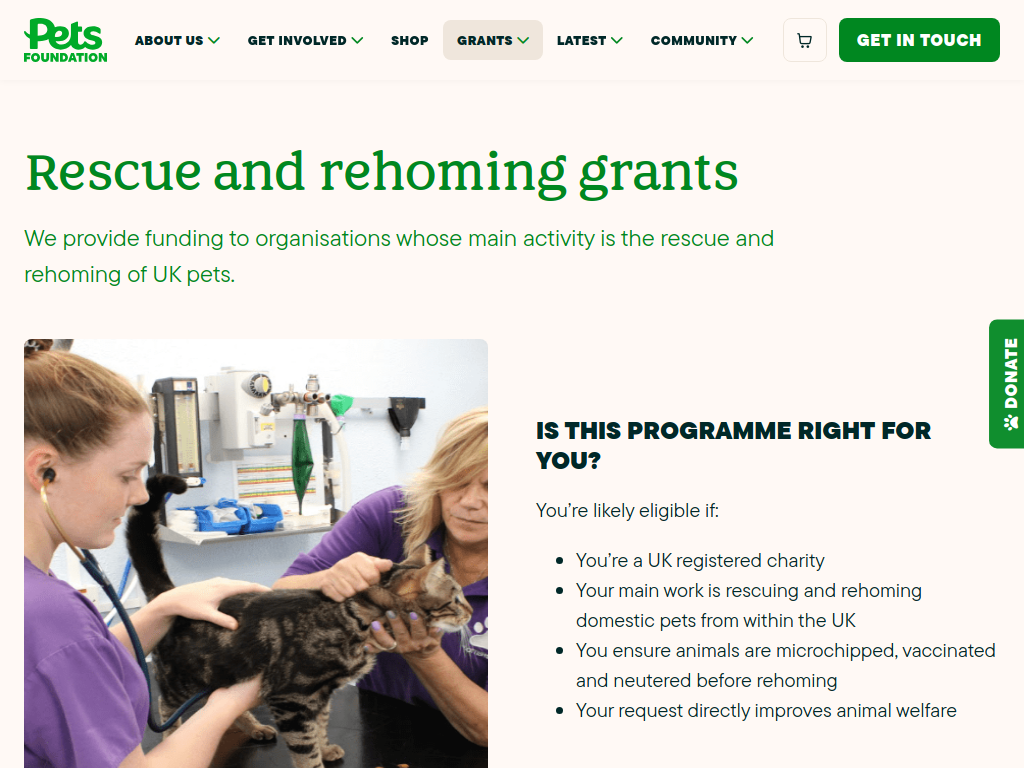
Up to £100,000 for UK Animal Rescue and Rehoming Charities – Pets Foundation
The Pets Foundation Rescue and Rehoming Grants Programme provides funding to UK charities whose main activity is rescuing, caring for and rehoming domestic pets.
The Foundation supports organisations working to improve animal welfare, helping them cover essential running costs, purchase equipment, improve facilities and provide veterinary care.
One-off grants of up to £100,000 are generally considered, although this is guidance rather than a guaranteed maximum award.
Applications are accepted throughout the year, with no fixed deadline.
Here's what you can expect:
One-off grants, with awards above £100,000 considered unlikely
Funding for essential animal rescue and rehoming activities
Support with veterinary bills and animal care
Funding for food, bedding and boarding costs
Equipment purchases
Vehicles used for animal welfare
Building improvements and animal accommodation
Applications accepted on a rolling basis
Monthly reviews for requests under £50,000
What can be funded?
1. Veterinary Care
Funding towards veterinary treatment for rescued animals, helping organisations maintain their health and welfare before rehoming.
2. Essential Running Costs
Support for eligible operational expenses, including:
Utility bills
Animal food
Bedding
Boarding fees
Other eligible animal care costs
3. Equipment
Funding for equipment used in rescue and rehoming activities, such as:
Animal trapping cages
Microchip scanners
Washing machines
Incubators
Other essential animal care equipment
4. Vehicles
Support towards purchasing suitable vehicles, including animal ambulances and horse boxes.
5. Building Improvements
Funding for projects improving animal accommodation and welfare facilities, including suitable building works and onsite veterinary facilities.
All funding requests must demonstrate a direct benefit to animal welfare.
Who can apply?
The programme is intended for eligible UK animal rescue and rehoming organisations.
Applicants should:
Be an appropriately registered UK charity or other eligible charitable organisation under the current grant criteria.
Have rescuing and rehoming domestic pets as their main activity.
Primarily rescue animals originating from within the UK.
Follow appropriate vaccination, microchipping and neutering practices before rehoming.
Demonstrate how the proposed funding will directly improve animal welfare.
Meet the Foundation's organisational and financial requirements.
The Foundation prioritises small and medium-sized charitable organisations.
Organisations primarily operating as animal sanctuaries or rehoming pets from overseas should check the exclusions carefully.
How much funding is available?
Funding Amount: One-off grants, generally up to £100,000
Requests Under £50,000: Reviewed monthly
Requests Over £50,000: Applicants should contact the Foundation before applying
Funding Type: Charitable grant
Geographic Eligibility: United Kingdom
Application Deadline: Rolling
The Foundation advises that awards above £100,000 are unlikely, although exceptional projects may be considered.
What information is required?
Applicants must provide:
Recent organisational accounts
Updated draft financial figures if the latest accounts are more than 12 months old
Evidence supporting the requested costs
Relevant quotations, invoices or supplier information
Details of the proposed project or activity
Examples of supporting evidence include veterinary bills, utility bills, vehicle listings and equipment quotations.
How does the application process work?
Step 1 – Review Eligibility
Read the Foundation's 2026 Rescue and Rehoming Grant Criteria and Grant Programme FAQs.
Step 2 – Request an Application Form
Eligible organisations should complete the application form request on the official programme webpage.
Step 3 – Prepare Supporting Information
Gather recent accounts, project details and evidence of the proposed costs.
Step 4 – Submit the Application
Complete the application form provided by the Foundation.
Step 5 – Application Review
The Foundation assesses applications and may request additional information or arrange a virtual or in-person meeting.
Step 6 – Funding Decision
Applications under £50,000 are reviewed monthly.
The Foundation advises that decisions can take approximately four to five months, depending on application volumes and any additional information required.
Funding information
Funder: Pets Foundation
Funding Amount: Generally up to £100,000
Funding Type: One-off charitable grant
Geographic Eligibility: United Kingdom
Target Audience: Animal rescue and rehoming charities
Eligible Activities: Animal care, running costs, equipment, vehicles and facilities
Application Deadline: No fixed deadline
Application Status: OPEN – Rolling Applications
-
Up to $5,000 in Monthly Microgrants for Women – National Fund for Women
The National Fund for Women (NFW) provides monthly microgrants ranging from US$100 to US$5,000 to help individuals manage everyday expenses, overcome financial barriers and build greater economic stability.
The programme is designed to provide accessible financial assistance without lengthy applications or complicated paperwork.
Grant opportunities change each month and may support personal wellbeing, household expenses, education, family activities or entrepreneurial ambitions.
November 2026 applications are now open, with three grants worth between $100 and $1,000 available.
Here's what you can expect:
Microgrants ranging from $100 to $5,000 across the wider programme
New funding opportunities every month
A short online application
Financial support for personal needs
Opportunities to apply for up to three grants each month
One grant award per successful applicant per month
Digital payment for approved applications
No requirement to operate a registered business
November 2026 funding opportunities
1. $1,000 Home for the Holidays Grant
This grant provides financial assistance to help recipients travel during the holiday season.
Funding Amount: $1,000
Deadline: 22 November 2026
2. $500 Gathering Grant
This grant supports individuals hosting gatherings with family or friends.
Potential uses include family dinners, holiday celebrations and other gatherings.
Funding Amount: $500
Deadline: 22 November 2026
3. $100 Gift Budget Grant
This grant provides additional financial support towards seasonal gift expenses.
Funding Amount: $100
Deadline: 22 November 2026
What other funding opportunities are available?
The National Fund for Women organises its monthly grants into three general categories.
Everyday Support – $100 to $500
Smaller grants designed to help individuals manage everyday expenses or improve their wellbeing.
Get Ahead Support – $500 to $2,500
Funding intended to help recipients overcome financial barriers and make progress towards personal goals.
Build Something Bigger – $2,500 to $5,000
Larger grants that may support personal development, economic opportunities or ambitions such as starting a small business.
Not every category or funding amount is available in every monthly round.
Who can apply?
Applicants must:
Be at least 18 years old.
Be a US citizen or permanent resident.
Hold an eligible National Fund for Women membership.
Apply for funding that addresses their own needs.
Meet the requirements of the specific monthly grant.
Although the programme prioritises women, the organisation states that it considers all eligible applicants without discrimination based on sex.
UK residents without qualifying US citizenship or permanent residency are not eligible.
Can businesses apply?
No.
The National Fund for Women provides microgrants directly to individuals rather than companies or organisations.
Some future grants may help individuals develop business ideas or pursue entrepreneurial ambitions, but this does not make them direct business grants.
The November 2026 grants focus on personal and seasonal expenses.
Is membership required?
Yes.
Applicants must be members of the National Fund for Women to access its microgrants.
Standard Membership: $15 per year
Membership includes access to:
Monthly microgrant applications
Member discounts
Other member benefits and resources
The organisation also offers a waitlist for sponsored memberships for individuals unable to afford the annual fee.
Important: Membership does not guarantee that an applicant will receive funding.
How does the application process work?
Step 1 – Become a Member
Create an account and select an eligible membership option.
Step 2 – Review Available Grants
Visit the microgrants page to see the opportunities available during the current month.
Step 3 – Complete the Application
Applicants answer a short series of questions explaining their circumstances and intended use of the funding.
Step 4 – Submit Before the Deadline
Applications close on the 22nd of each month.
Applicants may submit applications for up to three different grants during the same month.
Step 5 – Application Review
The National Fund for Women reviews completed applications, considering the applicant's circumstances and the potential impact of the financial support.
Step 6 – Funding Decision
Applicants are notified whether their application has been approved.
Step 7 – Payment
Successful applicants complete identity verification and provide the required payment information.
Funds are then transferred securely.
Key dates
November Applications Opened: 1 November 2026
November Application Deadline: 22 November 2026
November Funding Available: $100, $500 and $1,000 grants
Next Monthly Round: Expected 1 December 2026
Application Status: OPEN
Funding information
Programme Funding Range: US$100–US$5,000
November 2026 Award Range: US$100–US$1,000
Funding Type: Personal microgrants
Geographic Eligibility: United States
Minimum Age: 18
Membership Required: Yes
Annual Membership Cost: From US$15
Businesses Eligible: No
Application Deadline: 22 November 2026
-
Education Programme Funding and Partnerships – Dubai Cares
Dubai Cares provides funding and strategic partnerships to organisations delivering education programmes that improve opportunities for children and young people in developing countries.
Established in 2007 and based in the United Arab Emirates, Dubai Cares works with international organisations, NGOs and local implementation partners to improve access to quality education.
The organisation supports initiatives addressing educational inequality, early childhood development, school infrastructure, teacher training, youth skills and education during humanitarian emergencies.
Organisations can currently submit partnership proposals through the official Dubai Cares website.
Unlike a traditional grant competition, there is no publicly advertised fixed funding amount or application deadline.
Here's what you can expect:
Opportunities to propose education programmes for funding consideration
Potential financial support for eligible projects
Collaboration with an international philanthropic organisation
Support for education initiatives in developing countries
Opportunities for partnerships with NGOs and development organisations
Funding consideration for programmes addressing educational inequality
Support for sustainable and scalable education solutions
An online process for submitting programme proposals
Important: Funding is discretionary. Submission of a proposal does not guarantee an award.
What projects can be considered?
Dubai Cares supports a range of education and development priorities.
1. Early Childhood Education
Projects improving access to quality early childhood education and development opportunities.
Examples include:
Early learning programmes
Preschool education
Child development initiatives
Support for vulnerable young children
2. Primary and Secondary Education
Projects improving access to quality education.
Examples include:
School infrastructure
Literacy and numeracy
Curriculum development
Learning assessments
Improving teaching quality
3. Teacher Training and Development
Projects supporting educators and strengthening education systems.
Examples include:
Teacher training
Professional development
Teaching resources
Capacity-building programmes
4. Youth Skills and Employment
Projects helping young people develop practical skills and improve their future opportunities.
Examples include:
Technical education
Vocational training
Youth skills development
Career preparation
5. Education in Emergencies
Projects supporting children and young people affected by humanitarian crises.
Examples include:
Education for displaced children
Learning opportunities during emergencies
Safe learning environments
Education continuity programmes
6. School Health and Nutrition
Projects improving the conditions that enable children to learn.
Examples include:
School feeding
Hygiene education
Water and sanitation facilities
School health initiatives
Nutrition support
7. Girls' Education
Projects reducing barriers to education for girls and young women.
Examples include:
Improving school access
Supporting educational participation
Addressing gender-related barriers
Improving learning opportunities
Who can apply?
Dubai Cares works with organisations involved in international education and development.
Potential partners include:
Non-governmental organisations
International development organisations
Registered nonprofit organisations
Education-focused charities
Local implementing organisations
Organisations with relevant experience delivering education programmes
The organisation has previously partnered with international NGOs and United Nations agencies.
Individuals are not eligible to receive programme funding.
Can UK organisations apply?
UK-registered charities and international development organisations may be able to submit partnership proposals.
However, applicants should demonstrate how their proposed programme would benefit children or young people in developing countries.
This is not a general funding opportunity for education projects delivered exclusively within the United Kingdom.
Dubai Cares assesses potential partnerships according to its priorities and programme requirements.
How much funding is available?
Funding Amount: Not publicly specified
Funding Type: Programme funding and strategic partnerships
Funding Duration: Determined by the proposed programme and any subsequent agreement
Geographic Focus: Developing countries
Application Deadline: No fixed deadline published
There is no confirmed minimum or maximum grant amount.
Organisations must provide a proposed programme budget when submitting their partnership enquiry.
How does the application process work?
Step 1 – Review the Organisation's Priorities
Applicants should familiarise themselves with Dubai Cares' education and development objectives.
Step 2 – Prepare a Programme Concept Note
Organisations must prepare a concept note explaining their proposed programme.
Dubai Cares indicates that concept notes should generally be approximately 3–4 pages long.
Step 3 – Prepare a Programme Budget
Applicants must complete the official programme budget template.
Step 4 – Complete the Partnership Form
The online form requests information about:
Organisation name
Organisation location
Organisation type
Date of establishment
Organisation description
Legal registration documentation
Proposed programme themes
Programme budget
Programme duration
Target education level
Step 5 – Upload Supporting Documents
Applicants must upload the required concept note, programme budget and organisational documentation.
Step 6 – Submit for Consideration
Dubai Cares reviews submissions to identify potential partnerships aligned with its priorities.
Further discussions or documentation may be requested.
Submission does not guarantee that an organisation will receive funding.
Funding information
Funder: Dubai Cares
Funding Amount: Not specified
Funding Type: Education programme funding and partnerships
Geographic Focus: Developing countries
UK Organisations: May submit relevant international programme proposals
Target Audience: NGOs, charities and international development organisations
Individual Applications: Not accepted
-
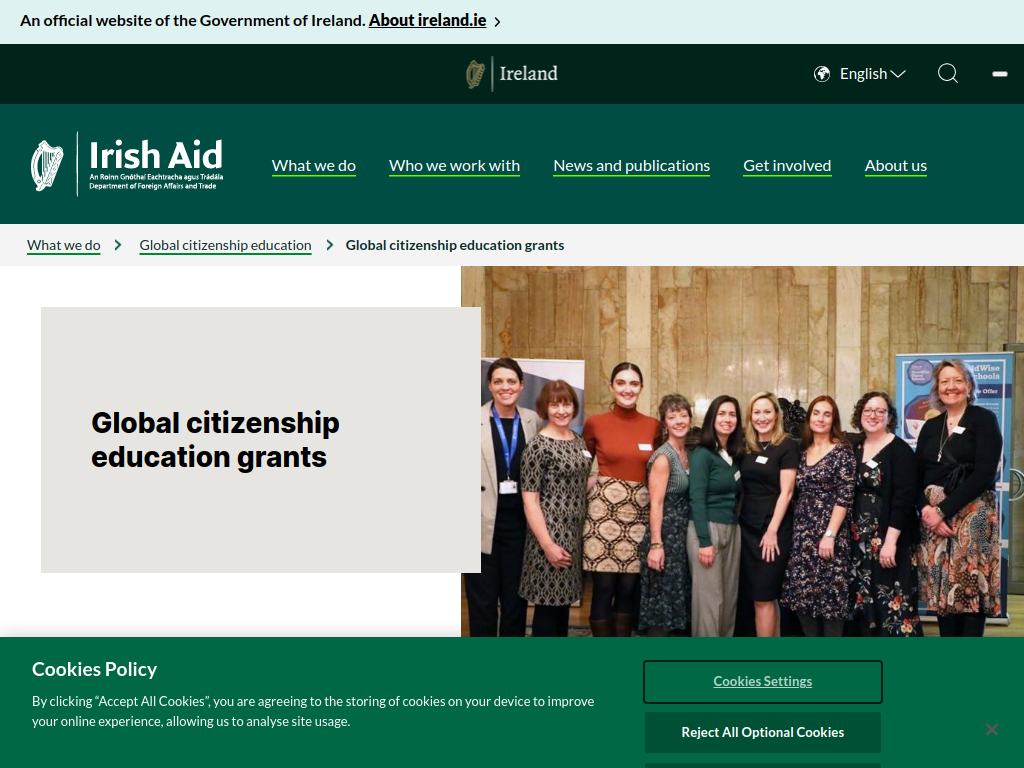
Up to €180,000 for Global Citizenship Education Projects – Irish Aid Grants 2027
The Irish Aid Global Citizenship Education Grant Scheme 2027 is offering €10,000 to €180,000 to support Irish-based organisations delivering educational projects that increase public understanding of global development issues.
The programme aims to help people understand the causes of global poverty, inequality and injustice while encouraging meaningful action towards a more equitable and sustainable world.
Funding is available for eligible organisations working in education, youth development, community engagement and related sectors.
Applications are currently open, with an initial eligibility deadline of 6 November 2026.
Here's what you can expect:
Grants ranging from €10,000 to €180,000
Funding for one-year projects in 2027
Support for innovative educational initiatives
Opportunities to engage new audiences
Funding for global development education
Support for community participation and awareness
Opportunities to develop educational resources
Funding for projects encouraging informed action on global issues
What projects can be funded?
The programme supports global citizenship education activities that encourage critical thinking, understanding and engagement.
Relevant project areas may include:
1. Global Development Education
Projects helping people understand international development challenges.
Examples include:
Global poverty awareness
International inequality
Human rights education
Sustainable development
Global economic justice
2. Climate and Environmental Education
Projects exploring environmental challenges and their relationship with global development.
Examples include:
Climate justice
Environmental sustainability
Sustainable consumption
Climate impacts on vulnerable communities
Education about global environmental responsibility
3. Youth and Community Engagement
Projects encouraging young people and community groups to engage with global issues.
Examples include:
Youth education programmes
Community workshops
Participatory learning activities
Educational events
Community-led awareness initiatives
4. Innovative Education Approaches
Projects developing new ways to engage audiences with global development issues.
Examples include:
Digital learning resources
Interactive educational tools
Creative education programmes
Multimedia learning activities
Innovative community engagement methods
Projects must align with the objectives and assessment criteria of Irish Aid's Global Citizenship Education Grant Scheme.
Who can apply?
The programme is open to eligible organisations based in Ireland.
Potential applicants include:
Registered charities
Nonprofit organisations
Community organisations
Educational organisations
Youth organisations
Development education organisations
Other eligible Irish-based organisations delivering global citizenship education
Applicants should consult the official guidance to confirm their organisational eligibility.
Important: The programme is restricted to Irish-based organisations. UK-only organisations are not eligible.
Key eligibility requirements
Applicants must:
Be based in Ireland.
Meet Irish Aid's organisational eligibility requirements.
Propose activities aligned with global citizenship education.
Demonstrate the capacity to deliver the proposed project.
Submit the required eligibility form before the initial deadline.
Complete the full application if confirmed as eligible.
Provide the required organisational and project information.
Organisations that miss the eligibility deadline cannot proceed to the full application stage.
How much funding is available?
Minimum Grant: €10,000
Maximum Grant: €180,000
Funding Type: Project grant
Project Duration: One year
Eligible Location: Ireland
Funding Year: 2027
The exact award depends on the proposed project, its budget and the outcome of the assessment process.
How does the application process work?
Step 1 – Request an Eligibility Form
Organisations must contact the Irish Aid Global Citizenship Education team to obtain the eligibility form.
Step 2 – Submit the Eligibility Form
Completed eligibility forms must be submitted by:
Friday 6 November 2026 at 12 noon
This is a mandatory first stage.
Step 3 – Eligibility Confirmation
Organisations will be notified of their eligibility by:
Monday 9 November 2026
Eligible applicants will receive the full application form.
Step 4 – Prepare the Full Application
Applicants must provide information about:
The proposed project
Target audiences
Educational objectives
Planned activities
Expected outcomes
Delivery arrangements
Project budget
The application must be signed by an authorised legal representative of the organisation.
Step 5 – Submit the Full Application
Completed applications must be emailed to the Irish Aid Global Citizenship Education team.
Deadline: Wednesday 9 December 2026 at 12 noon
Late applications will not be considered.
Step 6 – Assessment and Funding Decisions
Applications are expected to be assessed during the first quarter of 2027.
Funding decisions are anticipated in March or April 2027, although the timetable may change.
Key dates
Application Status: OPEN
Eligibility Form Deadline: 6 November 2026 at 12 noon
Eligibility Notifications: 9 November 2026
Full Application Deadline: 9 December 2026 at 12 noon
Expected Funding Decisions: March–April 2027
Project Year: 2027
Funding information
Funding Amount: €10,000–€180,000
Funding Type: Global citizenship education project grants
Geographic Eligibility: Ireland only
Target Audience: Irish-based educational, charitable and nonprofit organisations
Project Duration: One year
Initial Deadline: 6 November 2026
Final Application Deadline: 9 December 2026
-
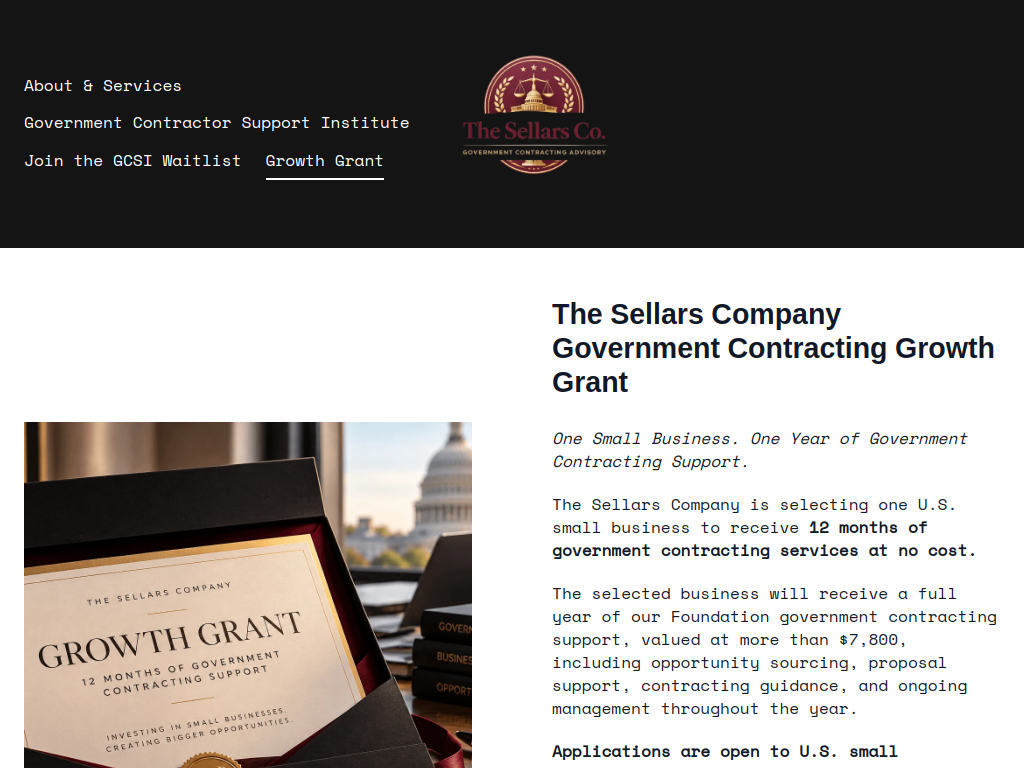
US$7,800 in Free Business Support for US Small Businesses – Sellars Company Growth Grant
The Sellars Company Government Contracting Growth Grant is offering one US small business 12 months of free professional government contracting support, valued at approximately US$7,800.
The programme is designed to help small businesses overcome barriers to entering the government procurement market, identify suitable contracting opportunities and strengthen their ability to compete for public sector contracts.
Successful applicants receive practical assistance with business positioning, contract opportunities, proposal development and ongoing contracting guidance.
Applications are currently open and close on 20 November 2026.
Here's what you can expect:
US$7,800 worth of professional services
12 months of government contracting support
Assistance identifying suitable government contracts
Guidance on preparing and submitting proposals
Support with government contracting readiness
Advice on registrations and certifications
Assistance identifying subcontracting opportunities
Ongoing account management
Monthly progress updates
Potential partial scholarships for additional applicants
Important: This is an in-kind professional services award. No cash funding is provided.
What support is available?
1. Government Contracting Readiness
The programme helps businesses assess their readiness to compete for government contracts.
Support may include:
Reviewing business capabilities
Identifying suitable contracting opportunities
Understanding government procurement requirements
Developing a government contracting strategy
2. Contract Opportunity Identification
Selected businesses receive assistance finding government procurement opportunities relevant to their products or services.
Support may include:
Identifying relevant contract opportunities
Reviewing government solicitations
Assessing suitable procurement pathways
Exploring subcontracting opportunities
3. Proposal Development
The programme provides guidance on preparing competitive government contract proposals.
Support may include:
Reviewing solicitation requirements
Developing proposal responses
Preparing supporting documentation
Guidance on proposal submissions
4. Government Contracting Guidance
Businesses receive ongoing advice to help them navigate government procurement.
Support may include:
Understanding relevant registrations
Identifying appropriate certifications
Reviewing contracting requirements
Developing longer-term government contracting plans
Who can apply?
The Growth Grant is open to legally formed US-based small businesses.
Eligible applicants may include:
Early-stage small businesses
Established small businesses
Businesses exploring government contracting for the first time
Companies seeking to expand their government contracting activities
Businesses requiring additional procurement guidance
Key eligibility requirements
Applicants must:
Be based in the United States.
Operate a legally formed small business.
Provide accurate and complete application information.
Demonstrate an interest in pursuing government contracting opportunities.
Be willing to participate in the programme if selected.
Applicants do not need to:
Have previously won a government contract.
Have prior government contracting experience.
Be registered with SAM.gov when applying.
Hold a government contracting certification.
Meet a minimum revenue requirement.
UK-based businesses are not eligible unless they independently meet the programme's US business requirements.
How much support is available?
Award Value: US$7,800
Number of Full Awards: One
Support Duration: 12 months
Monthly Service Value: US$650
Award Type: In-kind professional services
Cash Funding: None
The award covers services included in the Sellars Company's Foundation government contracting support package.
Additional services, third-party costs, filing fees, certification fees, legal services and other external expenses are not automatically included.
The award cannot be exchanged for cash, transferred or sold.
Are additional awards available?
Yes.
Applicants who do not receive the full Growth Grant may be considered for partial scholarships towards 12 months of government contracting services.
However:
Partial scholarships cover only part of the service costs.
Recipients may need to pay the remaining balance.
The number and value of scholarships are not fixed.
Applicants are not required to accept an offer.
Declining a scholarship does not create a financial obligation.
How are applicants selected?
The Sellars Company reviews applications based on several factors, including:
Business viability
Potential to compete for government contracts
Need for professional support
Business goals for the next 12 months
Current barriers to government contracting
Readiness to participate
Potential impact of receiving support
Only one business will receive the full 12-month award.
Selection does not guarantee that the business will subsequently secure a government contract.
How does the application process work?
Step 1 – Review the Programme Rules
Applicants should read the official Growth Grant eligibility requirements and award conditions.
Step 2 – Complete the Online Application
Visit the official Growth Grant webpage and complete the application form.
Step 3 – Explain Your Business Needs
Applicants should provide accurate information about their business, goals and government contracting support requirements.
Step 4 – Submit Before the Deadline
Applications must be received by 20 November 2026.
Late, incomplete, duplicate or ineligible applications may be excluded.
Step 5 – Selection and Notification
The Sellars Company reviews applications and selects the successful business.
Step 6 – Programme Onboarding
The selected recipient must complete the required onboarding documents and participate in the programme.
Key dates
Application Deadline: 20 November 2026
-
Up to £5,000 for UK Mental Health Charities – Sir Bernard & Lady Schreier Foundation
The Sir Bernard & Lady Schreier Foundation is offering grants of £500–£5,000 to UK charities providing direct support to people experiencing mental health difficulties.
The Foundation aims to improve mental health outcomes by supporting charitable organisations delivering essential services, particularly those helping children, young people and vulnerable communities.
Funding is generally awarded as a one-off contribution towards specific activities, with trustees usually covering up to 50% of the total project cost.
Applications are accepted throughout the year, with no fixed deadline.
Here's what you can expect:
Grants typically ranging from £500 to £5,000
Funding for UK mental health charities
Support for projects providing direct services to beneficiaries
Particular interest in children and young people's mental health
Funding for prevention and early intervention activities
Support for initiatives promoting mental wellbeing
One-off grants for specific activities
Applications accepted on a rolling basis
Funding decisions considered at quarterly trustee meetings
What projects can be funded?
The Foundation focuses on three main priorities.
1. Supporting Children and Young People
Projects empowering children and young people affected by mental illness.
Relevant activities may include:
Youth mental health support
Emotional wellbeing programmes
Community-based support services
Activities helping young people manage mental health challenges
2. Supporting People Experiencing Mental Health Difficulties
Projects providing practical support to individuals affected by mental illness.
Relevant activities may include:
Direct mental health support services
Community-based mental health programmes
Activities reducing isolation
Support for people experiencing mental health difficulties
3. Prevention, Early Intervention and Wellbeing
Projects helping charities prevent mental illness, intervene earlier and promote wellbeing.
Relevant activities may include:
Early intervention programmes
Mental health awareness and support activities
Preventative services
Wellbeing initiatives for vulnerable communities
All proposed activities must directly support people facing mental health issues.
Who can apply?
The Foundation normally awards grants to UK-registered mental health charities.
It is particularly interested in:
Small and medium-sized charities
Local charities
Community-based organisations
Charities supporting children and young people
Organisations providing direct mental health services
Charities delivering prevention and early intervention activities
Applicants should demonstrate how the proposed funding will benefit people experiencing mental health difficulties.
How much funding is available?
Typical Grant Amount: £500–£5,000
Funding Type: One-off charitable grants
Usual Funding Contribution: Up to 50% of project costs
Geographic Eligibility: United Kingdom
Application Deadline: Rolling
Each application is considered individually, and trustees may exercise discretion when determining grant amounts and funding contributions.
What is unlikely to be funded?
The Foundation's grant-making policy places restrictions on certain activities and costs.
These include:
Applications from individuals
Projects with a political element
General fundraising appeals
Sponsorship requests
Activities delivered by public bodies or organisations contracted to provide public services on their behalf
Salary costs, capital expenditure and overheads are generally excluded unless they are essential and directly linked to the proposed activity.
Applicants should review the full grant-making policy before submitting a request.
How does the application process work?
Step 1 – Review the Funding Criteria
Visit the Foundation's website and read its grant-making policy.
Step 2 – Download the Application Form
The application form is available on the official grants page.
Step 3 – Prepare Your Proposal
Applicants should explain:
Their organisation's charitable purpose
The mental health needs being addressed
The proposed activities
Who will benefit
How the grant will be used
The project budget
Any additional funding secured or requested
How the activities will be managed
Step 4 – Submit by Email
Complete the application form and email it to:
[email protected]
Step 5 – Trustee Review
The Board of Trustees normally meets quarterly to review grant applications.
Meetings take place in:
January
April
July
October
The Foundation also aims to consider urgent requests outside its normal meeting schedule where possible.
Step 6 – Funding Decision
Applicants are notified of the outcome by email.
Funding information
Grant Amount: £500–£5,000
Funding Type: Mental health charity grants
Usual Funding Rate: Up to 50% of project costs
Location: United Kingdom
Target Audience: UK mental health charities
Application Deadline: No fixed deadline
-
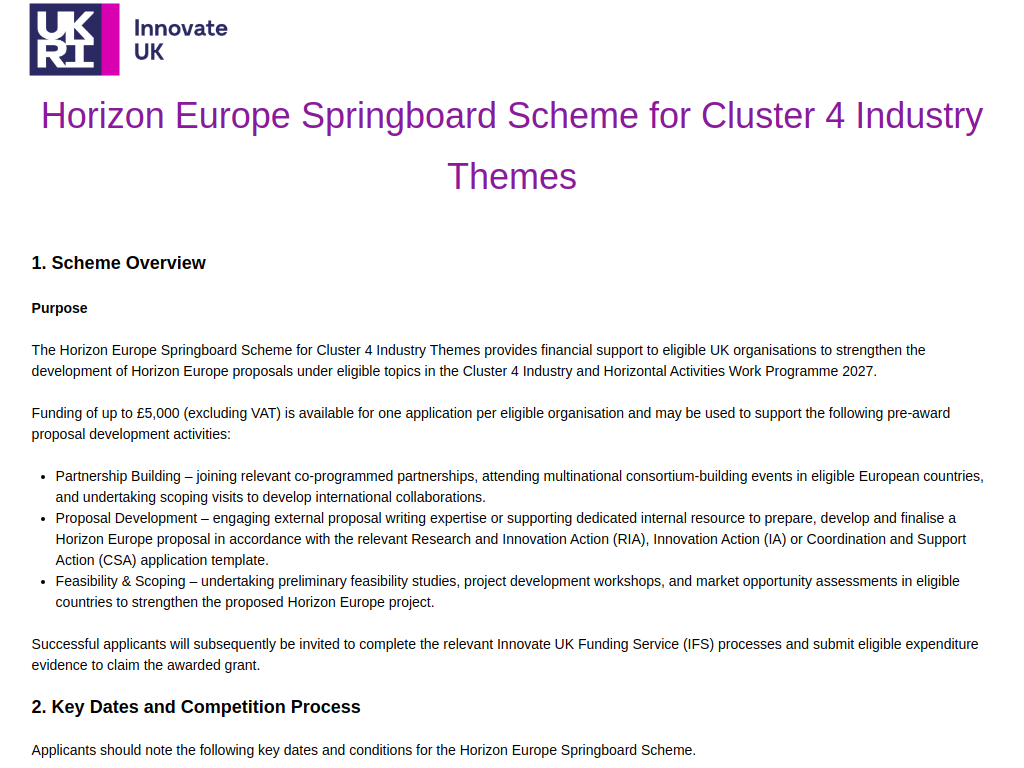
Up to £5,000 for UK Businesses and Research Organisations – Horizon Europe Springboard Scheme
The Horizon Europe Springboard Scheme for Cluster 4 Industry Themes is offering up to £5,000 in grant funding to help UK organisations prepare competitive applications for Horizon Europe research and innovation funding.
Delivered by Innovate UK and Innovate UK Business Connect, the scheme supports organisations developing proposals under eligible topics within the Horizon Europe Cluster 4 Industry and Horizontal Activities Work Programme 2027.
The programme aims to increase UK participation in European research and innovation by helping organisations establish international partnerships, strengthen project proposals and undertake preliminary research.
Applications are OPEN and close on 2 February 2027, or earlier if the available funding is exhausted.
Here's what you can expect:
Up to £5,000 in grant funding per organisation, excluding VAT
Funding for up to 20 eligible UK organisations
Support for preparing Horizon Europe funding applications
Funding for international partnership development
Support for external proposal-writing expertise
Funding for preliminary feasibility studies
Opportunities to develop international research collaborations
Support for project development workshops
Funding awarded on a rolling, first-come, first-served basis
What activities can be funded?
The programme supports three main types of activities.
1. International Partnership Building
Funding can help organisations establish the international relationships needed to develop collaborative Horizon Europe proposals.
Eligible activities include:
Joining relevant European partnerships
Attending international consortium-building events
Participating in brokerage and networking events
Visiting prospective research partners
Developing international collaborations
2. Horizon Europe Proposal Development
Organisations can use funding to strengthen the quality of their funding applications.
Eligible activities include:
Engaging external proposal-writing specialists
Allocating dedicated internal staff time
Developing project proposals
Preparing technical application documents
Organising proposal development workshops
Finalising applications for eligible Horizon Europe calls
3. Feasibility Studies and Project Scoping
Funding can support early-stage activities needed to develop a credible research and innovation proposal.
Examples include:
Preliminary feasibility studies
Market opportunity assessments
Project scoping activities
Technical planning
Project development workshops
What sectors are supported?
Applications must relate to eligible topics within the specified Horizon Europe 2027 work programmes.
Relevant innovation areas include:
Advanced manufacturing
Materials and production technologies
Industrial innovation
Digital technologies
Artificial intelligence
Robotics
Clean industrial technologies
Sustainable manufacturing
Other eligible Cluster 4 Industry and Horizontal Activities topics
Important: Not every Horizon Europe Cluster 4 topic qualifies. Applicants must check the scheme's eligible topic list before applying.
Who can apply?
The programme is open to eligible UK-established organisations interested in participating in Horizon Europe.
Potential applicants include:
Startups and SMEs
Established businesses
Universities
Research organisations
Research and technology organisations
Other eligible organisations preparing Horizon Europe proposals
Applicants must demonstrate that their proposed activities directly support the development of an application under an eligible 2027 Horizon Europe topic.
Key eligibility requirements
Applicants must:
Be legally established in the United Kingdom.
Be developing a proposal for an eligible Horizon Europe 2027 topic.
Explain how the requested funding will strengthen their application.
Identify appropriate partnership-building, proposal-development or feasibility activities.
Obtain written eligibility confirmation from the UK Cluster 4 Industry National Contact Point before applying.
Submit no more than one application per organisation.
Important: Contact the National Contact Point First
Before submitting an application, organisations must contact the UK Cluster 4 Industry National Contact Point (NCP).
Applicants need to:
Identify their intended Horizon Europe funding topic.
Explain their proposed project concept.
Outline the activities they want the Springboard funding to support.
Request confirmation of eligibility.
Receive written approval before submitting the application.
National Contact Point Email:
[email protected]
A phone call or meeting alone does not count as approval.
The NCP aims to respond within 10 working days, so applicants should allow sufficient time before the deadline.
How much funding is available?
Maximum Grant: £5,000 per organisation
Number of Awards: Up to 20
Funding Type: Proposal development and international collaboration grants
VAT: The £5,000 maximum excludes VAT.
Only one grant is available per eligible organisation.
If proposed activities cost more than £5,000, applicants must explain how the additional costs will be funded.
How is funding paid?
Successful applicants must complete the relevant Innovate UK Innovation Funding Service onboarding process.
Grant funding is paid through reimbursement of eligible expenditure.
Applicants must:
Retain evidence of eligible costs.
Submit the required financial documentation.
Comply with their Grant Offer Letter.
Complete the relevant grant claims process.
Payments are expected between 1 and 15 April 2027, subject to the grant conditions.
Important: Applicants should not assume their costs will be reimbursed before receiving formal confirmation of funding.
How does the application process work?
Step 1 – Identify an Eligible Horizon Europe Topic
Review the eligible Cluster 4 Industry and Horizontal Activities topics for 2027.
Step 2 – Contact the National Contact Point
Email [email protected] with your proposal concept and intended activities.
Step 3 – Obtain Written Confirmation
Wait for written confirmation that your organisation and proposed activities are eligible.
Step 4 – Prepare Your Application
Applicants will need to explain:
Their proposed Horizon Europe project
The relevant funding topic
Their organisation's expertise
Existing or planned international partnerships
How the requested funding will be used
Expected outcomes
Proposed activities and costs
Step 5 – Submit Online
Complete the official Springboard Scheme application form.
Step 6 – Complete Grant Onboarding
Successful applicants will be invited to complete the Innovate UK funding administration process.
Key dates
Applications Opened: 10 August 2026
Application Deadline: 2 February 2027
-
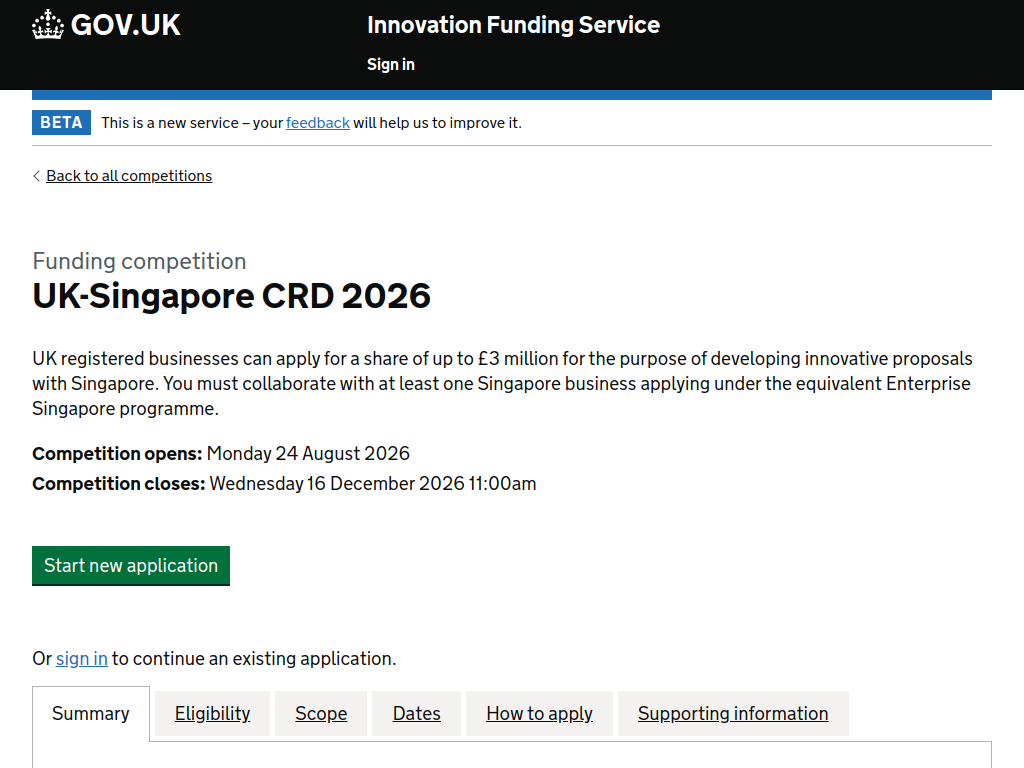
Up to £900,000 for UK Businesses – Innovate UK–Singapore Collaborative R&D 2026
Innovate UK, part of UK Research and Innovation (UKRI), is offering up to £900,000 in grant funding per project to support UK businesses developing innovative technologies in collaboration with Singapore-based companies.
The UK–Singapore Collaborative Research and Development (CR&D) 2026 competition has a total funding allocation of £3 million for UK participants.
The programme aims to strengthen international research partnerships, accelerate technological innovation and help businesses develop commercially viable products, processes and services.
Funding is available for projects in advanced manufacturing, clean energy, life sciences and selected frontier technologies.
Applications are OPEN and close on 16 December 2026 at 11:00am UK time.
Here's what you can expect:
£100,000–£900,000 in grant funding per UK project
A total UK funding budget of £3 million
Up to 70% of eligible costs funded for micro and small businesses
Up to 60% for medium-sized businesses
Up to 50% for large businesses
Support for international research and development partnerships
Funding for industrial research projects lasting 24–36 months
Opportunities to collaborate with Singapore-based companies
Support for developing commercially viable technologies
Funding for eligible research and development expenses
What projects can be funded?
Projects must focus on one of four priority sectors.
1. Advanced Manufacturing
Innovations developing new manufacturing technologies, processes or capabilities.
Examples include:
Advanced production processes
Manufacturing automation
Innovative materials and production technologies
Technologies improving industrial efficiency
2. Clean Energy
Projects developing technologies that support cleaner and more sustainable energy systems.
Examples include:
Renewable energy technologies
Advanced energy storage
Energy efficiency innovations
Technologies supporting industrial decarbonisation
3. Life Sciences
Research and development projects creating new technologies for life sciences applications.
Examples include:
Biotechnology
Healthcare-related technologies
Innovative life sciences processes
Advanced diagnostic technologies
4. Digital and Frontier Technologies
Projects developing innovative technologies in the following areas:
Semiconductors
Quantum technologies
Artificial intelligence
Cybersecurity
Advanced connectivity technologies
Engineering biology
Projects must demonstrate genuine industrial research and clear commercial potential.
Who can apply?
The competition welcomes UK-registered businesses of any size.
Eligible lead applicants include:
Micro businesses
Small businesses
Medium-sized enterprises
Large businesses
UK project partners may include:
Other UK-registered businesses
Universities
Academic institutions
Research and technology organisations
International partnership requirements
Every project must include at least one Singapore-registered business.
The Singapore partner must:
Be a separate legal entity from the UK applicants.
Be independent of the UK project partners.
Apply through the equivalent Enterprise Singapore programme.
Make a meaningful technological contribution to the project.
Important: Singapore partners do not receive funding from Innovate UK.
Instead, they apply separately to Enterprise Singapore for their share of project funding.
Both Innovate UK and Enterprise Singapore must independently approve the project before funding can be awarded.
Key eligibility requirements
Projects must:
Request between £100,000 and £900,000 in UK grant funding.
Last between 24 and 36 months.
Start no earlier than 1 May 2027.
Finish by 30 April 2030.
Include at least one independent Singapore-registered business.
Demonstrate balanced technological contributions from both countries.
Focus on eligible industrial research.
Show a clear intention to commercialise the results.
Carry out most project work in the UK and Singapore.
Ensure UK partners undertake most of their work in the UK.
Ensure UK partners intend to exploit project results in or from the UK.
No individual partner or country may account for more than 70% of total project costs.
How much funding is available?
Total UK Competition Funding: £3 Million
Minimum UK Grant Request: £100,000
Maximum UK Grant Request: £900,000
The funding rate depends on the size and type of organisation.
Micro and Small Businesses
Up to 70% of eligible project costs
Medium-Sized Businesses
Up to 60% of eligible project costs
Large Businesses
Up to 50% of eligible project costs
Research Organisations
For eligible non-economic research activity:
Research and technology organisations may receive up to 100% of eligible costs.
Academic institutions may receive up to 80% of full economic costs.
Research organisations undertaking non-economic activity can collectively account for up to 30% of total eligible project costs.
Can subcontractors be used?
Yes.
Subcontractors are permitted, but their costs must not exceed 20% of the total eligible costs of UK participation.
Subcontractors must be based in the UK and selected through an appropriate procurement process.
What projects cannot be funded?
The competition does not support projects that:
Request less than £100,000 or more than £900,000 in UK grant funding.
Do not have an eligible Singapore business partner.
Fall outside the specified technology sectors.
Do not meet industrial research requirements.
Fail to submit mandatory documentation.
Pose risks to UK national or economic security.
Do not meet the programme's collaboration requirements.
How does the application process work?
Step 1 – Identify a Singapore Partner
UK applicants must establish a genuine research and development partnership with an independent Singapore-registered business.
Step 2 – Review the Competition Guidance
Applicants should confirm their project's eligibility, research category and funding requirements.
Step 3 – Register Online
The UK lead business must create an application through the Innovate UK Innovation Funding Service.
Step 4 – Invite UK Project Partners
Any additional UK organisations must be invited into the application to complete their assigned sections and project finances.
Step 5 – Prepare the Application
The application includes:
Project details
Innovation and technical approach
Market opportunity
Commercialisation strategy
Project team and resources
International collaboration
Project management
Risks and mitigation
Financial information
Expected economic and wider impacts
Step 6 – Coordinate the Singapore Application
The Singapore business partner must submit its corresponding application through Enterprise Singapore.
Step 7 – Submit Before the Deadline
All UK application sections must be completed and submitted through the Innovation Funding Service before the deadline.
How competitive is the funding?
Innovate UK estimates that applicants may have approximately a 15% chance of success, based on experience from similar competitions.
Funding decisions depend on application quality, eligibility, available funding and approval by both national funding bodies.
Key dates
Applications Opened: 24 August 2026
Application Deadline: 16 December 2026
Closing Time: 11:00am UK time
-
€60,000 for UK Startups and SMEs Expanding Internationally – Innowwide Call 5
The Innowwide Programme is offering €60,000 in grant funding to help innovative startups and small and medium-sized enterprises (SMEs) explore new international markets.
Delivered by the Eureka Network and co-funded through the European Union's Horizon Europe programme, Innowwide supports businesses assessing whether their innovative products, services or technologies could succeed in markets outside Europe.
The fifth funding round has a total budget of €4.2 million, supporting up to 70 international market feasibility projects.
UK-registered businesses are eligible to apply.
Applications are currently open and close on 1 December 2026 at 1:00pm UK time.
Here's what you can expect:
€60,000 in grant funding per successful project
Up to 70% of eligible project costs covered
A total funding budget of €4.2 million
Funding for six-month international market feasibility projects
Support for innovative startups and SMEs
Opportunities to explore markets in Africa, Asia, the Americas and Oceania
Funding for technical and commercial feasibility studies
Support for international research and business development
Opportunities to establish partnerships with organisations in target markets
Funding for personnel, subcontracting and eligible travel expenses
What projects can be funded?
Innowwide supports businesses exploring the feasibility of introducing innovative products, processes or services into new international markets.
1. International Market Research
Projects investigating commercial opportunities in a target country.
Examples include:
Assessing customer demand
Researching competitors
Understanding market conditions
Identifying potential customers
Evaluating market-entry opportunities
2. Technical Feasibility Studies
Projects assessing whether an innovative solution can operate successfully in a new market.
Examples include:
Testing technical compatibility
Evaluating local infrastructure requirements
Assessing product adaptations
Investigating technical barriers
Validating potential applications
3. International Business Development
Projects exploring how an innovation could be commercialised internationally.
Examples include:
Developing market-entry strategies
Assessing business models
Identifying commercial partnerships
Investigating distribution opportunities
Evaluating potential routes to commercialisation
4. Regulatory and Legal Assessments
Projects investigating requirements that could affect international expansion.
Examples include:
Local regulations
Product certification requirements
Intellectual property considerations
Legal barriers to market entry
Industry-specific compliance requirements
5. International Research and Innovation Partnerships
Projects exploring opportunities to collaborate with organisations in a target country.
Examples include:
Research partnerships
Technology validation
Joint innovation opportunities
Developing future international R&D projects
Working with local suppliers or end users
The programme is open to innovative businesses across different sectors, with no specific industry or technology theme.
Who can apply?
The programme welcomes eligible SMEs and startups legally established in:
European Union Member States
United Kingdom
Iceland
Israel
Norway
Switzerland
Türkiye
Key eligibility requirements
Applicants must:
Be a legally registered SME in an eligible country.
Have been incorporated on or before 1 December 2024.
Propose a six-month market feasibility project.
Explore a target market in Africa, the Americas, Asia or Oceania.
Have an independent local subcontractor in the target country.
Demonstrate that their innovation has reached at least Technology Readiness Level 4.
Ensure their technology does not exceed Technology Readiness Level 8 in the target market.
Have total eligible project costs of at least €86,000.
Contribute at least €26,000 towards project costs.
Focus exclusively on civilian applications.
Submit their application in English.
Businesses that received funding through a previous Innowwide call are not eligible for this round.
International partnership requirements
Applicants must identify an independent organisation in their chosen target country.
This organisation will act as the project's main subcontractor.
Potential partners include:
Local businesses
Research organisations
Technology providers
Suppliers
Customers
End users
Innovation organisations
The international partner must contribute to the market feasibility project.
Important: The grant is awarded to the applicant SME, not directly to the international partner.
What costs can be funded?
Eligible project expenses include:
Staff and personnel costs
Subcontracting
Travel and subsistence
Equipment depreciation
Goods and materials
Professional services
Other eligible project implementation expenses
Indirect costs calculated using the programme's applicable flat rate
How much funding is available?
Grant Amount: €60,000
Total Competition Funding: €4.2 Million
Number of Projects: 70
Maximum Funding Rate: 70%
Minimum Eligible Project Costs: €86,000
Minimum Applicant Contribution: €26,000
Project Duration: Six Months
Funding is provided in two instalments.
First Payment: €42,000
Successful applicants receive 70% of the grant at the beginning of their project.
Second Payment: €18,000
The remaining 30% is paid after completion of the six-month project and acceptance of the final report.
How does the application process work?
Step 1 – Review Eligibility
Applicants should confirm that their business, innovation and target market meet the programme requirements.
Step 2 – Identify an International Partner
Businesses must establish a relationship with an independent subcontractor in their target country.
Step 3 – Register Online
Create an account through the Eureka Network's SmartSimple application platform.
Step 4 – Prepare the Application
Applicants must explain:
Their innovative product, process or service
The international market they want to explore
Their proposed feasibility activities
The technical and commercial challenges
Their international partnership
Expected project outcomes
The project budget
Step 5 – Complete Supporting Documents
Applicants must upload the official project workplan.
The international subcontractor must also complete the required commitment and declaration through the application platform.
Step 6 – Submit Before the Deadline
Only one application may be submitted per company.
Applications must be completed in English.
How are applications assessed?
Eligible proposals are evaluated by independent experts.
Assessment focuses on:
Excellence and innovation
Expected commercial and economic impact
Quality of project implementation
Strength of the international collaboration
Feasibility of the proposed activities
Funding is awarded to the highest-ranked eligible applications, subject to the available budget.
Key dates
Applications Opened: 1 October 2026
Application Deadline: 1 December 2026
-
Up to €1 Million for Digital Health Innovation – UNITE Open Call 2
The UNITE Digital Health Open Call 2 is offering up to €1 million in grant funding per project to support innovative healthcare technologies developed through international partnerships.
The programme has a total funding allocation of €6 million, with individual organisations eligible to receive up to €600,000, subject to programme rules.
Co-funded through the European Union's Horizon Europe programme, UNITE aims to strengthen digital healthcare innovation, improve access to health services and tackle workforce challenges across Europe.
The competition welcomes eligible businesses, startups, research organisations and healthcare providers from participating European regions, including Scotland and Wales.
Applications are currently open and close on 10 December 2026 at 4:00pm UK time.
Here's what you can expect:
Up to €1 million in grant funding per collaborative project
Up to €600,000 per participating organisation
A total funding budget of €6 million
Up to six projects expected to receive support
Funding for 18-month innovation projects
Support for developing and testing digital health technologies
Opportunities to collaborate with European research organisations
Access to healthcare providers and real-world testing environments
International networking and matchmaking opportunities
Support for developing cross-border innovation partnerships
What projects can be funded?
The programme focuses on two major challenges affecting European healthcare systems.
1. Deep-Tech Innovations for Equal Access to Healthcare
Projects developing technologies that improve healthcare access and outcomes for different population groups.
Examples include:
Personalised digital healthcare solutions
Technologies supporting older people
Digital tools for disadvantaged communities
Solutions improving patient independence
Technologies connecting fragmented healthcare services
Innovative approaches to improving health equity
Projects should demonstrate how their technology can improve healthcare accessibility, personalisation or coordination.
2. Digital Solutions to Address Healthcare Workforce Shortages
Projects developing technologies that help healthcare organisations respond to workforce pressures.
Examples include:
Healthcare automation
Digital tools reducing administrative workloads
Technologies improving clinical workflows
Workforce planning and management solutions
Digital training platforms
Healthcare staff upskilling technologies
Solutions improving operational efficiency
Projects should demonstrate how their innovation can improve workforce capacity, productivity or access to essential healthcare services.
Who can apply?
The programme welcomes eligible organisations involved in digital health innovation, including:
Startups
Small and medium-sized enterprises
Established technology companies
Research institutions
Universities
Hospitals
Healthcare providers
Innovation clusters
Living labs
Testing and demonstration facilities
Other relevant innovation organisations
Geographic eligibility
Applicants must be legally established in one of the following participating regions:
United Kingdom
Scotland
Wales
Greece
Central Macedonia
Italy
Lombardy
Spain
Extremadura
Aragón
Romania
Nationwide
Important: Organisations based solely in England or Northern Ireland are not eligible under the published regional requirements.
Consortium requirements
Applications must be submitted by international partnerships.
Each consortium must include:
At least three organisations
Organisations from at least three different participating regions
At least one company or other organisation developing a market-ready solution
At least one research organisation
At least one end-user organisation that will test or demonstrate the technology
Partnerships must also include:
At least one organisation from Scotland or Wales
At least one organisation from Central Macedonia, Romania, Lombardy, Extremadura or Aragón
Individual organisations cannot apply independently.
What types of organisations can form a consortium?
A suitable partnership could include:
Technology Developer
A startup or company developing an innovative digital health solution.
Research Partner
A university or research organisation supporting technical development, testing or evaluation.
Healthcare End User
A hospital, healthcare provider, living lab or other organisation demonstrating the technology in a real-world environment.
The consortium must meet all applicable geographic and organisational requirements.
How much funding is available?
Total Competition Funding: €6 Million
Maximum Grant per Project: €1 Million
Maximum Funding per Organisation: €600,000
Expected Number of Funded Projects: Up to Six
Project Duration: 18 Months
The €600,000 beneficiary limit applies across UNITE open calls, rather than separately to each funding round.
The amount awarded to each organisation depends on its role, eligible costs and the applicable funding rules.
What additional support is available?
Beyond financial assistance, UNITE provides opportunities for:
International partnership development
Matchmaking with European organisations
Networking events
Collaboration with research institutions
Access to healthcare innovation ecosystems
Support with developing cross-border project proposals
Knowledge sharing between participating regions
Applicants can use the UNITE Matchmaking Platform to identify suitable project partners.
How does the application process work?
Step 1 – Review the Funding Guidelines
Applicants should download and read:
The UNITE Call Document
The UNITE Specific Call 2 Document
These documents explain the detailed eligibility, assessment and financial requirements.
Step 2 – Form an Eligible Consortium
Applicants must establish a partnership involving at least three organisations from three different participating regions.
The consortium must include a technology developer, research partner and end-user organisation.
Step 3 – Develop the Project Proposal
Partners should prepare a joint proposal explaining:
The healthcare challenge being addressed
The proposed digital health innovation
The technology's expected impact
The roles of participating organisations
How the solution will be developed and tested
The proposed project budget
Expected outcomes and opportunities for scaling
Step 4 – Register on the UNITE Cloud
Applications must be prepared and submitted through the official UNITE Cloud platform.
Step 5 – Submit Before the Deadline
The consortium must submit its completed proposal before the competition closes.
Key dates
Applications Opened: 10 September 2026
Application Deadline: 10 December 2026
-
Up to $500,000 for Climate Technology Innovators – Breakthrough Energy Fellows 2027
The Breakthrough Energy Fellows Programme is offering up to $500,000 in early-stage investment to support scientists, engineers and entrepreneurs developing breakthrough technologies to tackle climate change.
Delivered through Breakthrough Energy Discovery, the programme helps promising early-stage technologies progress from scientific development towards commercialisation.
The 2027 programme welcomes applications from innovators worldwide, including the United Kingdom.
Alongside financial support, successful applicants receive expert mentorship, technical guidance, business development assistance and access to an international network of investors and industry partners.
Applications are open for Cohort 7 and close on 2 November 2026.
Here's what you can expect:
Up to $500,000 in early-stage investment for Innovator Fellows
Approximately $50,000–$250,000 in research funding for Explorers
A 12-month Innovator Fellowship
Technical development and commercialisation support
Expert mentoring and business guidance
Access to investors and industry partners
Support with research and development expenses
Opportunities to develop and validate new climate technologies
Access to specialist expertise and professional networks
International participation, including UK applicants
What technologies are supported?
The programme focuses on breakthrough technologies capable of delivering significant climate benefits.
1. Clean Energy and Electricity
Innovations that could transform energy generation, storage and distribution.
Examples include:
Advanced energy storage
Next-generation electricity technologies
Innovative grid technologies
Breakthrough energy generation systems
2. Sustainable Manufacturing
Technologies addressing emissions from industrial production.
Examples include:
Low-carbon industrial processes
Cleaner manufacturing technologies
Alternative production methods
Innovations reducing emissions from hard-to-decarbonise industries
3. Transportation and Mobility
Technologies with the potential to significantly reduce transport-related emissions.
Examples include:
Advanced transportation technologies
Low-carbon fuels
Innovative propulsion systems
New approaches to transport decarbonisation
4. Food and Agriculture
Innovations reducing emissions from food production and agriculture.
Examples include:
Low-emission agricultural technologies
Alternative production processes
Innovative food technologies
Breakthrough approaches to agricultural emissions
5. Buildings and Construction
Technologies reducing emissions associated with buildings and construction.
Examples include:
Low-carbon building materials
Innovative heating and cooling technologies
Advanced building systems
Technologies improving the environmental performance of buildings
The programme also considers high-impact innovations outside these categories where they meet its climate impact requirements.
What funding routes are available?
1. Innovator Fellowship – Up to $500,000
The Innovator Fellowship supports scientists, engineers and entrepreneurs developing early-stage climate technologies with commercial potential.
Successful applicants receive:
Up to $500,000 in catalytic investment
Support with research and development costs
Business and commercialisation mentoring
Technical project management
Access to investors and industry experts
Professional development and networking
Important: Innovator funding is typically provided through a SAFE or similar investment agreement. It is not a non-repayable grant.
The programme also provides substantial in-kind support, including mentoring, specialist services and industry access.
2. Explorer Programme – Approximately $50,000–$250,000
The Explorer Programme supports earlier-stage, higher-risk climate technology research.
It is particularly relevant to:
University researchers
Scientists
Research institutions
Laboratory-based innovators
Teams developing proof-of-concept technologies
Funding can support:
Laboratory expenses
Equipment
Research materials
Technical consultants
Staff and personnel costs
Other eligible research and development expenses
Explorers can generally remain employed by their existing institution.
Who can apply?
The programme welcomes international applicants, including:
Scientists
Engineers
Climate technology entrepreneurs
Early-stage startup founders
University researchers
Research teams
Innovators developing breakthrough climate technologies
Key eligibility requirements
Innovator Fellowship applicants should typically:
Be developing a novel climate technology.
Have a technology readiness level of approximately 1–4.
Demonstrate significant potential to reduce or capture greenhouse gas emissions.
Typically have raised less than $2 million in dilutive investment.
Be prepared to work full-time on commercialising their technology.
Have a legally incorporated company before the programme begins in September 2027.
Demonstrate credible technical progress and supporting evidence.
Applicants do not need to have incorporated a company before applying.
Explorer applicants should typically:
Be developing a high-risk, early-stage climate technology.
Have a technology readiness level of approximately 0–2.
Be undertaking applied research with commercial potential.
Demonstrate the potential for substantial climate impact.
Be able to deliver agreed technical milestones.
What climate impact is required?
Breakthrough Energy focuses on technologies with the potential to reduce or capture greenhouse gas emissions by at least 500 million tonnes annually at scale.
The programme also welcomes technologies that meaningfully address adaptation to climate change.
Applicants must demonstrate why their technology represents a significant advance rather than an incremental improvement.
What costs can be supported?
Depending on the funding route, financial support may cover:
Laboratory space
Office space
Equipment
Research supplies
Technical consultants
Staff costs
Technology development
Testing and validation
Other agreed research and development expenses
Funding arrangements differ between Innovator and Explorer applicants.
How does the application process work?
Stage 1 – Concept Paper
Applicants submit a technology proposal and pitch deck through the online application portal.
The proposal should explain:
The technology being developed
The problem it addresses
Its potential climate impact
Technical innovation and feasibility
Current development progress
Planned research and development activities
Stage 2 – Full Application
Selected Innovator applicants are invited to submit additional information about:
Their technology
Commercialisation strategy
Business model
Potential climate impact
Development plans
Stage 3 – Deep-Dive Interview
Shortlisted Innovator applicants participate in an interview with the programme team.
Stage 4 – Selection
Successful applicants are selected for the 2027 programme.
Explorer applications follow a related process, with later stages arranged by invitation and on a rolling basis.
Key dates
Applications Opened: 22 September 2026
Innovator Concept Paper Deadline: 2 November 2026
Closing Time: 11:59pm Eastern Time
Full Application Invitations: Late 2026 to early 2027
Interviews: Early to mid-2027
Innovator Selection: Mid-2027
Programme Begins: September 2027
Explorer Applications: Considered on a rolling basis
Funding information
Innovator Investment: Up to $500,000
Explorer Research Funding: Approximately $50,000–$250,000
Funding Type: Early-stage investment, research funding and fellowship support
Location: Worldwide, including the United Kingdom
Programme Duration: Approximately 12 months
Target Audience: Climate technology innovators, scientists, engineers and researchers
Innovator Deadline: 2 November 2026
-
£50,000 for Grassroots Conservation Leaders – Whitley Awards 2027
The Whitley Fund for Nature (WFN) is offering £50,000 in project funding to support grassroots conservation leaders protecting wildlife, restoring ecosystems and tackling biodiversity loss.
The 2027 Whitley Awards recognise experienced conservationists working directly with local communities to deliver practical, science-based environmental solutions.
Each award provides funding over one year, alongside international recognition, professional development and opportunities to access additional conservation funding.
Applications are currently open and close on 30 October 2026 at 11:59pm GMT.
Here's what you can expect:
£50,000 in project funding
Financial support over one year
International recognition for conservation achievements
Professional communications and media support
Training and professional development opportunities
Networking with international conservation leaders
Peer learning and collaboration
Access to a global conservation network
Potential eligibility for future Continuation Funding
Opportunities to be considered for the Whitley Gold Award
What projects can be funded?
The programme supports established conservation projects demonstrating measurable environmental benefits.
1. Wildlife and Biodiversity Conservation
Projects protecting threatened species and ecosystems.
Examples include:
Protecting endangered wildlife
Reducing threats to biodiversity
Improving habitat management
Supporting ecosystem recovery
2. Community-Led Conservation
Initiatives involving local communities in environmental protection.
Examples include:
Community-managed conservation areas
Indigenous-led environmental protection
Collaborative wildlife management
Local conservation leadership
3. Habitat and Ecosystem Protection
Projects protecting or restoring important landscapes and seascapes.
Examples include:
Forest conservation
Wetland protection
Marine ecosystem conservation
Landscape restoration
4. Human-Wildlife Coexistence
Projects addressing challenges between communities and wildlife.
Examples include:
Reducing human-wildlife conflict
Supporting coexistence strategies
Developing community-based conservation approaches
5. Scaling Successful Conservation Projects
Initiatives expanding established conservation work.
Examples include:
Replicating successful conservation approaches
Strengthening local conservation partnerships
Expanding protection across landscapes
Developing long-term conservation strategies
Projects must demonstrate direct, measurable biodiversity benefits and meaningful community involvement.
Who can apply?
The Whitley Awards are designed for mid-career conservation leaders working in eligible countries.
Applicants must:
Be nationals of the country where they work.
Lead an established conservation project.
Work in an eligible country, generally a low- or middle-income economy.
Be embedded in local communities.
Work for a locally incorporated NGO, charity, nonprofit organisation or university.
Demonstrate previous conservation achievements.
Lead or work with an experienced project team.
Show how their project benefits biodiversity and local communities.
Demonstrate potential to expand successful conservation work.
Be able to communicate verbally in English without a translator.
Applicants do not need to be nominated or invited.
Geographic eligibility
The programme primarily supports conservation leaders in eligible countries outside high-income economies.
Applicants should consult the official country eligibility list before applying.
Important: UK-based conservation projects are generally not eligible, despite the Whitley Fund for Nature being a UK charity.
What cannot be funded?
The programme does not support:
New or untested pilot projects
Pure academic research
MSc or PhD fieldwork undertaken primarily for qualifications
Expeditions
Land purchases
Building construction
Animal welfare projects without wider conservation outcomes
General rural or economic development without measurable biodiversity benefits
Projects led by expatriates
Individuals working without an established team
Joint applications
Projects lacking meaningful community involvement
Government employees are generally ineligible, although some university-based conservationists may qualify.
How much funding is available?
Award Amount: £50,000
Funding Duration: One year
Each successful applicant receives £50,000 to support their conservation project.
Additional benefits include professional communications support, training, international visibility and networking opportunities.
Award winners may also become eligible for further support through WFN's Continuation Funding programme.
How does the application process work?
Step 1 – Check Eligibility
Applicants should review the eligibility criteria and confirm that their project operates in an eligible country.
Step 2 – Register Online
Create an account through the Whitley Fund for Nature's application portal.
Step 3 – Complete the Application
Applicants must provide information about:
Their conservation experience
The environmental challenge being addressed
Evidence of previous project success
Community participation
Proposed conservation activities
Expected environmental outcomes
Project sustainability
Step 4 – Prepare Supporting Documents
Applicants must complete:
A project logical framework and timeline
A detailed project budget
The official templates must be downloaded from the application portal.
Step 5 – Nominate Three Referees
Applicants must nominate three referees to support their application.
All three references must be submitted before the deadline.
Step 6 – Submit the Application
Applications must be submitted through the official online portal by 30 October 2026.
Key dates
Application Deadline: Friday 30 October 2026
Closing Time: 11:59pm GMT
Award Winners Announced: Spring 2027
Awards Ceremony: London, Spring 2027
Funding information
Funding Amount: £50,000
Funding Duration: One year
Funding Type: Conservation grants and awards
Location: Eligible low- and middle-income countries
Target Audience: Established grassroots conservation leaders
Application Deadline: 30 October 2026 at 11:59pm GMT
-
$75,000 for Climate Innovation Projects – Climate Intervention Environmental Impact Fund
The Climate Intervention Environmental Impact Fund (CIEIF) is offering $75,000 grants to support innovative climate technologies with the potential to address the causes or major effects of global warming.
The fund supports organisations and researchers worldwide developing climate intervention technologies that are approaching the field-testing stage.
CIEIF is offering three grants of $75,000 each in its latest funding round.
Funding is specifically available for environmental impact assessments, predictive impact modelling and engagement with communities and stakeholders who could be affected by proposed field tests.
Applications are currently open and close on 1 December 2026.
Here's what you can expect:
$75,000 in grant funding per successful application
Three grants available in the current round
International applications welcomed
Support for innovative climate intervention technologies
Funding for environmental impact assessments
Support for predictive environmental impact modelling
Funding for stakeholder and community engagement
Opportunities to work with independent environmental consultants
Expert advice from CIEIF's team
Potential eligibility for repeat funding in future rounds
What projects can be funded?
The programme supports environmental assessments associated with innovative technologies capable of delivering meaningful climate benefits.
1. Carbon Removal Technologies
Projects investigating technologies designed to remove greenhouse gases from the atmosphere or environment.
Examples include:
Enhanced rock weathering
Biochar-based carbon removal
Marine carbon dioxide removal
Ocean alkalinity enhancement
Other innovative carbon removal approaches
2. Methane Reduction and Removal
Projects investigating technologies that address methane emissions or atmospheric methane.
Examples include:
Livestock methane capture
Agricultural methane removal
Methane removal technologies
Innovative approaches to reducing atmospheric methane
3. Ocean and Marine Climate Interventions
Projects exploring approaches to addressing climate change through marine environments.
Examples include:
Ocean fertilisation
Marine carbon removal
Ocean-based climate intervention technologies
Environmental assessment of marine field tests
4. Ice and Glacier Interventions
Projects investigating technologies designed to address the loss of ice and related climate impacts.
Examples include:
Ice preservation
Glacier stabilisation
Ice-thickening technologies
Surface reflectivity interventions
5. Environmental Impact and Stakeholder Research
Projects assessing the environmental and social implications of proposed climate intervention field tests.
Examples include:
Environmental impact assessments
Predictive impact modelling
Independent environmental analysis
Community engagement
Public health and safety assessments
Stakeholder consultation
These examples illustrate potentially relevant technologies. Funding must be used for eligible assessment, modelling or engagement activities rather than general technology development.
Who can apply?
Applications are welcomed from organisations worldwide, including:
Nonprofit organisations
Universities and research institutions
Climate technology companies
Environmental research organisations
Eligible project partnerships
CIEIF gives particular priority to nonprofit institutions but also welcomes applications from private businesses.
UK-based organisations are eligible to apply.
Key eligibility requirements
Applicants must:
Be an eligible organisation rather than an individual applicant.
Be developing an innovative climate intervention technology.
Have a proposed field test that is approaching implementation.
Demonstrate the technology's potential for meaningful climate benefits.
Explain how the proposed intervention could be scaled.
Focus the funding request on environmental impact assessment, modelling or stakeholder engagement.
Identify relevant environmental, social, economic or health risks.
Explain any government permits or approvals required.
Demonstrate willingness to publish findings through peer review.
Provide a clear proposed budget for the $75,000 award.
What costs can be funded?
Funding can support:
Environmental impact assessments
Independent environmental consultants
Predictive impact modelling
Stakeholder engagement activities
Community consultation
Relevant technical analysis
Associated staff time
Closely related project expenses
Costs must be directly connected to the fund's eligible assessment, modelling or engagement activities.
What cannot be funded?
CIEIF does not support:
Basic scientific research
General climate technology development
Full-scale technology implementation
Renewable energy projects
General emissions reduction programmes
Climate adaptation projects
Climate resilience programmes
Sustainable development projects
Direct air capture technologies
Carbon capture, utilisation and storage
Stratospheric solar radiation management
Applications from individuals or students
Government agencies
The programme is specifically designed to support the responsible assessment of innovative climate interventions.
How much funding is available?
Grant Amount: $75,000
Number of Grants: Three
Total Available This Round: $225,000
Funding is paid in stages.
Successful applicants receive approximately one-third of their grant after initial project-scoping discussions.
The remaining payments are released according to agreed project milestones.
Repeat annual funding may be possible, subject to future decisions.
How does the application process work?
Step 1 – Review Eligibility
Applicants should confirm that their proposed field test and funding requirements align with CIEIF's priorities.
Step 2 – Prepare a Written Proposal
Applications must address ten key areas, including:
Applicant and project team information
Description of the proposed climate intervention
Existing research supporting the technology
Potential environmental and social impacts
Required government approvals
Relevant scientific publications
Potential independent consultants
Proposed use of the $75,000 grant
Other funding sources
Insurance arrangements and publication commitments
Step 3 – Prepare a Budget
Applicants must explain how the grant would be used for eligible assessment, modelling or engagement activities.
Step 4 – Contact CIEIF
There is no standard online application form.
Applicants must contact the fund manager before submitting their completed proposal to confirm the submission process.
Step 5 – Funding Assessment
Applications are reviewed against their scientific credibility, potential climate benefits and suitability for the programme.
Successful applicants are expected to participate in further discussions about their assessment and engagement requirements.
Important application requirements
Proposals must be written in English.
Applications should not exceed 20 single-spaced pages using 12-point font.
Supporting scientific publications and biographies may be submitted separately.
Applicants must agree to publish their findings through an appropriate peer-review process.
CIEIF explicitly prohibits AI-generated application materials.
The fund states that applicants using AI in cover letters or applications may be rejected and barred from future applications.
Applicants should prepare their submissions independently and follow the official guidance carefully.
Key dates
Application Deadline: 1 December 2026
Funding Decisions Expected: 1 February 2027
Funding information
Grant Amount: $75,000
Total Available: $225,000
Number of Awards: Three
Funding Type: Climate innovation and environmental assessment grants
Location: Worldwide, including the United Kingdom
Target Audience: Climate technology companies, nonprofits and research institutions
Application Deadline: 1 December 2026
-
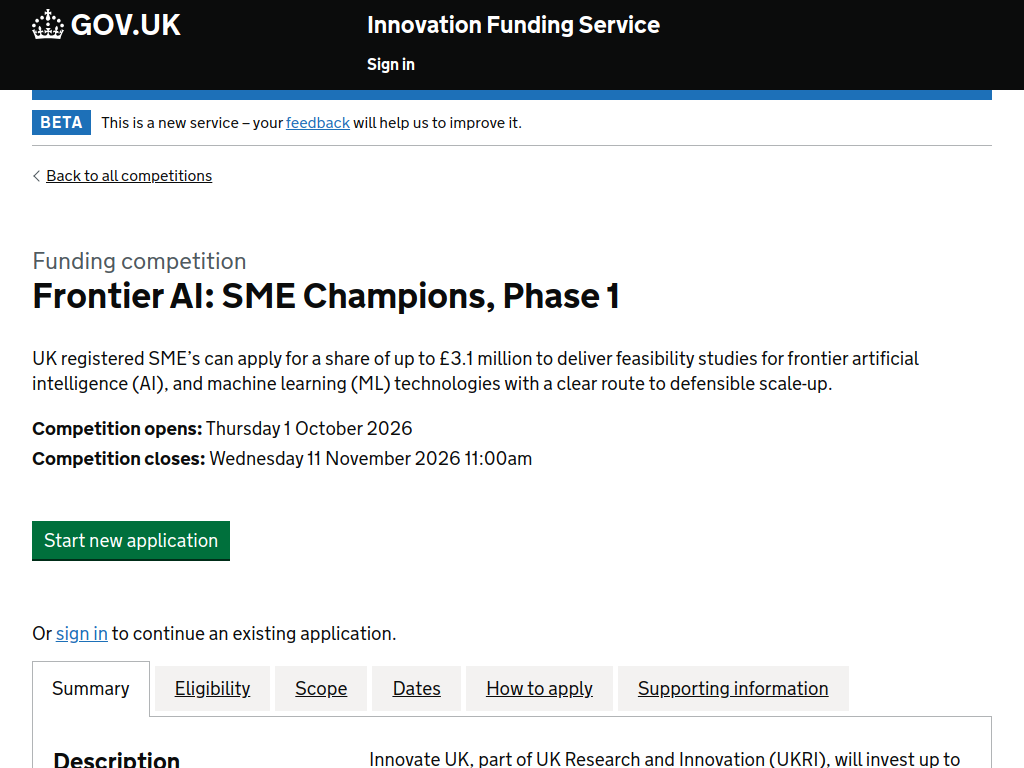
Up to £175,000 for UK AI Startups and SMEs – Innovate UK Frontier AI: SME Champions, Phase 1
Innovate UK, part of UK Research and Innovation (UKRI), is offering grants of up to £175,000 to support UK micro and small businesses developing innovative artificial intelligence (AI) and machine learning (ML) technologies.
The Frontier AI: SME Champions, Phase 1 competition has a total funding allocation of £3.1 million and aims to help ambitious UK businesses demonstrate the technical feasibility of advanced AI innovations with strong commercial potential.
Projects must have eligible costs between £150,000 and £250,000, with grants covering up to 70% of eligible costs for micro and small businesses or 60% for medium-sized businesses.
Applications close 11 November 2026 at 11:00am.
Here's what you can expect:
Up to £175,000 in grant funding for eligible micro and small businesses
Up to £150,000 for eligible medium-sized businesses
A share of £3.1 million in total competition funding
Support for feasibility studies and industrial research
Funding for developing novel AI and machine learning technologies
Opportunities to validate technical innovations and demonstrate commercial potential
Support for creating proof-of-concept prototypes
Potential progression to further funding phases, subject to selection and approvals
What projects can be funded?
Projects must focus on developing genuinely innovative AI or ML technologies and align with at least one of four priority themes.
1. AI-Enabled Health and Life Sciences
Innovations improving healthcare, medical research and life sciences.
Priority areas include:
Predictive healthcare
Medicines discovery
Medicines manufacturing optimisation
Genomics and multi-omics
2. Advanced Materials with AI
Projects using advanced AI technologies to improve materials research and development.
Priority areas include:
AI-powered materials prediction
Generative models and optimisation
Physics-based machine learning
Materials discovery and simulation
AI-enabled manufacturing optimisation
Advanced materials characterisation
3. Secure AI for National Security and Defence
Projects developing advanced AI capabilities for secure and resilient systems.
Priority areas include:
Autonomous decision-support systems
Advanced AI reasoning
Multi-source data analysis
Resilient AI systems
Edge intelligence
Secure AI architectures
4. AI Safety and Assurance Technologies
Innovations improving the reliability, security and safety of advanced AI systems.
Priority areas include:
AI safety testing
Runtime verification
Autonomous system controls
AI evaluation environments
Detecting and preventing AI failures
Safety assurance technologies
Who can apply?
The competition is open to:
UK-registered micro businesses
UK-registered small businesses
UK-registered medium-sized enterprises
Applicants must work independently rather than as part of a consortium.
Key eligibility requirements
Applicants must:
Be a UK-registered SME.
Submit only one application per organisation.
Have total eligible project costs between £150,000 and £250,000.
Deliver a project lasting between one and three months.
Start the project by 1 April 2027.
Complete the project by 30 June 2027.
Carry out funded project work in the UK.
Intend to exploit the project's results in the UK.
Spend most of the funding within the UK.
Demonstrate genuine technical innovation in AI or ML.
Have a credible route towards commercialisation and scale-up.
Subcontractors are not permitted.
What types of innovation are eligible?
Projects must develop novel AI or machine learning technology rather than simply apply existing AI tools.
Innovations should involve advances in areas such as:
AI model architecture
Training methodologies
Core learning algorithms
Core control algorithms
Projects must begin at Technology Readiness Level 1–3.
Successful proposals must demonstrate:
A clear technical challenge
Evidence of innovation
Measurable technical objectives
A route to defensible intellectual property or competitive advantage
A credible market opportunity
Potential for future commercialisation
What cannot be funded?
The competition does not support projects that:
Simply integrate existing AI tools into business processes
Rely on existing third-party AI models without substantial technical innovation
Focus mainly on routine software development
Lack clear technical novelty
Do not demonstrate a measurable feasibility challenge
Have no credible route to commercialisation
Lack a defined market opportunity
Focus primarily on hardware development where AI is secondary
Do not align with the specified competition themes
How much funding is available?
Total Competition Funding: £3.1 million
Eligible Project Costs: £150,000–£250,000
Micro and Small Businesses
Up to 70% of eligible project costs
Maximum potential grant: £175,000
Medium-Sized Businesses
Up to 60% of eligible project costs
Maximum potential grant: £150,000
Applicants must fund the remaining proportion of their project costs.
The amount awarded depends on project eligibility, assessment and available competition funding.
What must successful projects deliver?
By the end of Phase 1, projects must produce:
A proof-of-concept prototype or critical technical component
Evidence demonstrating the innovation's technical feasibility
A clear validation methodology
Measurable technical results
Evidence of technical novelty
A rationale for future scaling
A technical white paper outlining project findings
Successful Phase 1 applicants may be invited to apply for Phase 2 funding.
Phase 2 is expected to support further development of demonstrators, with eligible project costs potentially reaching £1 million.
Progression is not guaranteed and depends on future competition approvals and project outcomes.
How does the application process work?
Step 1 – Review the Competition Guidance
Applicants should read the eligibility, scope and funding requirements.
Step 2 – Register Online
Create an account or sign in through the Innovate UK Innovation Funding Service.
Step 3 – Prepare the Application
Applications must include:
Project details
Technical innovation and objectives
Evidence of intellectual property and defensibility
Market opportunity
Project team and resources
Development and validation plans
Project finances
Expected project impact
Step 4 – Submit Supporting Documents
Applicants may need to provide supporting documents, including technical diagrams and project team CVs.
Step 5 – Submit Before the Deadline
All application sections must be completed and submitted through the online funding portal.
Key dates
Applications Opened: 1 October 2026
Application Deadline: 11 November 2026 at 11:00am
-
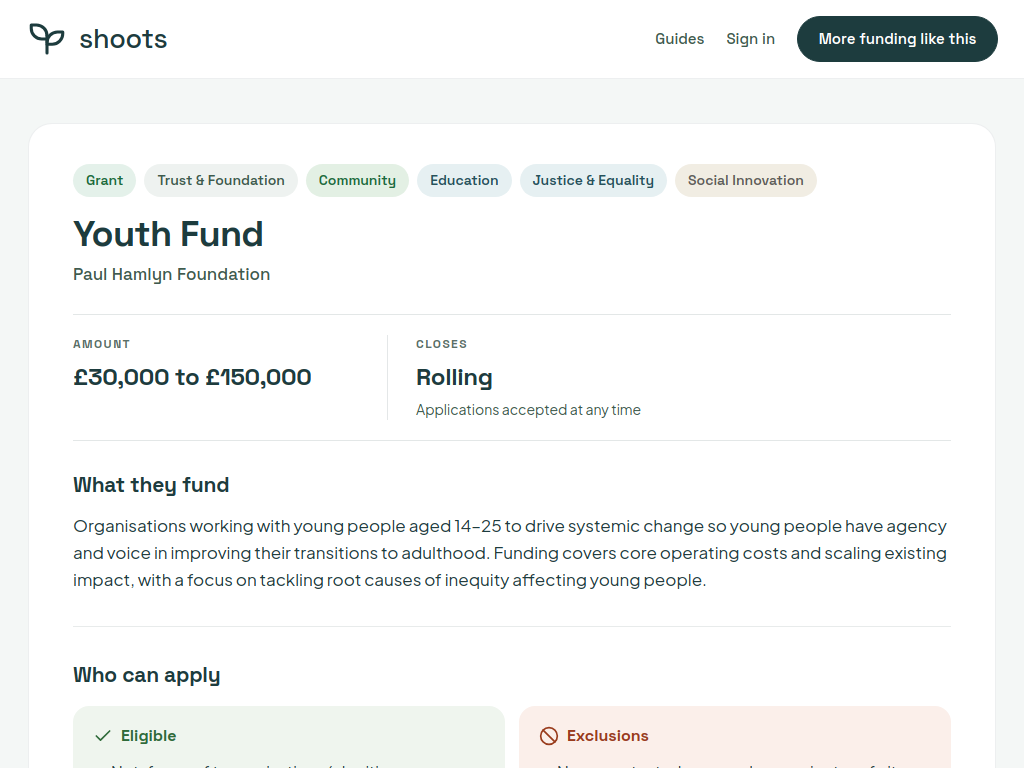
Up to £150,000 for Youth Organisations – Paul Hamlyn Foundation Youth Fund
The Paul Hamlyn Foundation Youth Fund provides grants of up to £150,000 over three years to support UK nonprofit organisations working with young people aged 14–25.
The fund aims to help organisations address the root causes of inequality, strengthen young people's voices and create lasting improvements in the systems and services affecting their transition into adulthood.
Unlike many project-based grants, the Youth Fund provides funding towards core operating costs, allowing established organisations to strengthen and expand their existing work.
Applications are currently open on a rolling basis, with no fixed deadline.
Here's what you can expect:
Up to £150,000 in grant funding
Funding of £30,000–£50,000 per year
Three years of financial support
Funding for core organisational costs
Support for salaries and operational expenses
Investment in established youth organisations
Opportunities to strengthen existing services and influence wider change
Support for organisations addressing inequality and injustice
Funding for work that centres young people's voices and experiences
What work can be funded?
The Youth Fund supports organisations working to create lasting improvements for young people experiencing systemic inequality.
1. Tackling Inequality and Injustice
Work addressing the underlying causes of barriers faced by young people.
Examples include:
Challenging discrimination
Addressing inequalities in access to services
Supporting young people experiencing exclusion
Improving opportunities for marginalised groups
Tackling structural barriers affecting young people's lives
2. Improving Systems and Services
Initiatives helping organisations and institutions improve how they support young people.
Examples include:
Improving youth support services
Developing more inclusive practices
Training professionals
Influencing service delivery
Strengthening young people's rights and entitlements
3. Youth Voice and Participation
Work ensuring young people have meaningful influence over decisions affecting their lives.
Examples include:
Youth-led decision-making
Advocacy programmes
Youth representation
Developing leadership opportunities
Supporting young people to influence policy and practice
4. Supporting Challenging Transitions
Organisations supporting young people experiencing barriers during important life transitions.
Examples include:
Moving into or out of education
Leaving care
Experiencing housing insecurity
Transitioning from youth justice settings
Navigating complex support systems
5. Influencing Policy and Practice
Work creating improvements beyond an organisation's immediate beneficiaries.
Examples include:
Research linked to practical action
Advocacy for policy changes
Sharing evidence and good practice
Improving professional standards
Influencing institutional decision-making
Who can apply?
The programme is open to established UK nonprofit organisations, including:
Registered charities
Community organisations
Social enterprises
Not-for-profit companies
Key eligibility requirements
Applicants must:
Have an annual income between £100,000 and £2 million.
Dedicate at least 50% of their organisational work to young people aged 14–25.
Have independently audited or examined accounts.
Demonstrate an established track record of supporting young people.
Show how their work addresses systemic inequality.
Demonstrate how young people influence their organisation's work.
Have a clear commitment to anti-racism and inclusive practice.
Focus on strengthening existing work rather than introducing entirely new projects.
Non-charitable organisations must demonstrate that the funding will be used for charitable purposes and have an appropriate asset lock.
Partnership applications are permitted where an established partnership has a lead organisation responsible for receiving the funding.
What costs can be funded?
The Youth Fund provides flexible support towards existing organisational activities.
Eligible costs include:
Staff salaries
Core operating expenses
Organisational development
Delivery costs
Activities supporting wider systems change
Strengthening existing programmes
Improving organisational capacity and impact
What cannot be funded?
The programme does not support:
Newly registered organisations without independently audited or examined accounts
New or untested projects
Short-term activities with no wider impact
Statutory responsibilities
Direct service delivery without a wider change objective
Research without a clear pathway to action
Hospice or end-of-life care for young people
Projects focused exclusively on employment pathways
Projects focused exclusively on access to further or higher education
YMCA projects are generally excluded unless they aim to achieve significant wider changes in housing provision or young people's entitlements.
How much funding is available?
Minimum Grant: £90,000 over three years
Maximum Grant: £150,000 over three years
The Foundation provides between £30,000 and £50,000 annually.
Funding is awarded for the full three-year period.
The Foundation generally prefers to award the maximum amount where appropriate.
How does the application process work?
Stage 1 – Written Application
Applicants complete an online application explaining:
Their organisation's existing work
The young people they support
Their ambitions for wider change
How their approach aligns with the fund's priorities
How young people influence their work
Applicants must also provide:
An organisational, business or strategic plan
A safeguarding policy
Stage 2 – Online Interview
Shortlisted applicants are invited to an interview.
Additional information may be requested about:
Organisational finances
Fundraising
Governance
Impact and outcomes
Stage 3 – Funding Decision
Applications are reviewed by the Foundation's team and considered by a grants panel.
The Foundation normally takes four to six months to reach a final decision.
Applicants should usually receive an initial response within eight weeks.
How competitive is the fund?
The Foundation reports that:
Approximately 20 grants are awarded annually.
Around 10–12% of applicants receive funding.
Applicants should demonstrate a strong track record, meaningful youth involvement and clear ambitions for wider change.
Funding information
Grant Amount: £90,000–£150,000
Annual Funding: £30,000–£50,000
Funding Duration: Three years
Funding Type: Core organisational funding
Location: United Kingdom
Target Audience: Established nonprofit organisations supporting young people aged 14–25
Application Deadline: Rolling – no fixed deadline
-
Up to £3,000 for UK Charities and Community Projects – BCBN Grant Initiative 2026
The Better Community Business Network (BCBN) Grant Initiative provides grants of up to £3,000 to support small charities, nonprofit organisations and grassroots community projects across the UK, excluding Northern Ireland.
The programme aims to improve quality of life within local communities, particularly for people experiencing disadvantage or social deprivation.
BCBN distributes up to £36,000 annually through the initiative, supporting organisations that can demonstrate a positive and measurable impact.
Next published application deadline: 9 November 2026.
Here's what you can expect:
Up to £3,000 in one-off grant funding
Support for grassroots charities and community groups
Funding for projects addressing local community needs
Opportunities for organisations working with disadvantaged communities
Support for education, health and wellbeing initiatives
Funding for community development and social inclusion projects
Grants for activities delivering clear benefits to local residents
What projects can be funded?
The programme supports a broad range of charitable community initiatives.
1. Children and Education
Projects improving educational opportunities and supporting young people.
Examples include:
Youth development activities
Educational workshops
Community learning programmes
Activities supporting disadvantaged children
2. Health and Wellbeing
Initiatives improving physical or mental wellbeing within local communities.
Examples include:
Community wellbeing activities
Disability support projects
Health awareness initiatives
Activities reducing social isolation
3. Poverty and Homelessness
Projects helping individuals and families experiencing financial hardship or housing insecurity.
Examples include:
Community support initiatives
Practical assistance for vulnerable residents
Projects addressing poverty
Homelessness support activities
4. Arts, Culture and Community Engagement
Projects bringing communities together through creative and cultural activities.
Examples include:
Community arts projects
Cultural workshops
Creative activities promoting inclusion
Local community engagement programmes
5. Sport and Recreation
Initiatives improving access to recreational activities.
Examples include:
Inclusive sports programmes
Community recreation projects
Activities for disadvantaged young people
Projects encouraging participation and wellbeing
6. Social Inclusion and Community Development
Projects strengthening community relationships and supporting people facing barriers to participation.
Examples include:
Community cohesion activities
Support for older people
Disability inclusion
Projects supporting prisoners and former offenders
Initiatives improving opportunities for underserved groups
Who can apply?
Applications are open to eligible:
Registered charities
Nonprofit organisations
Community groups
Community interest organisations with charitable aims
Local branches of national charities
Key eligibility requirements
Applicants must:
Be based in England, Scotland or Wales.
Deliver a project benefiting a local UK community.
Address a community issue or support a local community initiative.
Have charitable or community-benefit objectives.
Be registered with a recognised governing body, such as the Charity Commission or Companies House, for at least 18 months.
Have annual accounts available and submitted.
Be able to provide governing documents, such as articles of association or a constitution.
Demonstrate the expected positive impact of their project.
What cannot be funded?
BCBN does not support:
Projects delivered outside the UK
Projects based in Northern Ireland
Political party activities
Individual sponsorship
Travel and accommodation costs
Retrospective funding
General organisational running costs
Ongoing venue hire, salaries and utility bills
Professional associations or professional training
Commercial companies without charitable aims
Endowments, loans or organisational deficits
General fundraising appeals
Applications requesting more than £3,000 may be rejected.
Organisations seeking partial project funding must disclose other funders and relevant partnerships.
How much funding is available?
Grant Amount: Up to £3,000 per organisation
The programme provides one-off grants to eligible community projects.
BCBN distributes up to £36,000 annually through the initiative.
Successful organisations cannot receive more than one award within a 12-month period.
Unsuccessful applicants may reapply after one year.
How does the application process work?
Step 1 – Check Eligibility
Applicants must complete the eligibility quiz on BCBN's official website.
Step 2 – Prepare Project Information
Organisations should be ready to explain:
The community issue being addressed
Who will benefit
The activities being delivered
The expected impact
How the grant will be spent
How project outcomes will be measured
Step 3 – Submit an Application
The online application button will become available on BCBN's website when the third application round opens.
Step 4 – Assessment
Applications are reviewed by BCBN's Charity Committee.
Step 5 – Funding Decision
Shortlisted organisations may be contacted for further information before awards are confirmed.
Successful recipients must provide an evaluation report explaining how their funding was used.
Key dates
Round 1 Deadline: 17 April 2026 – Closed
Round 2 Deadline: 7 September 2026 – Closed
Round 3 Deadline: 9 November 2026 – Listed by external funding directories; confirm on the official portal
Round 3 Award Decisions: 30 November 2026 – Reported by funding directories
2026 Programme Ends: November 2026
-
Up to £500,000 for Healthcare Innovation – British Heart Foundation
The British Heart Foundation (BHF) Healthcare Implementation Fund 2026 is offering grants of up to £500,000 to support innovative projects that improve the delivery of healthcare services for people living with cardiovascular disease.
Previously known as the Healthcare Innovation Fund, the programme supports early-stage testing and scaling of new approaches to cardiovascular care within real-world NHS settings.
The aim is to identify practical solutions that improve patient outcomes, strengthen healthcare services and demonstrate measurable improvements in care delivery.
Applications close 16 November 2026 at 12 noon.
Here's what you can expect:
Up to £500,000 in grant funding
Support for innovative cardiovascular healthcare projects
Funding for early-stage testing of new approaches
Opportunities to scale promising healthcare solutions
Support for improving patient care and clinical services
Funding for projects introducing new healthcare technologies
Opportunities for collaboration between NHS organisations, universities and other partners
Support for projects demonstrating measurable improvements in healthcare delivery
What projects can be funded?
The fund supports innovative approaches that address unmet needs in cardiovascular healthcare.
Projects should aim to achieve at least one of the following outcomes.
1. Reducing Hospital Admissions
Projects helping reduce unnecessary hospital admissions and readmissions.
Examples include:
Improving preventative care
Supporting earlier interventions
Strengthening patient monitoring
Improving community-based cardiovascular services
2. Improving Patient Flow
Initiatives helping patients access appropriate care more efficiently.
Examples include:
Improving referral pathways
Reducing delays in treatment
Strengthening coordination between healthcare services
Improving patient discharge processes
3. Enhancing Quality of Care
Projects improving the quality, safety and effectiveness of cardiovascular services.
Areas of interest include:
Improving patient experiences
Strengthening clinical pathways
Introducing new approaches to care delivery
Improving access to specialist services
4. Implementing New Technologies
Projects introducing innovative technologies into cardiovascular healthcare.
Examples may include:
Digital healthcare solutions
Remote patient monitoring
Innovative diagnostic technologies
New clinical tools
Technology-enabled care pathways
5. Improving Healthcare Resources
Initiatives helping healthcare providers make better use of available resources.
Examples include:
Improving service efficiency
Reducing unnecessary processes
Supporting workforce productivity
Improving resource allocation
6. Strengthening Communication and Collaboration
Projects improving coordination between healthcare professionals, services and patients.
Examples include:
Improving communication between clinical teams
Strengthening multidisciplinary working
Supporting patient engagement
Improving information sharing
Who can apply?
The fund is open to eligible healthcare and academic teams across the United Kingdom.
The lead applicant must be employed by:
An NHS organisation; or
A UK-based academic institution.
Applications are invited from teams identified and supported by relevant regional innovation bodies, including:
Health Innovation Networks in England
Innovation Hubs in Scotland
Cardiac Network Board in Wales
Cardiology Network in Northern Ireland
Projects may also involve additional partners, including:
Charities and voluntary organisations
Healthcare technology companies
Industry partners
Third-sector organisations
Other relevant healthcare stakeholders
However, the lead applicant must meet the NHS or UK academic employment requirement.
Key eligibility requirements
Applicants must demonstrate that:
The project introduces an innovative or novel approach.
The proposed solution addresses an identified cardiovascular healthcare need.
Initial project scoping has already been completed.
The project will deliver measurable improvements in healthcare services.
An appropriate multidisciplinary team has contributed to the proposal.
Patients and carers have been involved appropriately.
The project includes a structured evaluation plan.
The application provides a detailed and justified budget.
Projects requesting close to the maximum £500,000 must provide particularly strong justification for the funding required.
What types of projects are supported?
The fund supports two project stages.
Early-Stage Testing
Projects testing innovative solutions that have already undergone initial scoping.
These projects aim to establish whether a proposed approach can improve cardiovascular healthcare in practice.
Early-Stage Scaling
Projects expanding promising solutions that have already demonstrated potential.
These projects aim to assess whether an approach can be implemented more widely across healthcare settings.
How much funding is available?
Grant Amount: Up to £500,000 per project
The amount awarded will depend on the project's scope, complexity and proposed costs.
Applicants must provide a detailed budget explaining how the requested funding will be used.
The British Heart Foundation has previously awarded approximately £5.74 million through the Healthcare Implementation Fund and its predecessor.
How does the application process work?
Step 1 – Review the Funding Criteria
Applicants should read the Healthcare Implementation Fund Criteria Pack to confirm their project's eligibility.
Step 2 – Register for an Account
Create an account or sign in through the BHF Research Grants system.
Step 3 – Select the Application Type
Choose the relevant application form:
Early-stage testing
Early-stage scaling
Step 4 – Complete the Application
Provide details about:
The healthcare problem being addressed
The proposed innovative solution
Project objectives
Expected patient benefits
Team members and partnerships
Evaluation methods
Project budget
Step 5 – Submit Online
Applications must be submitted through the BHF Grant Management System.
Applications submitted by email will not be accepted.
Key dates
Applications Opened: 21 September 2026
Application Deadline: 16 November 2026 at 12 noon
Application Assessment: November–December 2026
Funding Decisions Expected: March 2027
Next Funding Round: March/April 2027
-
Cultural Innovation Grants with No Fixed Funding Cap – City of Edinburgh Innovate Fund 2026–2028
The City of Edinburgh Council Innovate Fund 2026–2028 is offering revenue grant funding to local cultural and creative organisations developing innovative projects that strengthen Edinburgh's cultural sector.
The programme aims to improve organisational resilience, encourage creative programming and make cultural activities more accessible to communities across the city.
There is no recommended minimum or maximum grant amount. Applicants should request the funding needed to deliver their proposed activities.
APPLICATIONS CLOSE 29 OCTOBER 2026!
Here's what you can expect:
Grant funding with no fixed minimum or maximum award
Support for innovative cultural and creative projects
Funding for new approaches to arts programming
Opportunities to improve access to cultural activities
Support for collaboration between creative organisations
Funding for digital innovation and audience engagement
Support for organisational resilience and sustainability
Eligible staffing, professional and project delivery costs
What projects can be funded?
Creative Programming & Innovation
Projects introducing new approaches to cultural activities, including:
New artistic programmes and experiences
Interdisciplinary creative collaborations
Immersive and digital cultural experiences
Community-created arts activities
Innovative approaches to engaging audiences
Community Engagement & Accessibility
Projects making arts and culture more accessible, including:
Cultural activities outside Edinburgh city centre
Programmes engaging underrepresented communities
Projects reducing barriers to cultural participation
Inclusive public celebrations and installations
Activities supporting community wellbeing
Digital Transformation
Initiatives using technology to strengthen cultural provision, such as:
Digital audience engagement
Innovative cultural experiences
New digital tools
Improved organisational processes
Technology-enabled creative collaborations
Organisational Resilience
Projects strengthening the long-term sustainability of cultural organisations, including:
Developing new income streams
Improving governance
Exploring alternative business models
Strengthening workforce wellbeing
Improving operational flexibility
Who can apply?
The programme is designed for local cultural organisations delivering projects that benefit Edinburgh's cultural sector.
Applicants must demonstrate how their proposed activities contribute to the Council's cultural priorities and Visitor Levy objectives.
Projects should support at least one of the following:
Innovation in cultural programming
Improved access to arts and culture
Greater organisational resilience
Stronger collaboration across the creative sector
Edinburgh's reputation as a leading cultural destination
What cannot be funded?
The following are ineligible:
Projects that are already underway
Existing projects currently being delivered
Projects currently or previously funded through the Council's Third Party Cultural Grant Funding
General operating or core business costs
Capital projects or building works
Costs associated with recovering Edinburgh's Visitor Levy
Eligible costs
Funding may cover:
Additional staffing required to deliver the project
Direct project delivery costs
Professional fees
Project management and monitoring costs, subject to limits
Freelance creative practitioners must be paid appropriate industry rates.
Funded organisations must also meet the Council's Fair Work requirements, including payment of the real Living Wage.
How much funding is available?
Grant Amount: No recommended minimum or maximum
Applicants should request the amount required for their proposed activities.
Successful applicants may receive less than the amount requested.
For awards exceeding £10,000, funding is normally paid in two instalments:
70% following the signed funding agreement
30% following submission of an annual progress report
Application requirements
Applicants must complete the online application and provide supporting documents, including:
Project budget
Articles of Association
Latest accounts and projected reserves
Business plan
Diversity and Inclusion Policy or Action Plan
Fair Work Policy
Environmental Policy
Projects must include measurable outcomes aligned with the programme's objectives.
Key dates
Applications Opened: 22 September 2026
Application Deadline: 29 October 2026, 11:59pm
Funding Decisions Expected: 17 December 2026
Project Start: From 18 December 2026
Project Completion: 31 March 2028, with possible extensions to 31 December 2028
Funding information
Grant Amount: No fixed minimum or maximum
Funding Type: Revenue project grants
Location: Edinburgh, Scotland
Target Audience: Local cultural and creative organisations
Application Status: OPEN – CLOSING SOON
APPLY NOW
Deadline: 29 October 2026 at 11:59pm
-

Up to $2 Million for AI Innovation & Public Service Projects – Cities Deliver 2026
The Rockefeller Foundation and OpenAI Foundation are offering $500,000–$2 million in grant funding through their new Cities Deliver: AI Solutions for Public Services initiative.
With $50 million in total funding, the programme supports organisations working alongside city governments to develop and expand AI-powered solutions that improve public services, particularly for underserved communities.
The initiative aims to help projects collectively reach up to 100 million city residents worldwide.
Here's what you can expect:
$500,000–$2 million in grant funding per project
Funding for projects lasting 24 months
Support for developing, testing and scaling AI solutions
Opportunities to collaborate with city governments
Mentoring, peer learning and evaluation support
Access to networks of city leaders, funders and technical partners
Potential AI product and engineering support, subject to availability
Opportunities to showcase projects at international events
What funding is available?
1. 🌱 Seed Funding – $500,000 to Under $1 Million
For early-stage AI solutions ready to be tested in a city environment.
Funding can support:
Developing and refining innovative ideas
Building AI-powered prototypes
Testing solutions with city government partners
Running pilot projects
Gathering evidence of effectiveness
Preparing successful solutions for future expansion
2. 🚀 Scale Funding – $1 Million to $2 Million
For AI solutions that have already been piloted and demonstrated early results.
Funding can support:
Expanding existing AI solutions
Reaching additional residents
Scaling projects across city departments
Introducing successful solutions in other cities
Strengthening long-term financial sustainability
What projects can be funded?
The programme focuses on four priority areas.
1. 🏥 Public Health
AI solutions improving access to healthcare and public health services.
Examples include:
Disease surveillance and outbreak prediction
Improving access to frontline healthcare
Disability support services
Public health prevention programmes
Food access and nutrition initiatives
2. 💼 Economic Mobility
Projects helping residents access employment, training and financial opportunities.
Examples include:
AI-powered career guidance
Employment and skills matching
Improving access to public benefits
Supporting unemployed and underemployed residents
Connecting people with relevant training opportunities
3. 🌱 Environmental Resilience
AI technologies helping cities prepare for and respond to environmental challenges.
Examples include:
Flood prediction and early-warning systems
Emergency response technologies
Climate risk monitoring
Energy infrastructure management
Environmental disaster preparedness
Land management and resilience planning
4. 🏙️ Civic Engagement
Projects improving communication and interaction between residents and local government.
Examples include:
AI-powered public service assistants
Digital access to government services
Multilingual resident support
Public feedback and communication systems
Improving permitting and regulatory processes
Increasing participation in local decision-making
Important: Projects relating to voting or elections are excluded.
Who can apply?
Eligible lead applicants include:
Registered nonprofit organisations
Charities and civil society organisations
University laboratories and research organisations
Fiscally sponsored organisations
Public benefit corporations
Certain for-profit organisations delivering qualifying charitable projects
Important eligibility requirements:
Every application must:
Be submitted by an eligible lead organisation.
Include a committed city government partner.
Deliver a clear charitable or public-benefit purpose.
Focus on improving services for underserved or vulnerable communities.
Demonstrate how advanced AI technology is central to the proposed solution.
Show that the project addresses a genuine public service challenge.
Demonstrate the ability to deploy technology responsibly.
Include plans for privacy, safety, evaluation and long-term sustainability.
City governments cannot apply directly. They must collaborate with an eligible lead organisation.
Applicants are not required to use OpenAI technology. They may select the AI models and tools most appropriate for their project.
How is funding distributed?
Grants are awarded over 24 months.
50% of the approved funding is provided at the beginning of the project.
The remaining 50% is released after a documented mid-project milestone.
Applicants should demonstrate that their project can achieve its objectives within the grant period.
How does the application process work?
Stage 1 – Initial Application
Applicants complete an eligibility screening and submit their first-round proposal, including a short video.
Stage 2 – Interviews
Shortlisted applicants are invited to participate in interviews.
Stage 3 – Full Proposal
Successful applicants from the interview stage are invited to submit a detailed second-round proposal.
Stage 4 – Final Selection
Selected organisations receive funding and programme support to deliver their projects.
Key dates
Funding: $500,000–$2 million per project
Total Programme Funding: $50 million
Project Duration: 24 months
Geographic Eligibility: International
Applications Opened: 14 October 2026
Initial Application Deadline: 🚨 29 November 2026 at 11:59 pm US Eastern Time
-
CHF 5,000 for Child Development & Education Researchers – BOLD Science Communication Fellowship 2026
The Jacobs Foundation is offering a CHF 5,000 stipend through its BOLD Science Communication Fellowship, supporting early-career researchers who want to improve how scientific knowledge about children's learning and development is communicated.
The six-month programme provides expert training, mentoring and opportunities to create accessible research-based content for educators, parents and caregivers.
Up to three researchers will be selected.
Here's what you can expect:
CHF 5,000 stipend per selected fellow
Six months of professional development
Expert mentoring in science communication
Specialist training in science writing and editing
Workshops on communicating complex research
Training in creating educational videos for social media
Monthly writing sessions with the BOLD editorial team
Opportunities to publish content for an international audience
What areas of research are supported?
The fellowship focuses on communicating scientific research relating to children's learning and development.
Relevant topics may include:
1. Child Development
Cognitive development
Children's behaviour and learning
Social and emotional development
Individual differences in development
2. Education & Learning
Evidence-based teaching practices
Learning environments
Educational psychology
Supporting children's individual learning needs
3. Technology & Education
Digital learning
Educational technology
Technology's influence on children's development
Communicating research about modern learning environments
4. Supporting Educators & Caregivers
Translating scientific findings into practical advice
Helping parents understand child development
Making academic research accessible to wider audiences
Who can apply?
The fellowship welcomes early-career researchers working in child learning and development.
Researchers from around the world are invited to apply.
Applicants should be interested in developing their ability to communicate scientific research to non-specialist audiences.
Important: This opportunity is designed for individual researchers, rather than charities or businesses seeking general project funding.
What does the funding cover?
Selected fellows receive a CHF 5,000 stipend to support the time and resources needed to participate in the fellowship.
The programme also provides specialist professional development opportunities.
How does the programme work?
Successful applicants participate in a six-month programme combining training, mentoring and practical content creation.
Activities include:
Attending specialist writing workshops
Participating in monthly writing sessions
Developing science communication skills
Learning to edit research-based content
Producing accessible educational materials
Exploring video production for digital audiences
Key information
Funding: CHF 5,000 per fellow
Number of Places: Up to 3
Programme Duration: 6 months
Geographic Eligibility: International
Applications Opened: 1 September 2026
Application Deadline: 31 October 2026