


General Grants
Browse our earlier grant listings for startups, charities and community groups.
920 links
-

Funding opportunity: Ultra Long Duration Energy Storage Project Development Studies Relaunch
See the full opportunity details on the Innovation Funding Service.
UK registered businesses can apply for a share of up to £3 million for project development studies to support the development of electrochemical ultra long duration energy storage demonstration projects in the UK.
Eligibility summary
This competition is open to single applicants and collaborations.
To lead a collaborative project or to work alone, your organisation must be a UK registered business of any size.
The consortium may also contain one or more of the following organisation types:
other UK registered business academic institution research and technology organisation (RTO) charity not for profit public sector organisation -

Fundraising & Additional Funding for Nonprofits – GlobalGiving
The Pathway to GlobalGiving allows nonprofit organisations worldwide to work towards becoming approved GlobalGiving partners, giving them access to an international fundraising platform, donors, corporate partnerships, matching campaigns and other funding opportunities.
Here’s what you can expect:
Access to GlobalGiving's international fundraising platform
Your own professional fundraising/project pages
Ability to receive donations from supporters internationally
Access to corporate giving opportunities
Matching campaigns and bonus funding opportunities
Additional thematic funding opportunities
Fundraising training and resources
Support developing a fundraising strategy
Increased visibility with potential donors
Access to GlobalGiving's nonprofit community
Opportunities increase as organisations progress through GlobalGiving's Partner, Leader and Superstar reward levels
No guaranteed grant or fixed funding amount for joining
GlobalGiving says it drives millions of dollars to nonprofit partners each year through donations, matching funds, bonus prizes, corporate partnerships, gift cards and marketing. However, becoming a partner does not guarantee that an organisation will attract new donors.
Who can apply?
Registered nonprofit organisations
Charities
NGOs
Organisations from countries around the world
Organisations must demonstrate a track record of delivering projects
Applicants must pass GlobalGiving's due-diligence process
Organisations without registration may potentially participate through an eligible fiscal sponsor.
The current onboarding process begins with an interest survey. GlobalGiving then invites small cohorts of suitable organisations into its Pathway to GlobalGiving programme every two months.
Deadline: Rolling – cohorts are invited bi-monthly.
-

Up to $500 for Grassroots Community Projects – The Pollination Project
The Pollination Project Daily Grant Program provides small seed grants to individuals and grassroots groups starting practical projects that create positive change in their communities. It is deliberately broad, allowing charitable projects across many different causes and countries.
Here’s what you can expect:
Up to $500 in grant funding
365 microgrants awarded each year
Applications accepted on a rolling basis
Funding available worldwide
Support for early-stage grassroots projects
Projects can cover areas including education, women's empowerment, human rights, economic empowerment, health, environmental regeneration and creative communities
Successful applicants also join a global community of 6,000+ changemakers
Additional capacity-building and networking opportunities are available
Existing grantees may become eligible for other one-time funding opportunities in the future.
Who can apply?
Individuals
Informally organised groups
Grassroots community groups
Startup nonprofit organisations
Formally registered nonprofit organisations
Applicants anywhere in the world
Projects must have a total budget below $10,000
Organisations must have an annual budget below $50,000
Groups and organisations must have no paid staff
Applicants should already have started some practical work on their project
The project must be charitable rather than designed for personal profit
Previous Pollination Project seed-grant recipients generally cannot apply again.
The programme won't fund academic research without a tangible route to real-world change, political campaigning for candidates, discriminatory projects, religious proselytising or various activities involving animal agriculture.
Deadline: Rolling – applications accepted throughout the year
-
Up to $100,000 for Tech-Enabled Social Impact Projects – Cisco Global Impact Grants
The Cisco Global Impact Cash Grant Program supports nonprofits and NGOs developing innovative, technology-enabled solutions to significant social challenges, particularly programmes serving economically underserved communities.
Here’s what you can expect:
Up to $100,000 for first-time grant recipients
Cash grant funding for eligible programmes
Applications accepted throughout the year
Support for innovative, scalable social-impact solutions
Funding for programmes using technology to increase reach and efficiency
Projects should have measurable outcomes and clear impact metrics
Solutions should have potential to be replicated and scaled
Programmes must primarily benefit underserved communities
Funding can support programme-related costs, although general operating costs aren't normally eligible.
Cisco prioritises four main areas:
Crisis Response – food, housing, secure connectivity, disaster relief and other essential needs
Education – skills, learning, student engagement and educational opportunities
Economic Opportunity – employment, entrepreneurship, skills development and financial inclusion
Climate Resilience – regenerative agriculture, conservation, clean energy, education and resilient communities.
Who can apply?
Nonprofit organisations
Nongovernmental organisations (NGOs)
US organisations recognised as 501(c)(3) public charities
Organisations outside the US that can demonstrate equivalency to a US public charity
Organisations operating nationally or internationally
Programmes where more than 65% of beneficiaries are economically underserved
Organisations with overhead generally no higher than 25%
Applicants whose programmes fit at least one of Cisco's four priority areas
Individuals aren't eligible
Healthcare-focused programmes, research programmes, schools, scholarships and most events aren't eligible.
The application starts with an eligibility quiz, followed by a Letter of Inquiry (LOI). Organisations that are a strong fit are then invited to submit a full proposal.
Deadline: Rolling – applications accepted year-round.
-
Up to $500,000 to Prepare Young People for an AI-Powered Future – Citi Foundation
The Citi Foundation Fourth Global Innovation Challenge is funding community organisations developing or expanding programmes that prepare low-income young people for employment in an economy increasingly shaped by AI.
Here’s what you can expect:
$500,000 grant per successful organisation
$25 million available overall
50 organisations expected to receive funding
Support for programmes building young people's AI and digital skills
Funding for skills such as prompt engineering and digital content creation
Support for human-centred skills including critical thinking, problem-solving, resilience and flexibility
Projects connecting young people with employment opportunities
Support for access to devices, software and other technology
Funding to integrate AI into existing youth employment programmes
Support for partnerships between community organisations, employers and other sectors
Opportunities to pilot new approaches or expand existing programmes.
Who can apply?
Community organisations and nonprofits
Organisations supporting low-income young people
Applicants developing or scaling solutions that improve AI readiness and employability
Organisations working within the Challenge's eligible target geographies
Programmes should combine technological skills with broader workforce and human-centred skills
Organisations should demonstrate the ability to deliver meaningful outcomes for young people.
Deadline: 6 October 2026 at 12:00pm New York Time (ET).
-
Up to $500,000 to Prepare Young People for an AI-Powered Future – Citi Foundation
The Citi Foundation Fourth Global Innovation Challenge is funding community organisations developing or expanding programmes that prepare low-income young people for employment in an economy increasingly shaped by AI.
Here’s what you can expect:
$500,000 grant per successful organisation
$25 million available overall
50 organisations expected to receive funding
Support for programmes building young people's AI and digital skills
Funding for skills such as prompt engineering and digital content creation
Support for human-centred skills including critical thinking, problem-solving, resilience and flexibility
Projects connecting young people with employment opportunities
Support for access to devices, software and other technology
Funding to integrate AI into existing youth employment programmes
Support for partnerships between community organisations, employers and other sectors
Opportunities to pilot new approaches or expand existing programmes.
Who can apply?
Community organisations and nonprofits
Organisations supporting low-income young people
Applicants developing or scaling solutions that improve AI readiness and employability
Organisations working within the Challenge's eligible target geographies
Programmes should combine technological skills with broader workforce and human-centred skills
Organisations should demonstrate the ability to deliver meaningful outcomes for young people.
Deadline: 6 October 2026 at 12:00pm New York Time (ET).
-
Up to £50,000 for Sport, Movement & Performing Arts Projects – Wembley Stadium Foundation
The Wembley Stadium Foundation Targeted Fund provides multi-year funding for charities delivering projects that increase access to sport, physical activity and the performing arts for children and young people across England.
Here’s what you can expect:
Up to £25,000 per year
Up to £50,000 over two years
Multi-year project funding
Full cost recovery, meaning funding can contribute towards core organisational costs as well as direct project costs
Funding can strengthen or expand existing projects
New approaches can also be tested
Projects don't need to be entirely funded by the Foundation
Support for activities involving sport, movement and performing arts
Particular focus on reducing barriers caused by disability, gender, race, socioeconomic disadvantage or other circumstances
Projects should increase participation and young people's sense of belonging.
Who can apply?
Registered charities
Organisations with annual income between £100,000 and £1 million
Organisations delivering projects in England
Projects supporting children and young people up to age 25
Projects must address a specific barrier preventing young people from participating
Applicants must contribute to all three outcomes: increased participation, reduced barriers and an enhanced sense of belonging
Projects delivered in community settings are particularly encouraged
The Foundation particularly welcomes projects outside London, Birmingham, Newcastle, Manchester and Liverpool
Organisations with strong track records and projects informed by young people's voices and lived experience are prioritised.
Deadline: 11 October 2026 at 5:00pm
-
Large-Scale Funding for Bold Social Impact Projects – The Audacious Project
The Audacious Project, housed at TED, connects established nonprofits and changemakers with major philanthropists to fund ambitious ideas capable of tackling some of the world's biggest social and environmental challenges.
Here’s what you can expect:
No minimum or maximum funding request
Large-scale, multi-year philanthropic funding
Funding amount is based on the realistic needs and scale of the proposed project
Support developing the idea into a compelling multi-year proposal
Due diligence and proposal-development support
Access to a network of major philanthropic donors
Finalists' projects are presented privately to potential funders
Funded projects can receive exposure through TED and TED Talks
Around 8–10 projects reach the finalist stage
All issue areas can be considered
Previous Audacious projects demonstrate that funding can reach tens of millions of dollars or more.
The programme is interested in areas including global health, climate change, education, social justice, science and other major global challenges, but it doesn't restrict applications to specific themes.
Who can apply?
Nonprofit organisations
NGOs
Institutions
Collaborations involving multiple organisations
Individuals aged 18+ applying on behalf of an eligible organisation
Organisations and initiatives with an annual operating budget of at least $2 million
Applicants worldwide
Organisations with an established team and infrastructure capable of managing large-scale philanthropic funding
Projects must have a proven concept, rather than simply being an early-stage idea
Proposals should demonstrate potential for significant, lasting and measurable impact.
This is really aimed at established organisations looking to dramatically scale something that already works, rather than small charities looking for £5K–£50K project grants.
Deadline: Rolling – no fixed deadline.
-
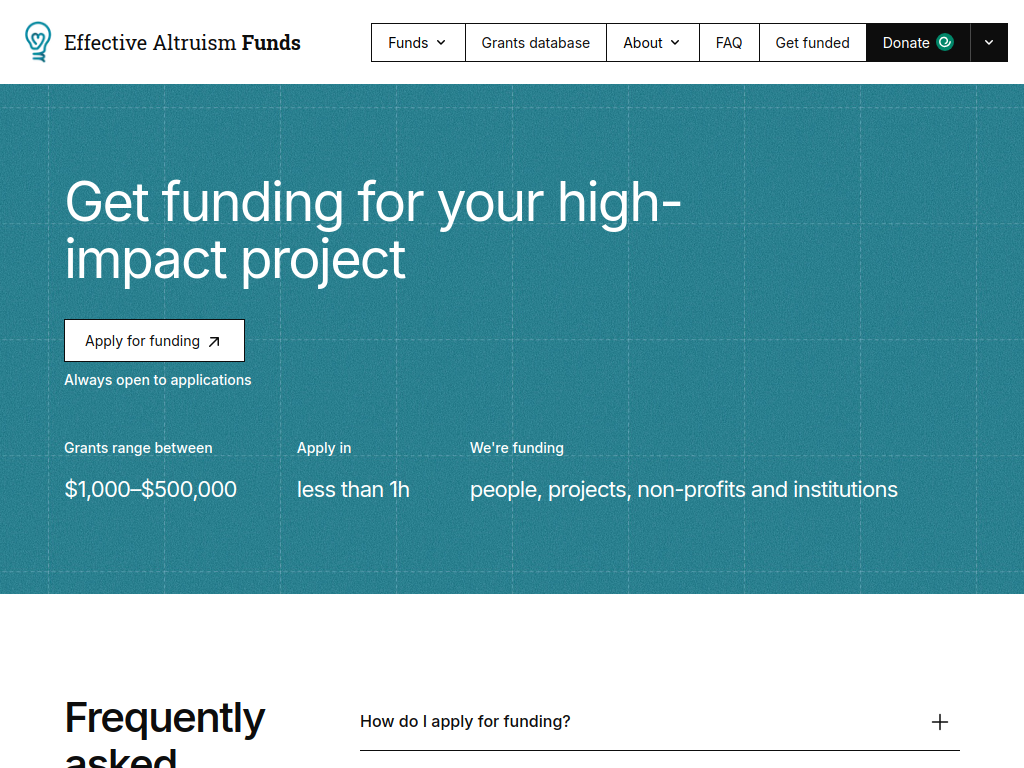
Up to $500,000 for High-Impact Projects – Effective Altruism Funds
Effective Altruism Funds (EA Funds) provides grants for high-impact projects tackling major global challenges. It focuses on areas where problems are particularly important, tractable and comparatively underfunded.
Here’s what you can expect:
$1,000–$500,000 in grant funding
Applications are accepted year-round
Funding for individuals as well as organisations
Support for new and existing projects
Funding for nonprofit organisations and institutions
Applications typically take less than an hour
Funding decisions are based heavily on expected impact and cost-effectiveness
Applicants don't necessarily need to be a registered charity
Different funds support different types of high-impact work.
Current funding areas include:
Animal Welfare – improving the wellbeing of animals, particularly neglected species and regions
EA Infrastructure – projects improving access to talent, funding and knowledge for high-impact work
Transformative AI – projects addressing catastrophic risks from advanced AI and other long-term risks
The Global Health and Development Fund is currently not accepting applications.
Who can apply?
Individuals
New projects
Existing projects
Nonprofit organisations
Institutions
Researchers and other people undertaking high-impact work
Applicants internationally, subject to the relevant fund and its priorities
EA Funds is particularly interested in proposals that can demonstrate a strong potential to create significant positive impact relative to the funding required.
Deadline: Rolling – applications are always open.
-
Average $900,000 in Funding for Nonprofits – Oak Foundation Grants
The Oak Foundation Grant Programme provides major, often multi-year funding to nonprofit organisations working towards a safer, fairer and more sustainable world. Funding can be provided as unrestricted core support or flexible project funding.
Here’s what you can expect:
Average grant award: approximately $900,000
Generally $25,000+ for programme grants
No fixed maximum grant amount is published
More than 300 grants awarded each year
Most grants are multi-year
Core/unrestricted organisational funding available
Flexible project funding available
Project grants can include appropriate overhead costs
Oak generally funds no more than 50% of a project's budget
It generally funds no more than 20% of an organisation's overall budget
Oak awarded $383 million in grants during 2025.
Funding programmes cover areas including environment and climate, international human rights, issues affecting women, learning differences, preventing child sexual abuse and other social-impact priorities.
Who can apply?
Registered nonprofit organisations
Civil society organisations
Organisations whose existing work strongly aligns with one of Oak's programme strategies
Organisations across multiple countries, depending on the individual programme's geographic priorities
Applicants should demonstrate strong organisational and financial management
Projects should address root causes and have potential for sustainable, long-term impact
Individuals aren't eligible
Scholarships and tuition aren't funded
Religious organisations aren't funded for religious purposes
Political parties and election campaigns aren't eligible.
One important point: Oak currently has no open calls for proposals. However, organisations that strongly align with its priorities can submit an unsolicited Letter of Enquiry. Only a small number of these enquiries progress to a formal invitation to apply.
Deadline: Rolling – no fixed deadline for Letters of Enquiry
-
Up to $1 Million for Community-Led AI Projects – Humanity AI
The Humanity AI Open Call: Communities Leading on AI is providing funding for US-based projects that give communities greater power over how AI is developed, governed and used. It particularly wants projects led by the people directly affected by AI, including workers, students, educators, artists and creators.
Here’s what you can expect:
$75,000–$1 million per grant
$10 million available overall
Tier 1: $75,000–$150,000
Tier 2: $150,000–$500,000
Tier 3: $500,000–$1 million
Funding can cover projects lasting up to three years
Support for community-led approaches to AI
Projects influencing how AI is governed and used
Development of AI and infrastructure shaped by communities
Work challenging harmful or inappropriate uses of AI
Priority for open-source or open-weight AI where AI models form a core part of the project.
Funding focuses on three main areas: education, labour and the economy, and humanities, arts and culture. Projects that are primarily AI literacy, simply encourage adoption of AI tools, or consist only of research without community leadership aren't within the scope of this call.
Who can apply?
US-based 501(c)(3) nonprofit organisations
Collaborations led by a US-based 501(c)(3)
Individuals and informal groups working through an eligible fiscal sponsor
Artists, students, workers, scholars and technologists through an eligible nonprofit/fiscal sponsor
Eligible Tribal governments
For-profit businesses can participate in collaborations but cannot be the lead applicant
International organisations can participate in collaborations but cannot lead
Proposed work must focus on US-based communities.
Deadline: 21 October 2026 at 4:59pm PT / 7:59pm ET.
-
Up to $225,000 for Pollinator & Sustainable Agriculture Projects – One Hive Foundation
The One Hive Foundation 2026–27 Grant Program supports nonprofit organisations, researchers and projects working to protect pollinators, reduce pesticide impacts and advance ecologically responsible agriculture.
Here’s what you can expect:
Impact Grants: up to $75,000 per year for up to three years — potentially $225,000 total
Catalyst Grants: up to $10,000 for one year
Impact Grants support larger, established or collaborative projects with significant potential impact
Catalyst Grants support pilot projects, emerging partnerships and early-stage/community initiatives
Multi-year funding is available
General operating support can be requested
Funding can cover salaries, travel, equipment, supplies and publications
Funding can be used as match funding alongside other public or private funding
Organisations invited to submit a full Impact Grant proposal receive a $500 unrestricted proposal stipend, even if ultimately unsuccessful.
Priority areas include:
Reducing pesticide use and its impact
Pollinator health and conservation
Sustainable and ecologically responsible agriculture
Farmer and beekeeper education
Scientific research into pesticides and pollinators
Biodiversity, soil health and water quality
Sustainable beekeeping
Translating scientific research into policy and practical action
Large-scale habitat conservation and restoration.
Who can apply?
Verified 501(c)(3) public charities
Nonprofit organisations
Universities and eligible research institutions
Independent researchers affiliated with an eligible nonprofit
Projects working through an eligible fiscal sponsor
Organisations in the United States, US territories and Canada
The Foundation's strongest geographic focus is Vermont, followed by the northeastern US, but projects elsewhere in the US and Canada can be considered
Government entities and private foundations aren't eligible.
Deadline: 15 September 2026 at 5:00pm
-
Share of €15 Million for Environmental & Climate NGOs – LIFE Operating Grants
The LIFE 2026 Specific Operating Grant Agreements provide operating funding to eligible nonprofit NGOs working to support EU environmental, climate and clean-energy objectives.
Here’s what you can expect:
€15 million available overall for Specific Operating Grant Agreements
Funding towards NGOs' annual operating activities
Support for organisations working on environmental and climate objectives
Relevant areas include nature and biodiversity
Climate change mitigation and adaptation
Circular economy and environmental protection
Zero pollution and quality of life
Clean-energy transition
Funding is provided through the EU's LIFE Programme
This is operating funding rather than funding for one standalone project.
Who can apply?
Nonprofit non-governmental organisations
Organisations active in environmental, climate or related policy areas
Applicants need to meet the requirements of the LIFE NGO Operating Grants programme
Crucially, this SGA call is linked to the Framework Partnership Agreement (FPA) process, so it isn't a general open-call grant for any NGO
Individuals cannot apply
Deadline: 22 September 2026 at 17:00 CEST.
-
Up to $150,000 in Funding for Organisations Advancing Democracy & Human Rights – NED Grants
The National Endowment for Democracy Grants Program funds nongovernmental organisations around the world delivering projects that advance democracy, protect human rights and strengthen democratic institutions.
Here’s what you can expect:
No fixed maximum grant amount is published
Funding for projects promoting and defending human rights and the rule of law
Support for freedom of information and independent media
Projects strengthening democratic ideas and values
Accountability and transparency initiatives
Support to strengthen civil society organisations
Democratic political processes and institutions
Civic education
Democratic conflict resolution
Freedom of association
Projects supporting a broad-based market economy
Funding decisions are made three times each year by NED's Board of Directors.
Who can apply?
Nongovernmental organisations
Civil society organisations
Civic organisations and associations
Independent media organisations
Other similar nongovernmental groups
Organisations working in emerging democracies, countries undergoing democratic transitions and more restrictive political environments
Organisations based in established democracies can potentially apply where their project operates in an eligible country or region
Individuals cannot apply
Government bodies aren't eligible
State-supported institutions, including public universities, aren't eligible.
Interestingly, an organisation doesn't necessarily have to be formally registered. Where registration isn't possible, applicants can explain why and provide information on their current legal status instead.
Deadline: 21 September 2026 for consideration at the next funding round. Applications submitted afterwards move to the following round, with the next deadline on 27 January 2027.
-
Up to £5,000 for Grassroots Community Organisations – Comic Relief Community Fund
The Comic Relief Community Fund (England) 2026/27, delivered by Groundwork, supports small community-led organisations tackling some of the biggest challenges facing people locally, with a particular focus on basic needs, early childhood development and safety.
Here’s what you can expect:
Up to £5,000 per organisation
Just over £600,000 available overall
Around 120 organisations expected to receive grants
Funding can cover core organisational costs, project costs, or a combination of both
Eligible core costs can include staff wages, rent, energy bills and training
Project costs can include venue hire, coordinators, outreach workers, activity staff and improvements to facilities
Funding for projects addressing homelessness, food poverty, essential goods and cost-of-living pressures
Support for early childhood development for children aged up to eight
Funding for projects preventing violence against women and girls
Support for refugees, asylum seekers and people experiencing forced migration.
Who can apply?
Constituted voluntary and community groups
Registered charities
Social enterprises
Community Interest Companies limited by guarantee
Not-for-profit companies limited by guarantee
Organisations must have an annual income of £250,000 or less
Organisations must be based in England
Applicants must be based in the same region where their project will be delivered
CICs must have been operating for at least two years
Projects should draw on the lived experience of the people and communities they support
Individuals, schools, universities, hospitals and profit-making businesses aren't eligible.
One important exclusion: projects where mental health is the principal focus aren't eligible this year. Mental-health support can still form part of a wider eligible project, such as supporting survivors of domestic violence.
Deadline: 30 September 2026 at 5:00pm.
-
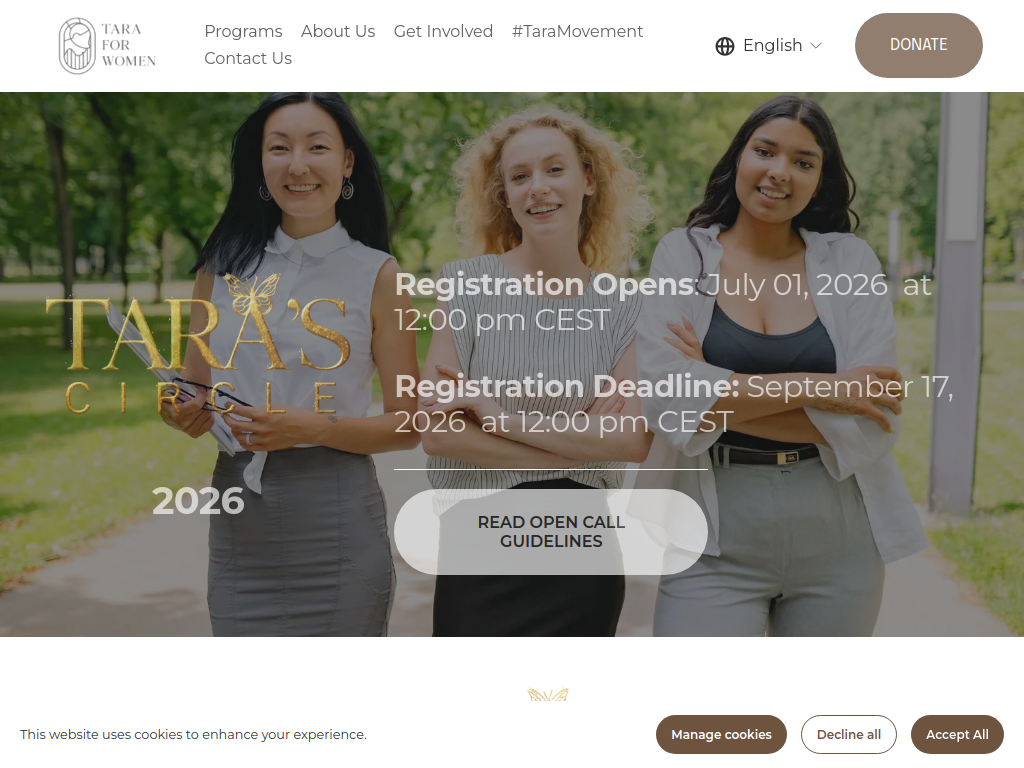
Up to €10,000 for Women-Led Impact Projects – Tara’s Circle 2026
Tara’s Circle 2026 is an international programme supporting women-led projects creating measurable social, environmental or economic impact. Successful founders can receive cash funding alongside mentorship, international visibility and connections to Tara for Women’s global network.
Here’s what you can expect:
Up to €10,000 per winning project
€100,000 total funding available
15 projects will receive cash awards
Five different impact categories, with €20,000 allocated to each
1st place in each category receives €10,000
2nd place receives €6,000
3rd place receives €4,000
Strategic mentorship and support
International visibility
Access to networks, partners and potential investors
Funding can support activities such as technology development, marketing, recruitment and commercial expansion.
The five areas cover Sustainability, Environment & Mobility; Health & Wellbeing; Social Innovation, Education & Community Development; Technology & Science; and Design, Culture & Impact-Driven Fashion.
Who can apply?
Women aged 18+
Women founders or co-founders who actively lead their project
Applicants can be based anywhere in the world
Projects can have national or international scope
Ventures should be at seed stage
Applicants need a defined or functional MVP
Projects should create social, environmental and/or economic impact
Ventures should demonstrate potential for scalability and sustainability.
Applicants need to submit an application form, PDF pitch deck and an elevator pitch of no more than two minutes.
Deadline: 17 September 2026 at 12:00pm CEST.
-
Funding opportunity: Invite only: Precision prevention: biological mechanisms of response variation
Apply for funding to investigate why biomedical prevention interventions work differently across people. Projects must generate mechanistic evidence in humans by testing biomedical experimental interventions or challenges in pre-disease or early disease states, providing insight into how to improve the targeting and effectiveness of precision prevention strategies.
Your project must:
include an experimental intervention or challenge in humans focus on a mechanistic hypothesis The full economic cost (FEC) of your project can be up to £5 million over a duration of up to five years. MRC will fund 80% of your project’s full economic cost.
You must have submitted a mandatory expression of interest (EOI) and be invited to submit a full application.
-
Funding opportunity: Expression of interest: Chemical, biological, radiological and nuclear (CBRN) medical countermeasures R&D
Apply for funding to develop and test novel therapeutics, medical devices, diagnostics and other interventions across any stage of the developmental pathway, from prototype development, through pre-clinical refinement, to early-phase clinical studies (up to phase 2a) for CBRN threats.
Applications must demonstrate how the proposed research will result in improved domestic preparedness for CBRN threats.
There is a funding limit of £4 million per application and requested costs should be appropriate to the project. MRC will fund 80% of the full economic cost (FEC).
The duration of your project should be up to 30 months.
You must submit a mandatory expression of interest (EOI) and be invited to submit a full application.
-
Funding opportunity: Biodiversa+ 2026 to 2027: novel ecosystems (BiodivFuture)
This funding opportunity allows UK based researchers to collaborate with international partners and submit joint application to the Biodiversa+ 2026 to 2027 joint funding opportunity Novel ecosystems (BiodivFuture).
You must be based at a UK research organisation eligible for NERC funding.
The full economic cost (FEC) of the total requested budget from all UK partners on a project can be up to £375,000. NERC will fund 80% of the FEC and fund your project for up to 36 months.
-
Funding opportunity: Pre-announcement: NMIP sandpit: Digital materials for accelerated innovation
Apply to attend a three to five-day sandpit to develop high-impact projects that address the challenges and opportunities of integrating digital approaches to accelerate the translation of materials research.
You must be based at a UK research organisation eligible for Engineering and Physical Sciences Research Council (EPSRC) funding to receive project funding from the sandpit.
Attendance at the sandpit does not guarantee UK Research and Innovation (UKRI) funding.
This is a pre-announcement and the information may change. The funding opportunity will open later in 2026. More information will be available on this page then.
-
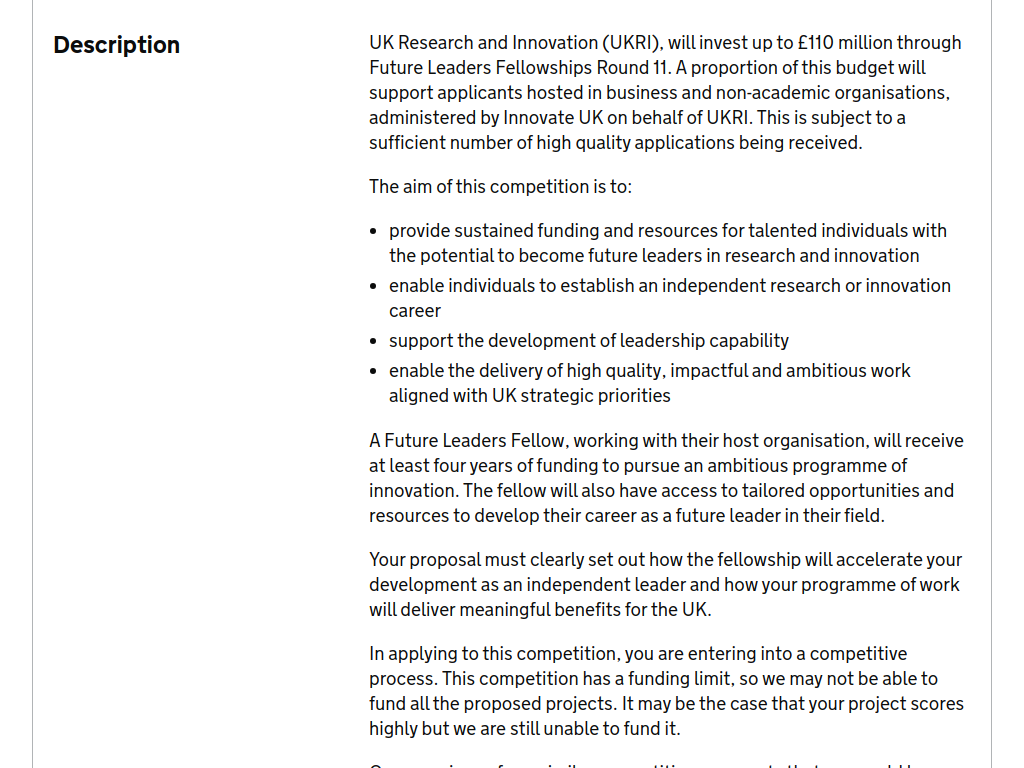
Up to £3 Million for Future Research & Innovation Leaders – UKRI
The Future Leaders Fellowships: Round 11 – Business and Non-Academic competition provides long-term funding for talented researchers and innovators to establish themselves as independent leaders while delivering ambitious research or innovation with meaningful benefits for the UK.
Here’s what you can expect:
£100,000–£3 million per fellowship
Up to £110 million available across Future Leaders Fellowships Round 11
At least four years of funding, with the potential to extend for a further three years
Funding for ambitious research and innovation programmes
Support for the Fellow's professional and leadership development
Projects can cover all areas of research and innovation
This includes technology, business, creative industries, culture, services, arts, humanities and social sciences
Multidisciplinary and interdisciplinary projects are welcomed
Industrial research can receive up to 70% of eligible costs for micro/small organisations, 60% for medium organisations and 50% for large organisations
Experimental development can receive up to 45%, 35% and 25% respectively
Non-economic work by eligible charities, nonprofits, RTOs and public-sector organisations can receive up to 100% of eligible costs.
Who can apply?
UK-registered businesses of any size
Charities
Not-for-profit organisations
Public-sector organisations
Agri-tech centres
Other eligible research organisations, subject to the appropriate application route
The proposed Fellow must demonstrate the skills and experience to lead an ambitious research or innovation programme
A PhD is not required
There is no eligibility rule based on the number of years since gaining a PhD
Researchers and innovators from outside the UK can participate with an eligible UK host organisation
Applicants from diverse career backgrounds and people returning after career breaks are specifically welcomed
Fellows can work part-time or through an approved job-share arrangement.
UKRI says similar competitions suggest applicants could have around a 13% chance of success, so this is a highly competitive programme.
Deadline: 4 November 2026 at 11:00am UK time.
-
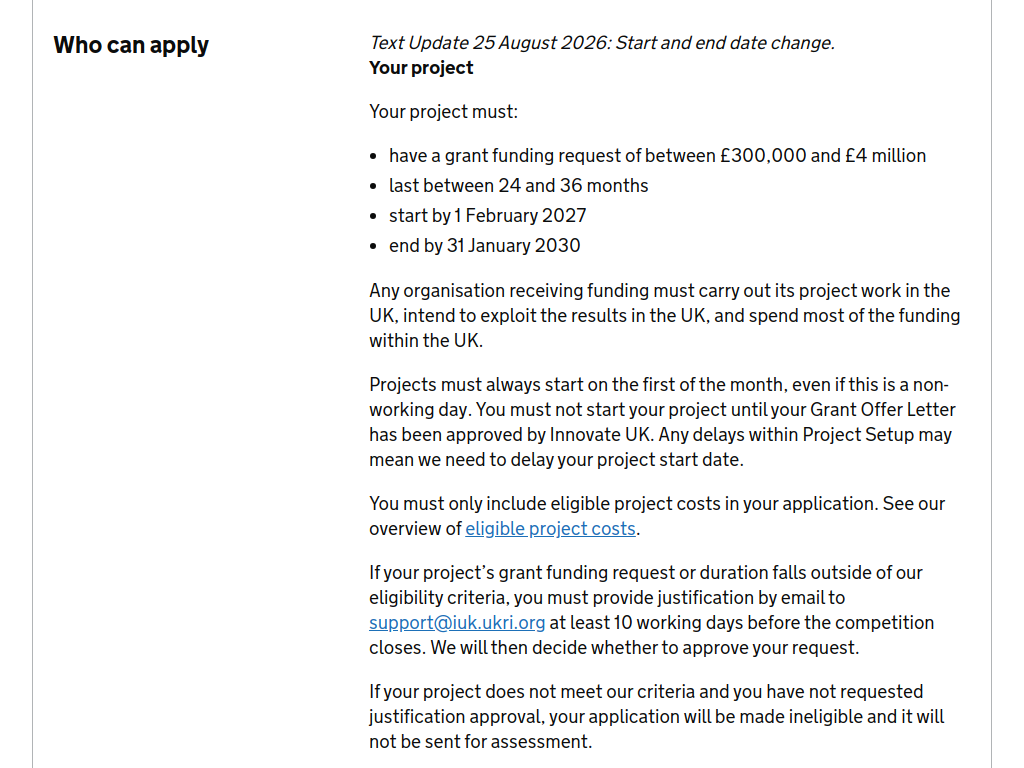
Up to £4 Million for Quantum Computing Applications – Innovate UK
The Quantum Computing Applications for Large Scale Impact: CR&D competition is funding collaborative UK projects that develop and implement high-impact quantum computing software applications. Projects need to tackle real-world industrial, economic, public-sector or societal problems and demonstrate where quantum computing could offer practical advantages over classical approaches.
Here’s what you can expect:
£300,000–£4 million grant request per project
Up to £13 million available overall
Up to 70% of eligible costs for micro and small businesses
Up to 60% for medium-sized businesses
Up to 50% for large businesses
Funding for industrial research and collaborative R&D
Development and implementation of quantum computing software
Testing, benchmarking and validation on near-term quantum systems
Projects tackling commercially and socially significant real-world challenges
Strong emphasis on demonstrating a route to adoption, exploitation and scaling in the UK.
Projects must focus on one or more of these areas:
Healthcare and drug discovery
Finance
Transport and infrastructure optimisation
Design and simulation of new materials
Quantum machine learning.
Who can apply?
A UK-registered business of any size must lead
The project must be collaborative, with at least one other organisation applying for funding
Collaborators can include UK businesses
Universities and academic institutions
Charities and nonprofits
Public-sector organisations
Research and Technology Organisations (RTOs)
No single grant-claiming organisation can account for more than 70% of eligible project costs
No individual organisation can request more than £1 million per project
The majority of project activity must take place in the UK, with results intended to be exploited in the UK.
Deadline: 24 September 2026 at 11:00am UK time.
-
Funding opportunity: Pre-announcement: ESRC applicant-led: challenge awards
Apply for funding to bring people, expertise and ideas together in ambitious, larger-scale programmes. Challenge awards tackle major research, economic and societal challenges, generating impactful new knowledge and innovation.
You must be based at a UK research organisation eligible for ESRC funding.
The full economic cost (FEC) of your project can be between £2 million and £10 million. ESRC will fund 80% of the FEC. Projects can be up to five years in length.
This is a pre-announcement and the information may change. More information will be available on this page when the funding opportunity opens.
-
Funding opportunity: Water4All 2026 call: sustainable water management
Submit a pre-proposal on the Water4All website.
Funding for UK based researchers to collaborate with international partners and submit joint application to the Water4All 2026 joint translational call: sustainable water management.
You must be based at a UK research organisation eligible for UK Research and Innovation (UKRI) funding.
To be eligible, transnational research consortia must include teams from a minimum of three countries financially participating in the call.
The full economic cost (FEC) of the total requested budget from all UK partners on a project can be up to £312,500. UKRI will fund 80% of the FEC and fund your project for up to 36 months.
-
Funding opportunity: Pre-announcement: ESRC applicant-led: grow awards
Apply for funding to build the skills, experience and confidence to make a step-change in your research career. Grow awards support individuals at key career points to develop new capabilities or pivot in a new direction, strengthening the long-term capacity, adaptability and resilience of the UK’s social science research base.
You must be based at a UK research organisation eligible for ESRC funding.
The full economic cost (FEC) of your project can be up to £500,000. ESRC will fund 80% of the FEC. Projects can last between 18 months and five years.
This is a pre-announcement and the information may change. More information will be available on this page when the funding opportunity opens.